Geometric Constructions Made Easy
Introduction to Geometric Tools
The Tools of the Trade
Geometry is the art of shapes and the space they live in. To explore this world, we need more than just ideas; we need tools to draw, measure, and construct figures with accuracy. For centuries, geometers have relied on three basic instruments: the ruler, the protractor, and the compass. Mastering them is the first step to creating perfect geometric forms.
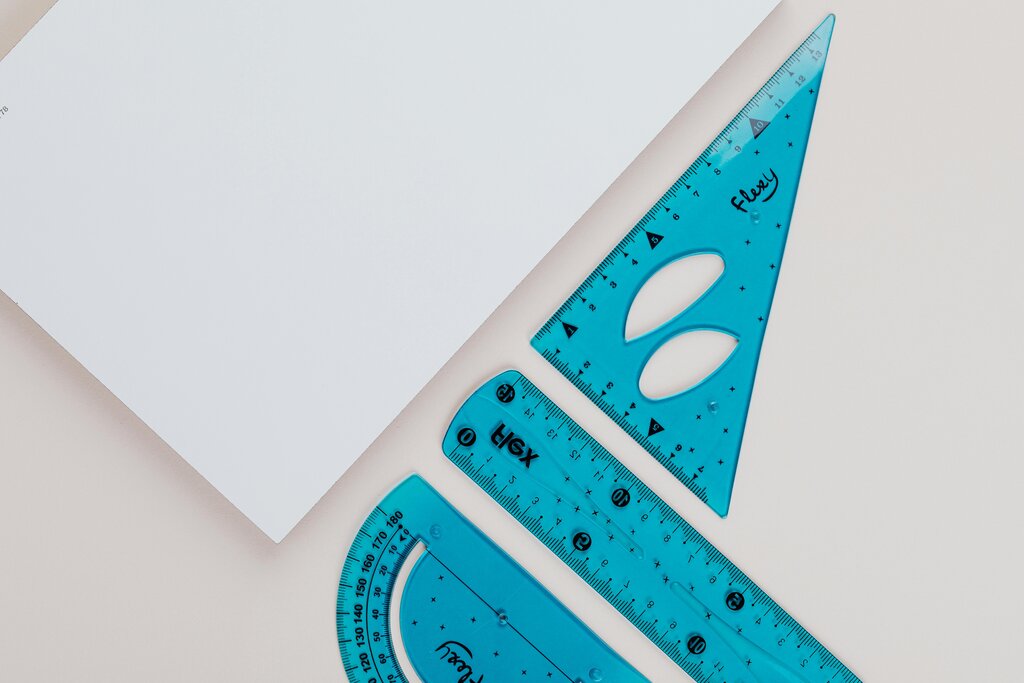
First up is the ruler. Its most obvious job is measuring distances, usually in inches or centimeters. But its more fundamental purpose in geometry is to serve as a straightedge. This means it helps you draw perfectly straight lines between two points. A line that looks straight to your eye might have tiny wobbles, but a line drawn with a ruler is precise.
When using a ruler, press it down firmly so it doesn't slip. Draw your line with a single, smooth motion of a sharp pencil.
Next is the protractor, the tool for measuring angles. Angles are a measure of rotation, and they're typically measured in degrees. A full circle is 360 degrees (), a straight line is 180 degrees (), and a right angle is 90 degrees ().
A protractor is a semicircle marked from to . To measure an angle, you place the protractor's center hole on the angle's vertex (the corner point) and align the baseline with one of the angle's sides. The other side will then point to the angle's measurement in degrees.
Finally, we have the compass. This isn't for finding north; it's for drawing circles and arcs. A compass has two legs connected by a hinge. One leg has a sharp point to anchor it to the paper, and the other holds a pencil. By keeping the anchor point fixed and rotating the pencil leg, you draw a perfect circle. The distance between the point and the pencil lead is the circle's radius.
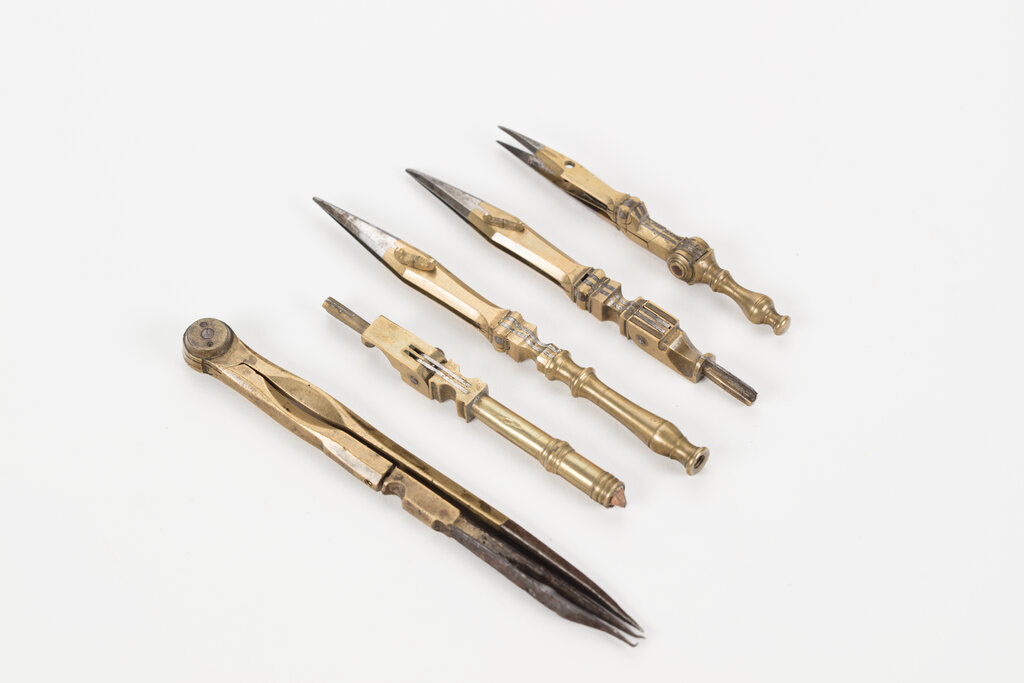
The compass is crucial for constructions that require transferring distances or creating shapes with equal side lengths, like an equilateral triangle.
Precision Is Key
Why bother with these tools when you can sketch freehand? In geometry, precision is everything. A tiny error in a measurement or a slightly crooked line can throw off an entire construction. A 90-degree angle that's actually 89 degrees isn't a right angle, and a square with unequal sides isn't a square.
Proper handling of your tools is the foundation of precision. Always use a sharp pencil for crisp, thin lines. When measuring, look directly down at the markings to avoid errors from viewing at an angle. Hold your compass firmly at the top so the radius doesn't change as you draw.
Clean tools are happy tools. Wiping your ruler and protractor keeps smudges off your work and ensures you can see the markings clearly.
Now that you know the tools, let's review their functions.
Ready to check your understanding?
What is the most fundamental purpose of a ruler in geometry?
To measure an angle with a protractor, where should you place the center hole of the tool?
With the ruler, protractor, and compass in hand, you are equipped to start building the world of geometry one line, angle, and circle at a time.