Geology of Fold Mountains
Mechanics of Crustal Deformation
Squeezing the Earth's Skin
The Earth's lithosphere isn't a static shell. It's a dynamic puzzle of tectonic plates in constant, slow-motion collision. When these plates converge, they exert unimaginable forces on each other. This immense pressure doesn't just push the plates around; it fundamentally changes the rock itself, crumpling and stacking crustal rock like a rug pushed against a wall. To understand how mountains rise and continents deform, we first need to look at the physics of how rocks respond to being squeezed.
The two key concepts are stress and strain. Stress is the force applied to a specific area of rock. Strain is the rock's reaction—the change in its shape or size as a result of that stress. Think of stretching a rubber band. The pull you exert is the stress, and the amount the band elongates is the strain.
Stress, Strain, and Rock Behavior
In geology, stress isn't just a single force. It can be compressional (squeezing), tensional (pulling apart), or shear (sliding past). At convergent boundaries, the dominant force is horizontal compression. This stress builds up over millions of years, and the lithosphere must accommodate it. The way it does so is described by its —how it deforms and flows under pressure.
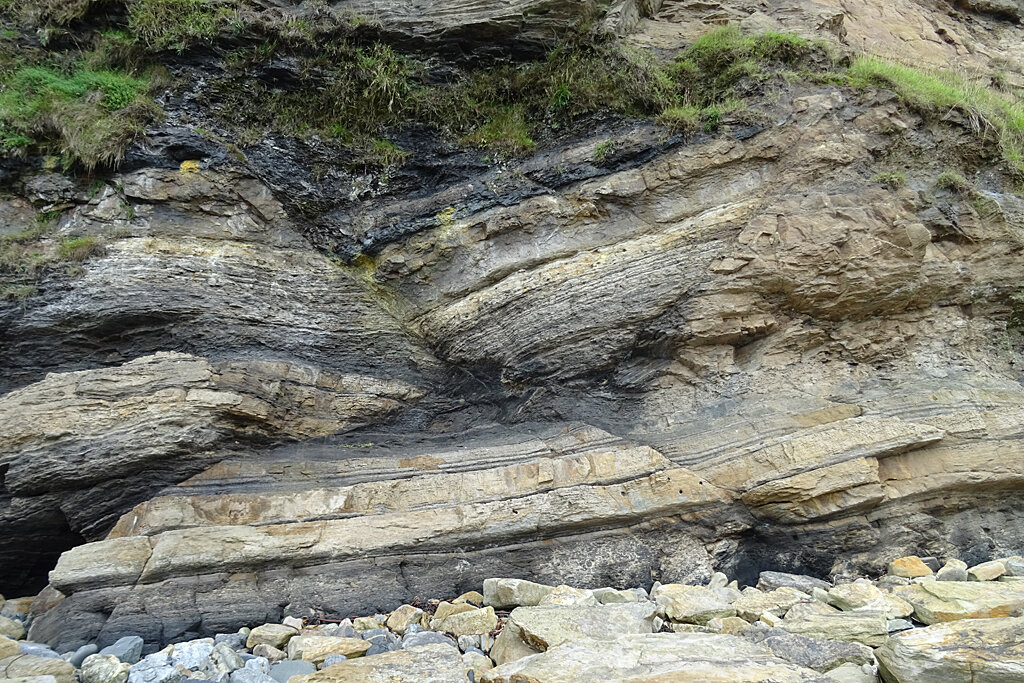
The relationship between stress and strain in a rock isn't always linear. A rock can absorb a certain amount of stress without permanent change (elastic deformation). If you remove the stress, it returns to its original shape. But past a certain point, called the elastic limit, the deformation becomes permanent. The rock has officially undergone strain.
Snap or Bend?
Once a rock's elastic limit is passed, it deforms in one of two ways: brittle or ductile. This behavior is not an intrinsic property of the rock type itself, but is dictated by the physical conditions it's under.
Brittle deformation is when a rock breaks. This process, called faulting, occurs in the shallow, cooler parts of the crust where rocks are rigid. Earthquakes are a classic manifestation of brittle failure.
Ductile deformation is when a rock bends or flows. This happens deeper in the crust and in the mantle, where high temperatures and pressures allow the mineral grains within the rock to recrystallize and slide past one another without fracturing. This creates the incredible folds you can see in mountain ranges.
Three main factors determine whether a rock will snap or bend:
- Temperature: Higher temperatures favor ductile deformation. Hot rocks are more malleable.
- Confining Pressure: This is the pressure exerted on a rock from all sides by the weight of the overlying material. High confining pressure squeezes the rock, making it harder for fractures to open, thus favoring ductile behavior.
- Strain Rate: This is how quickly the rock is being deformed. If stress is applied rapidly, the rock tends to fracture (brittle). If the same stress is applied very slowly over millions of years, the rock has time to flow (ductile).
Even in a subduction zone, where a cold oceanic plate is thrust deep into the mantle, this principle holds. The plate itself is cold and rigid, so it experiences brittle failure, generating deep earthquakes in what's known as the . The surrounding mantle, however, is hot and flows ductilely around the descending slab.
The Architecture of Mountains
At convergent boundaries, horizontal compression is the engine of mountain building, a process known as . This compression leads to two main results: crustal shortening and crustal thickening.
Crustal Shortening
noun
The decrease in the horizontal length of a region of the lithosphere in response to compressional stress.
Imagine a 100-kilometer-wide section of continental crust. As two continents collide, that region might be compressed into a width of only 80 kilometers. The rock hasn't vanished; it has been displaced. That displaced mass has to go somewhere. Since it's being squeezed from the sides, the only way to go is up (and down).
Crustal Thickening
noun
The increase in the vertical thickness of the lithosphere, which results from shortening.
This thickening creates not only the high peaks of a mountain range but also a deep crustal "root" that extends down into the mantle. The Himalayas, for example, have thickened the crust beneath them to over 70 kilometers, more than double the average continental crust thickness. This combination of faulting, folding, and vertical thickening is how compressional forces transform flat plains into the world's most dramatic landscapes.
Ready to test your knowledge on how the Earth's crust gets reshaped?
Which statement best describes the difference between stress and strain in geology?
At a convergent plate boundary, a 500 km wide section of continental crust is compressed over millions of years into a 400 km wide mountain range. This process is an example of:
Understanding these mechanical principles is the key to reading the story written in the rocks—a story of immense forces acting over geologic time, constantly reshaping the surface of our planet.