Genetics Exam Crash Course
Introduction to Genetics
The Blueprint of Life
Every living thing, from a bacterium to a blue whale, has a set of instructions that tells it how to grow, function, and reproduce. This master blueprint is deoxyribonucleic acid, or DNA. Think of it as the ultimate instruction manual, containing all the information that makes you unique.
DNA is organized into a beautiful and efficient structure called a double helix, which looks like a twisted ladder. The two long, twisting sides of the ladder are made of sugar and phosphate molecules. The rungs connecting the sides are what hold the actual genetic code. These rungs are made of pairs of chemical bases.
Gene
noun
A specific sequence of DNA that contains the instructions for building a particular protein or functional molecule.
There are four types of bases in DNA: Adenine (A), Guanine (G), Cytosine (C), and Thymine (T). They always pair up in a specific way: A always pairs with T, and C always pairs with G. The order of these bases along the ladder's rungs forms the genetic code. A specific stretch of this code that provides instructions for one particular task is called a gene.
From Code to Action
Having a blueprint is only useful if you can read it and build something from it. This is where gene expression comes in. It's the process of turning the information stored in a gene into a functional product, usually a protein. Proteins are the workhorses of the cell, carrying out a vast array of tasks, from digesting your food to fighting off infections.
The process happens in two main steps: transcription and translation.
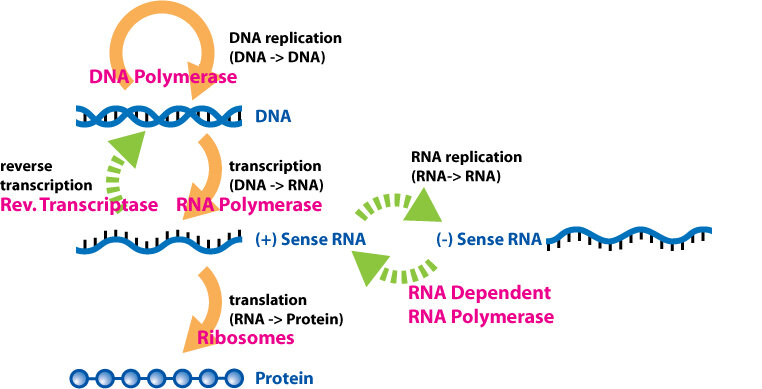
Transcription: Imagine your DNA is a rare, valuable cookbook kept in a library's reference section (the cell's nucleus). You can't check it out, but you can copy a recipe. Transcription is like making a photocopy of a single gene's instructions. This copy is made of a molecule called messenger RNA (mRNA).
Translation: The mRNA copy then leaves the nucleus and travels to the cell's workshop, a structure called a ribosome. Here, the ribosome reads the mRNA instructions three letters at a time and assembles a protein, amino acid by amino acid. It's like a chef reading your copied recipe and adding ingredients in the correct order to create the final dish.
Passing Traits Along
How do these traits get from one generation to the next? This question fascinated a 19th-century monk named Gregor Mendel, who discovered the basic principles of heredity by experimenting with pea plants. His work laid the foundation for modern genetics.
Mendel found that offspring inherit one version, or allele, of a gene from each parent.
Let's break down the key terms. An allele is a specific version of a gene. For example, a gene for flower color might have a purple allele and a white allele. The combination of alleles an organism has is its genotype. The observable trait that results from this combination, like the actual color of the flower, is its phenotype.
| Term | Definition | Example |
|---|---|---|
| Allele | A specific version of a gene | The 'purple flower' allele or 'white flower' allele |
| Genotype | The genetic makeup (combination of alleles) | PP, Pp, or pp |
| Phenotype | The observable physical trait | Purple flowers or white flowers |
Some alleles are dominant, meaning they will show their effect even if only one copy is present. Others are recessive, and their effect is only seen when two copies are present. In Mendel's pea plants, the purple flower allele (let's call it P) was dominant over the white flower allele (p). This means a plant with the genotype PP or Pp would have purple flowers, while only a plant with the pp genotype would have white flowers.
These simple rules of dominance and recessiveness allow us to predict the outcomes of genetic crosses, forming the basis of what we call Mendelian inheritance. It's the starting point for understanding how traits are passed down through families.
In the DNA double helix, the base Adenine (A) always pairs with which other base?
What is the process called where the genetic information from a gene is copied into a molecule of messenger RNA (mRNA)?
These fundamental concepts—the structure of DNA, the process of gene expression, and the patterns of inheritance—are the building blocks for all of genetics.