Genetics and Twins
Introduction to Genetics
The Blueprint of Life
Every living thing, from a blade of grass to you, has a set of instructions inside its cells. This blueprint dictates everything from eye color to how an organism functions. The molecule that holds these instructions is called deoxyribonucleic acid, or DNA.
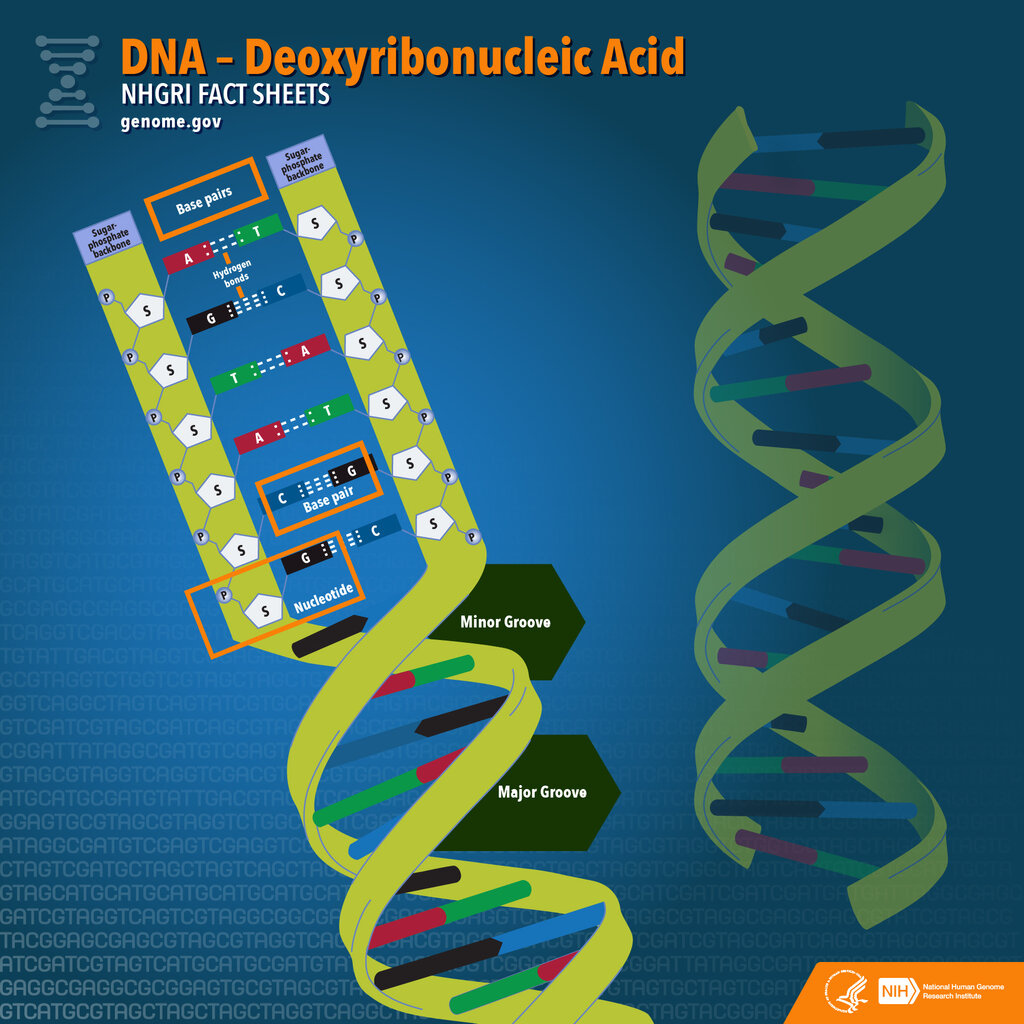
Think of DNA as a twisted ladder, a shape known as a double helix. The two long sides of the ladder are made of sugar and phosphate molecules, forming a sturdy backbone. The rungs connecting the sides are what truly matter. These are made of four chemical bases: adenine (A), guanine (G), cytosine (C), and thymine (T).
These bases pair up in a specific way: A always pairs with T, and C always pairs with G. The sequence of these pairs along the ladder forms a code. A specific, functional segment of this code is called a gene.
Gene
noun
A specific sequence of nucleotides in DNA that is located usually on a chromosome and that is the functional unit of inheritance controlling the transmission and expression of one or more traits.
Each gene provides the instructions for building a specific molecule, usually a protein. These proteins then go on to perform countless jobs within the body, like building tissues, carrying oxygen, or fighting infections.
Packaging the Instructions
If you stretched out the DNA from a single human cell, it would be about six feet long. To fit all this genetic material into a microscopic nucleus, it needs to be packaged very efficiently. This is where chromosomes come in.
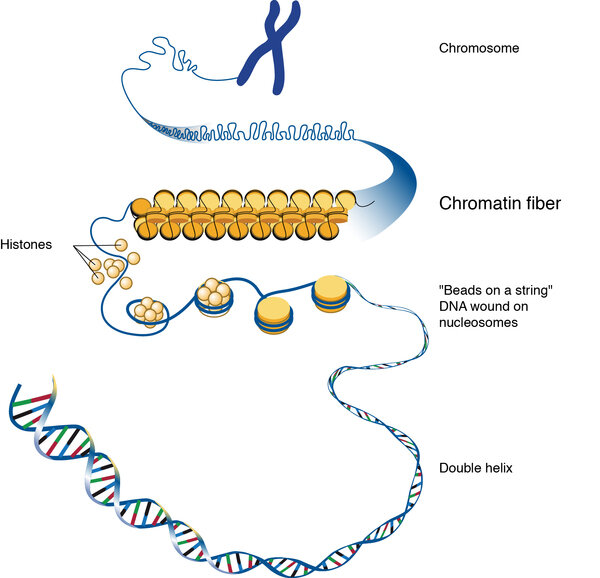
A chromosome is a structure made of DNA tightly coiled many times around proteins. This packaging keeps the DNA organized and accessible. Humans have 46 chromosomes in most cells, arranged in 23 pairs. You inherit one chromosome from each pair from your mother, and the other from your father.
How Traits Are Inherited
The basic principles of how traits are passed down were first discovered by a monk named Gregor Mendel in the 19th century. He studied pea plants and noticed clear patterns in the inheritance of traits like flower color and seed shape. His work laid the foundation for the field of genetics.
Mendel realized that for each trait, an organism inherits two copies of a gene, one from each parent. These different versions of a gene are called alleles.
Allele
noun
Any of the alternative forms of a gene that may occur at a given locus on a chromosome.
Some alleles are dominant, meaning only one copy is needed for the trait to be expressed. Others are recessive, requiring two copies for the trait to appear. For example, if the allele for brown eyes (B) is dominant and the allele for blue eyes (b) is recessive, a person with either a BB or Bb combination will have brown eyes. Only a person with the bb combination will have blue eyes.
From DNA to Protein
So how does the genetic code in DNA actually become a functional part of an organism? This process is described by the central dogma of molecular biology. It's a three-step journey: replication, transcription, and translation.
-
Replication: Before a cell divides, it must make a complete copy of its DNA. The DNA double helix unwinds, and each strand serves as a template to create a new, complementary strand. This ensures each new cell gets an identical set of genetic instructions.
-
Transcription: To make a protein, the information in a gene is first copied into a temporary messenger molecule called messenger RNA (mRNA). This process is called transcription. It's like copying a recipe from a large, valuable cookbook onto a small note card that you can take into the kitchen.
-
Translation: The mRNA molecule travels out of the nucleus to a cellular machine called a ribosome. The ribosome reads the mRNA code three bases at a time (a codon) and translates it into a specific sequence of amino acids, the building blocks of proteins. This chain of amino acids then folds into a unique 3D shape, becoming a functional protein.
DNA makes RNA, and RNA makes protein. This simple flow explains how the genetic blueprint stored in your cells is used to build and maintain your entire body.
This fundamental process is the basis for all life, connecting the information stored in our genes to the physical traits and functions that define us. Let's review some of these core concepts.
In the 'twisted ladder' model of a DNA molecule, what are the 'rungs' of the ladder made of?
If a particular gene has the DNA sequence G-T-A-C-G-A, what would the sequence of the complementary strand be?