Generative AI Systems Architect
Agentic System Foundations
Beyond the Prompt
Standard AI models, like the chatbots you might be used to, operate on a simple loop: you give them a prompt, and they give you a response. This is a powerful but limited interaction. It’s like having a brilliant calculator. It can solve any problem you give it, but it can’t decide which problems need solving.
Agentic AI represents a shift from this reactive model to a proactive one. Instead of just being an AI-enabled tool that enhances an existing process, an agentic system is AI-native. The AI isn't just a feature; it's the core engine that drives the entire workflow. It doesn't just answer questions, it pursues goals.
The key difference is autonomy. An AI-enabled system needs a human to direct every major step. An AI-native system can take a high-level goal and figure out the steps on its own.
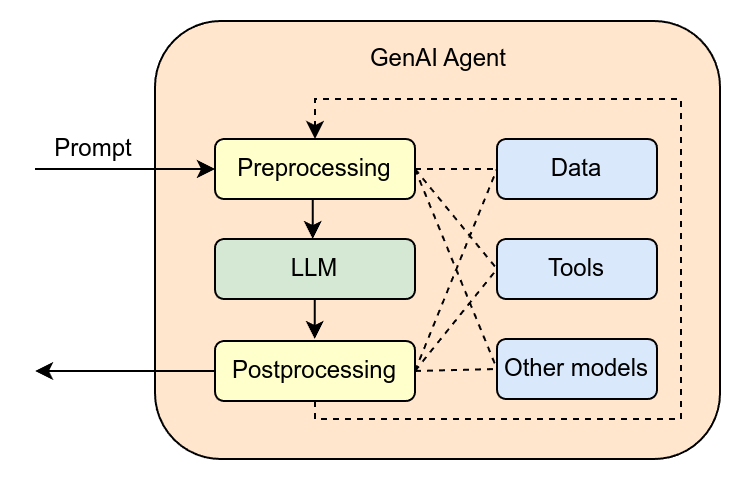
This autonomy is powered by an iterative process. Instead of a single input-output exchange, an agent operates in a continuous loop. It observes its environment, thinks about what to do next, and then takes an action. This cycle is often called a Reason-Act, or ReAct pattern.
Giving the Agent a Brain
For the ReAct loop to be effective, the agent needs a way to remember what it has done and what it has learned. This is the difference between stateful and stateless interactions.
A stateless interaction is a one-off transaction. The system has no memory of past events. A chatbot that forgets your name the moment you start a new sentence is stateless. A agent, however, maintains a memory, or 'state,' across interactions. It remembers previous observations, thoughts, and actions, allowing it to build on past experience to make better decisions in the future.
This memory is crucial for breaking down big problems. When you give an agent a complex goal, like "Plan a weekend trip to Paris," it doesn't solve it in one go. Instead, it uses a planning module for to break the objective into smaller, manageable sub-tasks.
| Sub-Task | Reasoning | Action |
|---|---|---|
| 1. Find flights | I need to find flights from the user's location to Paris for the specified dates. | Query flight search API with origin, destination, and dates. |
| 2. Book hotel | The user needs a place to stay. I should find hotels near the city center with good reviews. | Search hotel booking sites with filters for location and rating. |
| 3. Plan activities | What are the top attractions? I'll check popular guides. | Perform a web search for "top things to do in Paris." |
| 4. Create itinerary | Now I can assemble the flights, hotel, and activities into a schedule. | Generate a document listing the day-by-day plan. |
Each step in the table is one turn of the ReAct loop. The agent reasons about a sub-task and then takes an action using one of its available tools, like a search engine or an API.
Defining the Mission
An autonomous agent is powerful, but without clear direction, it can be useless or even counterproductive. This is where system prompts and personas come in. A system prompt is a set of high-level instructions that defines the agent’s purpose, constraints, and personality.
Think of it as the agent’s constitution or job description. It sets the ground rules for every decision the agent makes. For example, a customer service agent's system prompt might include:
- Persona: You are a friendly and helpful support assistant named 'Alex.'
- Goal: Resolve customer issues quickly and efficiently.
- Constraints: Never ask for password information. Always be polite. Escalate to a human agent if the issue involves a refund of more than $100.
Unlike traditional AI tools that simply respond to prompts, agentic systems can plan multi-step workflows, make autonomous decisions, and execute complex tasks with minimal human oversight.
This upfront definition transforms a generic language model into a specialized worker tailored for a specific task. By defining its persona and limitations, we can guide its autonomous behavior, ensuring it works toward the intended goal reliably and safely. This is the foundation of building predictable, AI-native systems that can orchestrate complex processes dynamically instead of following a rigid, static script.
Ready to check your understanding of these core concepts?
What is the primary difference between a standard AI model and an agentic AI system?
The continuous, iterative cycle where an AI agent observes, thinks, and then takes an action is known as the ______ loop.
These foundational patterns are the building blocks for creating more sophisticated agents that can collaborate, learn, and solve increasingly complex problems.