Generative AI Fundamentals
Introduction to Generative AI
What is Generative AI?
Most of the artificial intelligence you encounter is designed to analyze or classify existing information. An AI might identify spam in your inbox, recognize a face in a photo, or recommend a movie based on your watch history. It works with data that's already there.
Generative AI is different. Its purpose is to create something entirely new.
Generative AI refers to a type of artificial intelligence whose core function is to create new content—text, audio, images, video, or data—based on patterns it has learned from existing data.
Think of it like the difference between a music critic and a composer. A critic analyzes and categorizes existing music, which is a complex task requiring deep knowledge. That's like traditional AI. A composer, on the other hand, uses their understanding of music to write a new song. That's Generative AI.
This ability to generate, rather than just analyze, is a major leap. Instead of simply labeling a picture as 'cat' or 'dog', Generative AI can create a new image of a cat or a dog from scratch.
Where It Fits In
Artificial Intelligence is a broad field, and Generative AI is a specialized part of it. It sits within a few other key concepts.
- Artificial Intelligence (AI) is the widest category, covering any technique that enables computers to mimic human intelligence.
- Machine Learning (ML) is a subset of AI where systems learn from data to make predictions or decisions without being explicitly programmed.
- Neural Networks are a type of ML inspired by the human brain, used for more complex pattern recognition.
- Generative Models are a class of neural networks focused on creating new data samples.
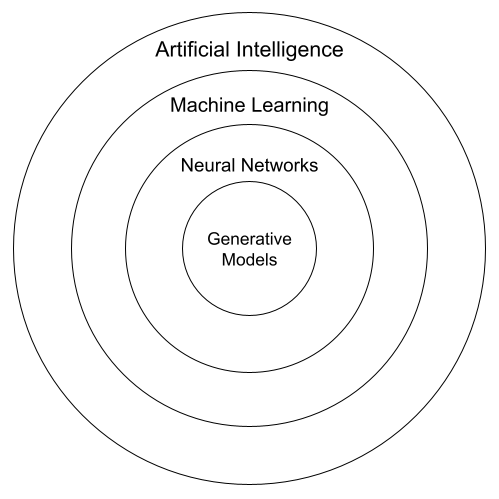
This structure shows that Generative AI builds upon decades of research. It's not a completely separate technology but rather the cutting edge of a long-standing scientific pursuit.
A Brief History
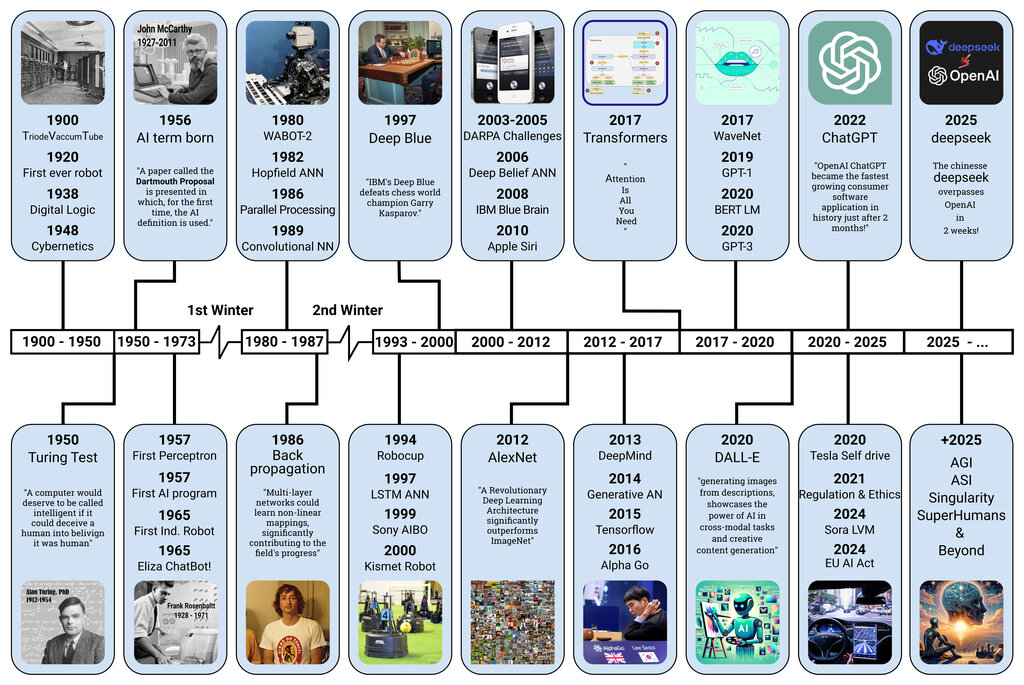
The idea of machines that can create isn't new. Early chatbots in the 1960s, like ELIZA, could simulate conversation by rearranging a user's statements. While simple, they were the first glimpse of machines generating human-like text.
For decades, progress was slow. The models weren't powerful enough to create truly convincing content. A significant breakthrough came in 2014 with the invention of Generative Adversarial Networks, or GANs. This technique pitted two neural networks against each other—one generating content and the other judging it—to rapidly improve the quality of the output. This led to a boom in realistic, AI-generated images.
The next major leap came with the development of the 'transformer' architecture in 2017. This model was exceptionally good at understanding the context and relationships in sequential data, like language. It paved the way for the Large Language Models (LLMs) we see today, such as the technology behind ChatGPT, which can produce sophisticated, coherent, and context-aware text.
Why It Matters
The shift from analyzing data to creating it is a fundamental change in what computers can do. Generative AI has the potential to act as a tool for human creativity, a partner in problem-solving, and a way to automate complex tasks.
It allows us to interact with computers using natural language, asking them to write code, draft emails, or brainstorm ideas. By learning the underlying patterns of human expression—in text, images, and sound—these tools can generate novel outputs that are useful and often surprising.
Generative AI marks the transition from computers that can understand our world to computers that can add to it.
This is just the beginning. Understanding what Generative AI is and where it came from is the first step in learning how to use it effectively.