Generative AI Fundamentals For Non-Technical Beginners
Introduction to AI
What Is Artificial Intelligence?
Artificial intelligence, or AI, is a broad field of computer science focused on creating machines that can perform tasks that typically require human intelligence. Think of it less as building a robot that looks human and more as programming a computer to learn, reason, and solve problems on its own.
At its core, AI is about making computers smart. Not just good at calculating, but capable of understanding, adapting, and making decisions.
Two Kinds of AI
When people talk about AI, they're usually referring to one of two categories. The first, and the only one we have today, is called Artificial Narrow Intelligence (ANI). ANI is designed to perform a single, specific task. A spam filter in your email, a chess-playing computer, or a voice assistant like Siri are all examples of narrow AI. They are incredibly good at their one job, but they can't operate outside of it. You can't ask your spam filter for a weather forecast.
The second category is Artificial General Intelligence (AGI). This is the type of AI you often see in science fiction. AGI would possess the ability to understand, learn, and apply its intelligence to solve any problem, much like a human being. It could switch from translating languages to composing music to driving a car without needing to be reprogrammed. AGI is a theoretical goal for researchers; it doesn't exist yet.
| Feature | Narrow AI (ANI) | General AI (AGI) |
|---|---|---|
| Scope | Performs a single task | Can handle any intellectual task |
| Learning | Limited to its specific domain | Can transfer knowledge across domains |
| Example | Facial recognition software | A human-like conscious robot |
| Status | Exists today | Theoretical / In development |
How Does AI Learn?
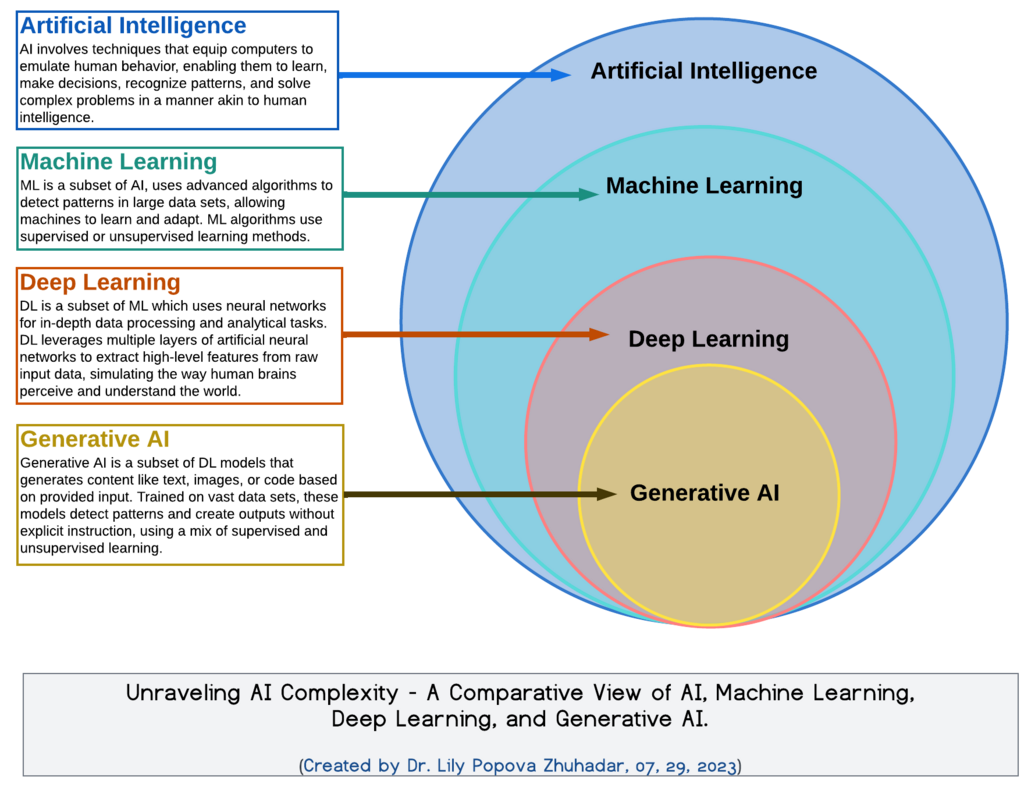
One of the most important methods for creating AI is machine learning. Instead of giving a computer a long list of rigid rules to follow, machine learning allows the computer to learn for itself by analyzing data. It's like teaching a child to recognize a cat. You don't list out rules like "has pointy ears, whiskers, and a long tail." Instead, you show them lots of pictures of cats. Eventually, the child learns to identify a cat on their own, even one they've never seen before.
Machine Learning
noun
A subset of artificial intelligence that gives computers the ability to learn from data without being explicitly programmed.
Machine learning algorithms look for patterns in massive datasets. By identifying these patterns, the AI can make predictions or decisions about new, unseen data. The more data it processes, the better it gets at its task.
The Brain of the AI
A key tool within machine learning is the neural network, which is a system inspired by the structure of the human brain. Our brains are made of billions of neurons that are connected to each other. When we learn something new, the connections between these neurons change.
Artificial neural networks work in a similar way. They are built from layers of interconnected digital "neurons." Data is fed into the first layer, which processes it and passes it to the next layer. Each layer analyzes the information a bit more, looking for increasingly complex patterns, until the final layer produces an output, like identifying an object in an image.
By adjusting the strength of the connections between these neurons based on the data it processes, the network learns. This structure is what allows AI to tackle complex problems in areas like image recognition and natural language processing.
What is the primary goal of artificial intelligence?
A sophisticated voice assistant like Siri or Alexa, which can answer questions and perform specific commands but cannot compose original music or write a novel, is an example of:
These concepts form the foundation of artificial intelligence. Understanding them is the first step to grasping how more complex AI systems work.