Generative AI Fundamentals
Introduction to Generative AI
Creator vs. Critic
Most of the AI you might have encountered until recently has been a type of critic. It's really good at sorting and labeling things it already knows. This is called discriminative AI. Think of a student who can ace a multiple-choice test. They can look at a picture and tell you if it's a cat or a dog. They can analyze data and flag a transaction as fraudulent or legitimate. They are discriminating between existing options.
Generative AI is different. It’s a creator. Instead of just identifying a cat, it can draw a picture of a cat that has never existed. Instead of flagging a sentence as grammatically incorrect, it can write a new, correct sentence from scratch. It generates new content—text, images, music, code—that is similar to the data it was trained on, but is entirely original.
Discriminative AI classifies data. Generative AI creates new data.
This ability to create is a huge leap forward. It unlocks new possibilities for everything from art and design to scientific research and software development. It's not just about recognizing patterns; it's about understanding and using those patterns to build something novel.
A Brief History
The idea of machines that can create isn't new, but making it a reality has been a long journey. Early AI in the 1950s and 60s focused on rules and logic. These systems were impressive but brittle. They could only do what they were explicitly programmed to do.
The shift towards modern generative models began with advancements in neural networks and machine learning. In the 1980s and 90s, models like Boltzmann machines showed they could generate simple patterns, but the results were often blurry or incoherent.
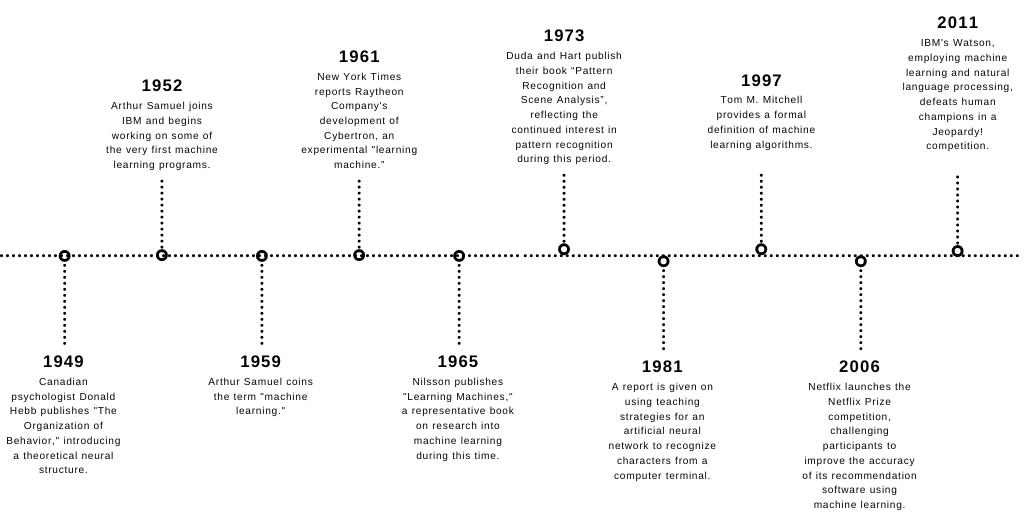
The 2010s were a turning point. The combination of massive datasets (thanks to the internet) and more powerful computers allowed for much deeper and more complex models. This decade saw the invention of the key architectures that power most generative AI today.
The Generative Toolkit
There are several different approaches to building a generative model. While they work in different ways, they all share the same goal: learn the underlying patterns in a dataset so well that they can produce new examples from scratch. Let's look at three of the most influential types.
Variational Autoencoders
noun
A type of neural network that learns to compress data into a simplified representation and then reconstruct it. It's great for generating new data by creating variations from this compressed form.
Imagine an artist who learns to draw a face by first sketching a very simple summary of its key features (like eye spacing and nose shape) and then filling in the details. VAEs work similarly. They learn to encode an image into a compact, latent space (the summary) and then decode it back into a full image. By tweaking the values in that latent space, they can generate new, varied faces.
Generative Adversarial Networks
noun
A model architecture where two neural networks, a generator and a discriminator, compete against each other. The generator creates fake data, and the discriminator tries to tell it apart from real data.
GANs, introduced in 2014, use a clever two-player game. The Generator is like a currency counterfeiter, trying to create fake money. The Discriminator is like a police detective, trying to spot the fakes. They train together. The generator gets better at making fakes, and the discriminator gets better at spotting them. This competition forces the generator to produce incredibly realistic outputs.
Finally, we have the models that power tools like ChatGPT.
Transformers
noun
A neural network architecture that excels at handling sequential data, like text or music, by using a mechanism called 'attention' to weigh the importance of different parts of the input.
Introduced in 2017, the Transformer architecture revolutionized how machines process language. Its key innovation is the attention mechanism. This allows the model to consider the context of a whole sentence or paragraph at once, rather than processing it word-by-word. It can pay 'attention' to the most relevant words, no matter where they are in the sequence. This deep understanding of context is what allows Transformers to generate coherent, relevant, and human-like text.
Let's check your understanding of these core concepts.
An AI model that analyzes medical scans to identify whether a tumor is malignant or benign is an example of which type of AI?
Which generative model is best described as a competitive game between a 'counterfeiter' and a 'detective'?
These models are the building blocks of the generative AI revolution, each contributing a unique way for machines to learn, understand, and create.