Generative AI for Data Analytics
Introduction to Generative AI
What Is Generative AI?
Generative AI creates new content. Unlike other forms of AI that classify data or make predictions based on it, generative models produce entirely new data instances that mimic the originals they were trained on. Think of it as an apprentice who studies a master's paintings and then creates a new piece in the same style.
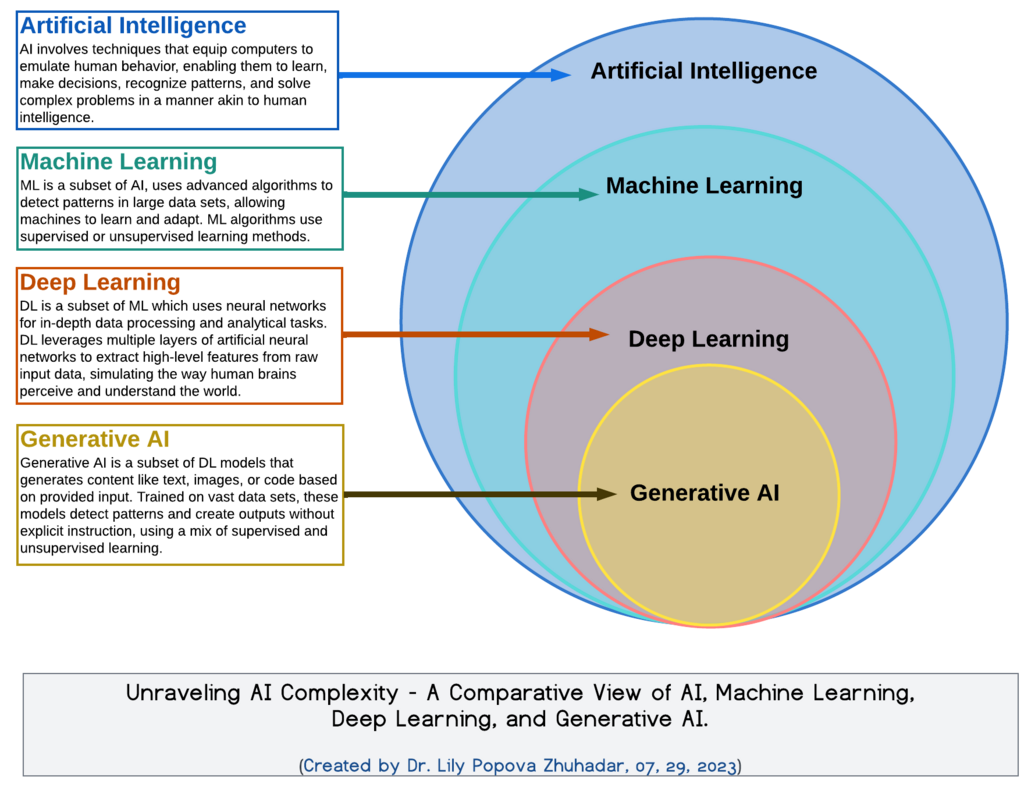
In data analysis, this is incredibly powerful. Imagine you have a small dataset and need more examples to train a predictive model effectively. Generative AI can create synthetic data points that are statistically similar to your real data, helping you build more robust models without collecting more real-world information. This is especially useful when data is scarce, expensive, or private.
Core Models
Two foundational architectures dominate the generative AI landscape: Generative Adversarial Networks (GANs) and Variational Autoencoders (VAEs).
Generative Adversarial Networks (GANs) work like a game between two competing neural networks: a Generator and a Discriminator.
The Generator's job is to create fake data—for instance, a synthetic image of a cat. The Discriminator's job is to act as a detective, trying to distinguish the Generator's fakes from real cat images. Initially, both are bad at their jobs. The Generator produces noise, and the Discriminator guesses randomly. But as they train against each other, they both improve. The Generator gets better at creating convincing fakes, and the Discriminator gets better at spotting them. This adversarial process continues until the Generator's creations are so good that the Discriminator is fooled about half the time.
Variational Autoencoders (VAEs) take a different approach. A VAE consists of two parts: an Encoder and a Decoder.
The Encoder's job is to compress input data into a simplified, lower-dimensional representation called a latent space. This space is like a blueprint, capturing the most essential features of the data. The Decoder then uses this blueprint to reconstruct the original data as closely as possible.
During training, the VAE learns to create a smooth, continuous latent space where similar data points are clustered together. To generate new data, we simply pick a random point from this latent space and feed it to the Decoder. The Decoder then generates a novel data instance that shares the characteristics of the original training set.
Ethical Speed Bumps
The power to generate realistic data comes with significant responsibility. Generative AI models learn from the data they are given, and if that data contains biases, the model will learn and even amplify them. For example, if a model is trained on historical loan data that reflects past discriminatory practices, it may generate synthetic data that perpetuates those same biases, leading to unfair outcomes if used to train new financial models.
Another major concern is the potential for misuse. The same technology that can create helpful synthetic medical images could also be used to create misleading or malicious content, such as deepfakes.
As data analysts and scientists, it's crucial to be aware of these issues. This means carefully curating training data, testing models for bias, and being transparent about the limitations and origins of generated data. Understanding the ethical landscape is just as important as understanding the technical architecture.
Now, let's test your understanding of these foundational concepts.
What is the primary function of Generative AI that distinguishes it from other forms of artificial intelligence, such as those used for classification or prediction?
In a Generative Adversarial Network (GAN), what are the respective roles of the Generator and the Discriminator?
Generative AI is a rapidly evolving field, but its core principles provide a powerful new toolkit for data analysis. By understanding how these models work and their ethical implications, you can begin to explore their potential in your own work.