Generative AI for Content Creation
Introduction to Generative AI
What is Generative AI?
Most artificial intelligence you might be familiar with is analytical. It's designed to recognize patterns, classify data, or make predictions. Think of a spam filter sorting your email or a system that identifies faces in photos. These are powerful tools, but they work with existing information.
Generative AI is different. It doesn't just analyze; it creates.
Generative AI is a branch of artificial intelligence that focuses on creating new content such as text, images, code, music and video using models like transformers, GANs and diffusion models.
Instead of asking, "Is this a cat or a dog?" a generative model can answer the request, "Create a picture of a cat riding a bicycle." It learns from vast amounts of data—text, images, sounds—and then uses those learned patterns to produce something entirely new and original.
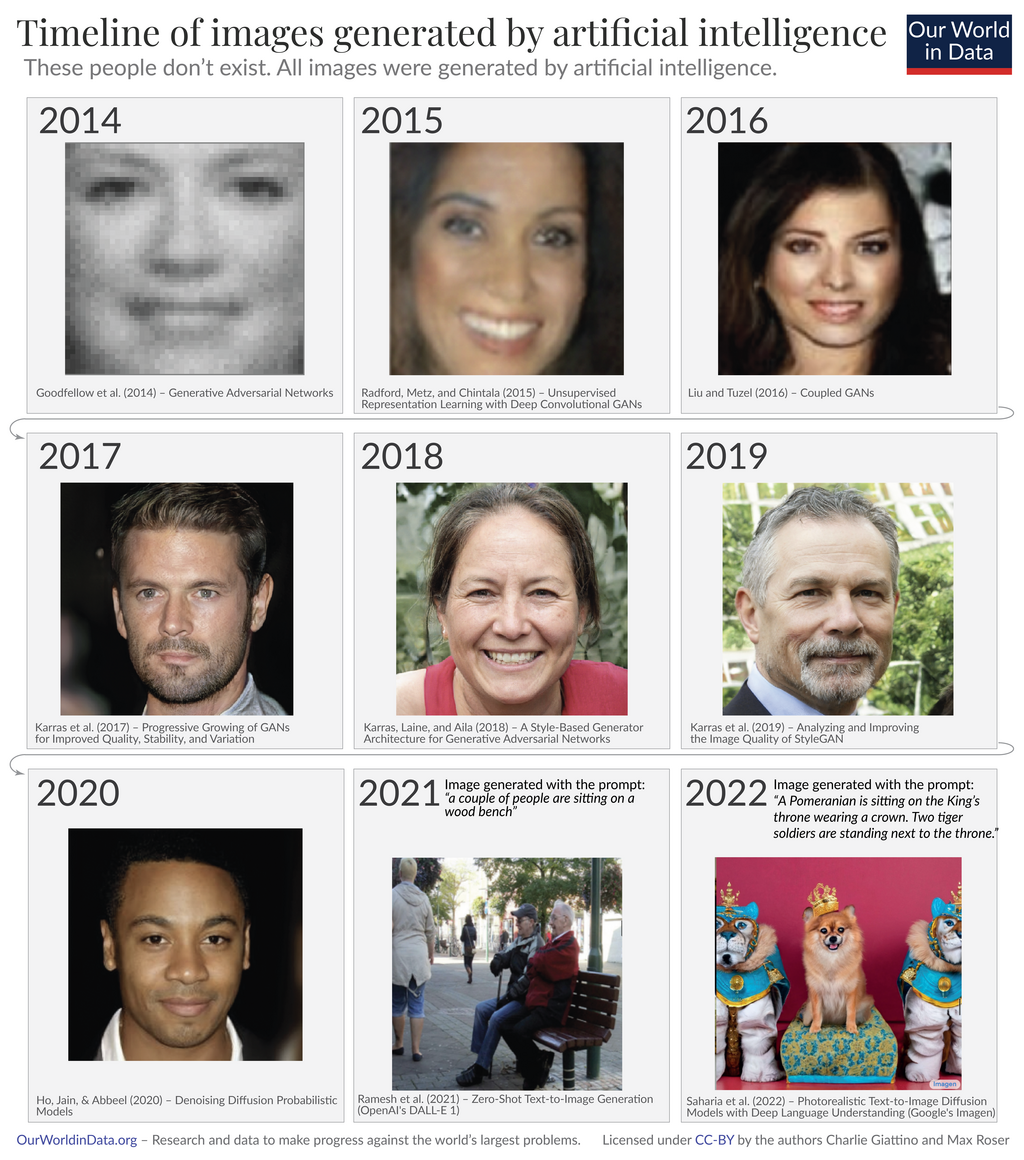
A Quick History
The idea of machines that can create isn't new, but for a long time, it was mostly science fiction. Early models from the 1950s and 60s could follow rigid rules to produce simple text or music, but they lacked any real spark of creativity. They were more like sophisticated calculators than artistic partners.
The field took a huge leap forward in the 2010s with the development of more advanced neural networks. These are complex systems inspired by the human brain, capable of learning much more nuanced patterns from data. This innovation paved the way for the two main techniques that power much of modern generative AI.
Two Creative Approaches
So, how does a machine actually learn to create? Two key methods are Variational Autoencoders (VAEs) and Generative Adversarial Networks (GANs). While their inner workings are complex, the core ideas are quite intuitive.
Variational Autoencoder
noun
A type of generative model that learns to compress data into a simplified representation and then reconstruct it. It excels at creating variations of the data it was trained on.
Imagine a VAE as a skilled artist who specializes in summarizing. The artist looks at thousands of pictures of faces. For each one, they don't redraw it perfectly. Instead, they write down a shorthand description: "Round face, blue eyes, long nose, small smile." This compressed description is called a latent representation. Later, the artist (or a different artist) can take that shorthand and try to reconstruct the original face. By tweaking the shorthand—like changing "blue eyes" to "green eyes"—they can generate a new, unique face that still looks realistic.
Generative Adversarial Network
noun
A model architecture where two neural networks, a Generator and a Discriminator, compete against each other to produce more realistic outputs.
GANs work more like an art forger and a detective playing a cat-and-mouse game.
- The Generator (the forger) creates a fake image—say, a painting.
- The Discriminator (the detective) looks at both the fake painting and a real one and must decide which is which.
At first, the forger is terrible, and the detective easily spots the fakes. But the forger learns from its mistakes and gets better. The detective, in turn, has to get better at spotting more convincing fakes. This competition continues, with both networks improving, until the Generator becomes so good that its creations are almost indistinguishable from the real thing.
Applications in the Wild
Generative AI isn't just a research concept; it's already creating content you may have seen, heard, or read.
- Image Generation: Tools can create stunningly realistic photos, illustrations, and abstract art from simple text descriptions. This is used in marketing, design, and entertainment.
- Text Generation: AI can write articles, emails, poems, and even computer code. Chatbots and virtual assistants use it to hold natural conversations.
- Music Generation: AI models can compose original melodies in various styles, from classical piano to electronic dance music. They can help artists break through creative blocks or generate royalty-free background music.
The core principle is always the same: learn the underlying patterns of a creative domain, then use those patterns to generate new examples.
Now that you have a sense of what generative AI is and how it works, let's review the key ideas.
Ready to check your understanding?
What is the primary difference between analytical AI and generative AI?
In a Variational Autoencoder (VAE), what is the compressed, shorthand description of data called?
These foundational concepts are the building blocks for the incredible variety of generative AI tools we see today. Understanding the difference between analyzing and creating is the first step to grasping the power of this technology.