Generative AI for Business
Introduction to Generative AI
Beyond Analysis
Most of the artificial intelligence we've encountered in daily life is analytical. Think of a spam filter sorting your email or a navigation app finding the fastest route. This type of AI is trained to recognize patterns, classify information, and make predictions based on existing data. It's incredibly useful, but it works with what's already there.
Generative AI is different. Instead of just analyzing data, it creates something entirely new.
This form of AI can write a poem, compose a piece of music, design an image, or produce a block of computer code. It generates content that didn't exist before, learning from vast amounts of information to produce novel outputs. It's the difference between an art critic who evaluates a painting and an artist who creates one from a blank canvas.
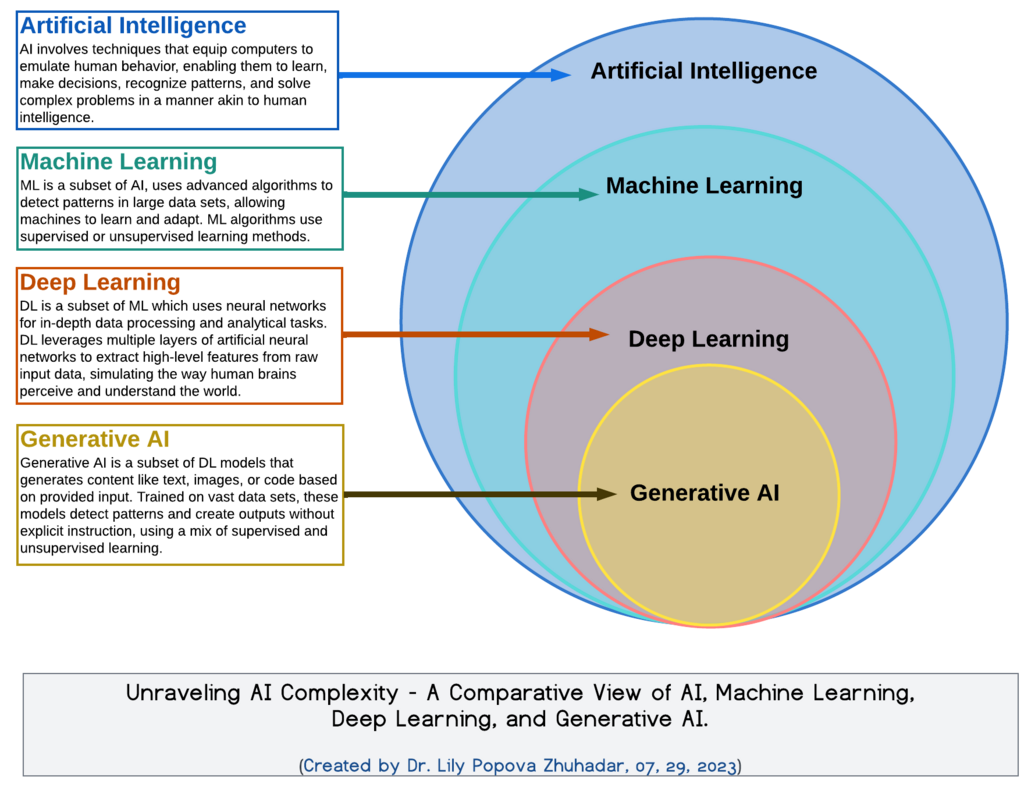
Generative AI isn't a separate tree; it's a branch of the larger AI family tree. It sits within the field of deep learning, which uses complex neural networks inspired by the human brain to process information. While traditional AI might answer the question "Is this a cat or a dog?", generative AI answers the prompt "Show me a picture of a cat wearing a tiny hat."
From Rules to Reinvention
The idea of a machine that creates isn't new. Early attempts in the mid-20th century involved rule-based systems. Programmers would write explicit instructions for a computer to follow. For example, an early chatbot might have a rule like, "If a user says 'hello,' respond with 'Hi there!'" These systems were clever, but they were limited by their programming. They could only do what their rules allowed; they couldn't learn or improvise.
The major breakthrough came with the rise of neural networks and machine learning. Instead of being fed rules, models were fed data—huge amounts of it. A model could learn the patterns, structures, and relationships within that data on its own. It learned what a cat looks like by analyzing millions of cat photos, not by being given a checklist of features like "has whiskers" and "is furry."
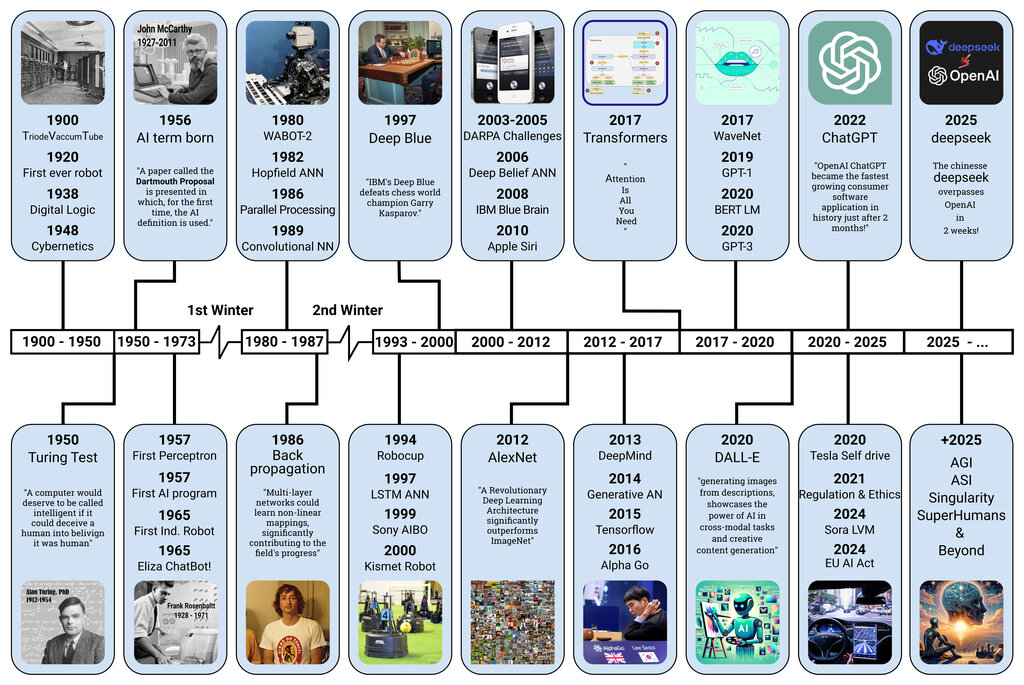
This shift from hard-coded rules to learned patterns is the core principle of modern generative AI. The model doesn't just memorize the data it's trained on. It develops an internal understanding of the data's underlying structure. When you ask it to generate something new, it uses that understanding to create a plausible output that fits the patterns it has learned.
Think of it like learning a language. You don't just memorize every sentence ever spoken. You learn the rules of grammar and vocabulary, which allows you to construct entirely new sentences to express new ideas.
Generative AI models do something similar, but on a massive scale. They learn the "grammar" of images, text, or sounds, enabling them to generate new combinations that are coherent and often surprisingly creative.
Key Differences
So, how can we neatly separate traditional and generative AI? The biggest distinction lies in their purpose.
| Feature | Traditional AI (Discriminative) | Generative AI |
|---|---|---|
| Primary Goal | Classify or predict from data | Create new data |
| Example Task | Is this a picture of a car? | Generate a picture of a car. |
| Output | A label, category, or number | New content (text, image, audio) |
| How it Works | Learns boundaries between data types | Learns the underlying distribution of data |
Traditional AI, often called discriminative AI, is focused on finding the dividing lines between different types of data. It learns to discriminate. Generative AI is concerned with understanding the data so deeply that it can produce more of it. One is a judge, the other is a creator.
Let's check your understanding of these core ideas.
What is the primary purpose of traditional AI, also known as discriminative AI?
The text compares generative AI to an artist. Which of the following tasks best fits this analogy?
This ability to create is what makes generative AI so powerful and transformative, opening up new possibilities across countless fields.