Generative AI Explained
Introduction to Generative AI
What Is Generative AI?
Most artificial intelligence you might be familiar with is analytical. It's designed to recognize patterns, classify information, and make predictions based on existing data. Think of an AI that identifies spam emails or predicts the weather. It analyzes what's already there.
Generative AI is different. Instead of just analyzing data, it creates something entirely new.
Generative AI
noun
A type of artificial intelligence that can produce original content, such as text, images, audio, and code, by learning patterns from vast amounts of existing data.
Imagine a chef. An analytical AI would be like a food critic who tastes a dish and identifies its ingredients and quality. A generative AI, on the other hand, is like the chef who dreams up a new recipe and cooks a dish you've never tasted before. It uses its knowledge of ingredients and cooking techniques to generate a novel creation.
While traditional AI analyzes and decides, generative AI creates and invents.
A Brief History
The idea of machines that create isn't new. Early concepts date back to the mid-20th century with pioneers like Alan Turing, who explored the potential for machine intelligence. However, the technology to build true generative systems didn't exist yet.
The journey began with simple models that could generate basic, often incoherent, text. For decades, progress was slow, limited by computing power and the amount of available data. The real breakthroughs started happening in the 2010s with the development of more sophisticated neural networks. These advancements allowed models to understand and replicate complex patterns in language and images, paving the way for the powerful tools we see today.

Generative vs. Other AI
To truly grasp what makes generative AI special, it's helpful to compare it to its counterpart: discriminative AI. Most analytical or predictive AI falls into this category.
A discriminative model's job is to find the boundary between different types of data. It learns to differentiate, or discriminate. For example, it learns what separates a picture of a cat from a picture of a dog. When you show it a new photo, it uses this understanding to classify it as one or the other.
A discriminative model asks: "Is this a cat or a dog?" A generative model asks: "What does a cat look like?" and then draws one.
Generative models take a different approach. Instead of learning the boundary between classes, they learn the underlying distribution of the data itself. This allows them to generate new samples that fit within that distribution. They learn the very essence of what makes something a cat, enabling them to create a new, unique image of a cat that has never existed.
| Feature | Discriminative AI | Generative AI |
|---|---|---|
| Primary Goal | Classify or predict | Create or generate |
| Example Task | Is this email spam or not? | Write a poem about the ocean. |
| Output | A label or a value | New, original content |
| Learning Method | Learns decision boundaries | Learns data distribution |
Generative AI is a subset of the broader field of AI. It sits within the disciplines of machine learning and deep learning, representing the cutting edge of what AI systems can create.
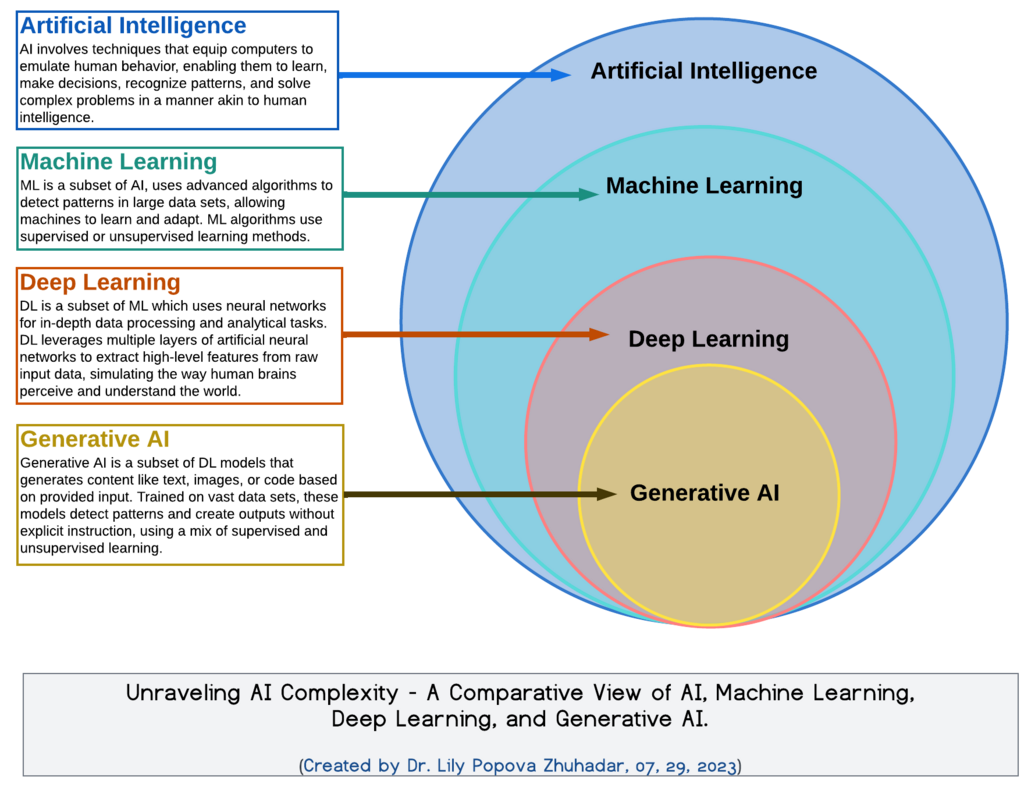
Now that you have a foundational understanding of what generative AI is and how it fits into the larger world of artificial intelligence, let's test your knowledge.
What is the primary function of generative AI?
Using the analogy from the lesson, if an analytical AI is like a food critic who identifies a dish's ingredients, what is a generative AI?
Understanding these core concepts provides the foundation for exploring how these powerful tools are built and used.