Generative AI Explained
Introduction to Generative AI
What is Generative AI?
Artificial intelligence can be broadly split into two categories: AI that analyzes existing information, and AI that creates something new. Generative AI falls into the second group. Its purpose is to generate original content—like text, images, code, or music—that is similar to, but not a direct copy of, the data it was trained on.
Generative AI is a branch of artificial intelligence that focuses on creating new content such as text, images, code, music and video using models like transformers, GANs and diffusion models.
Think of it like a musician who listens to thousands of hours of classical music. They don't just memorize and replay those exact songs. Instead, they learn the patterns, structures, and styles of the genre. Then, they can compose a brand new piece of music that sounds like it belongs to that era, yet has never been heard before. Generative AI works in a similar way, learning from vast datasets to produce novel creations.
A Quick Look Back
The idea of machines that can generate human-like content isn't new. Early experiments in the 1960s, like the chatbot ELIZA, could simulate conversation by rearranging user inputs. However, these systems were rigid and lacked true creative ability. For decades, generative AI remained a niche field, limited by computing power and the available data.
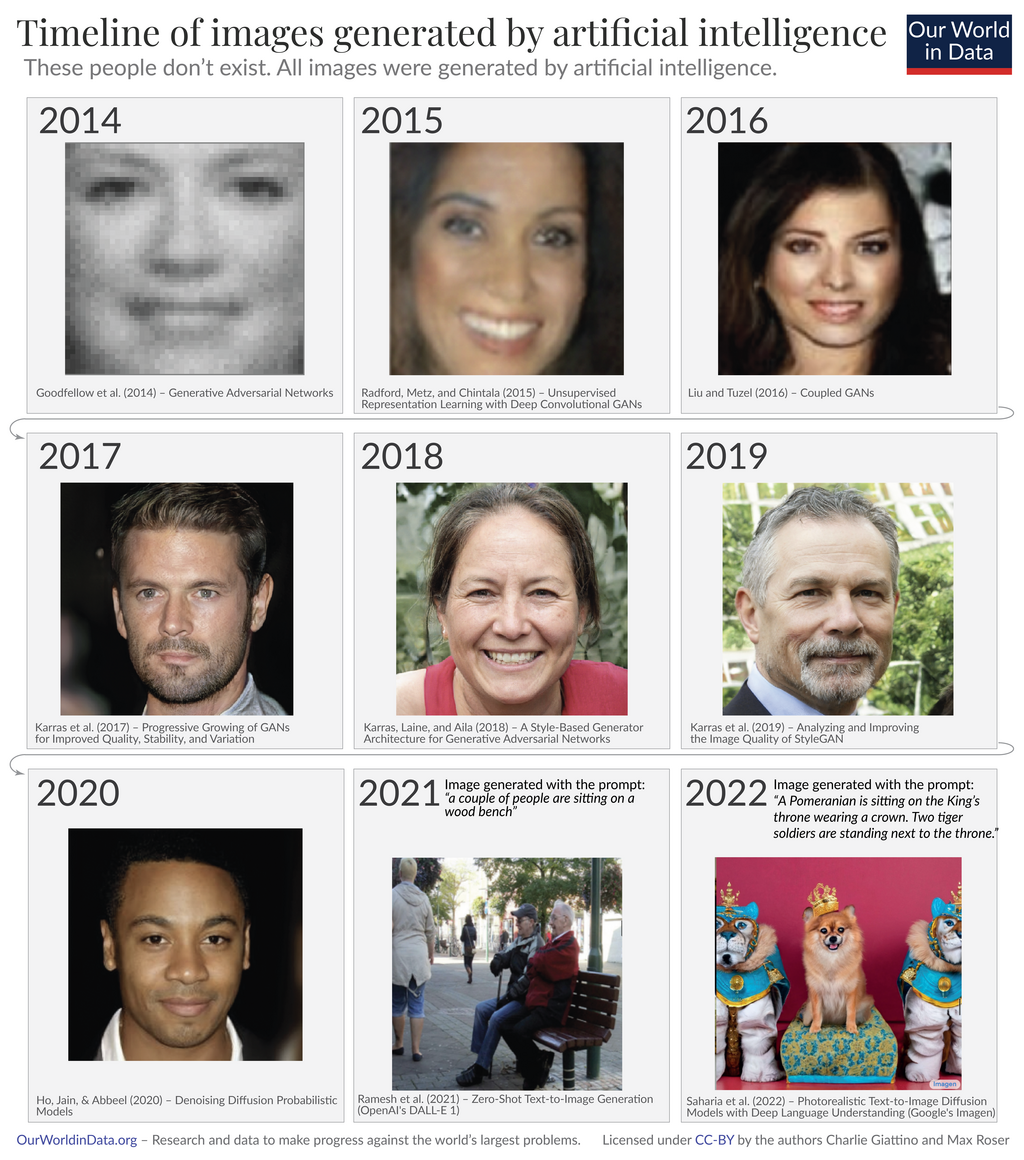
The modern era of generative AI began to take shape in the mid-2010s. A key breakthrough came in 2014 with the invention of Generative Adversarial Networks (GANs), which pitted two neural networks against each other to produce highly realistic images. This was followed by the development of the Transformer architecture in 2017, a model that revolutionized how machines process and understand language. These innovations laid the groundwork for the powerful tools we see today.
Creator vs. Critic
To better understand what makes generative AI unique, it helps to compare it with the other major AI paradigm: discriminative AI. Most of the AI you might have encountered before, like spam filters or image recognition software, is discriminative.
A discriminative model is like a critic. Its job is to look at something and make a judgment or classification. It learns the boundary between different categories. For example, it can learn to distinguish a cat photo from a dog photo by analyzing the features of each. It answers questions like, "Is this a cat or a dog?" or "Is this email spam or not spam?"
Discriminative AI classifies data. Generative AI creates data.
A generative model, on the other hand, is a creator. It learns the underlying patterns of the data itself. Instead of just learning the line between cats and dogs, it learns what makes a cat a cat and a dog a dog. With that knowledge, it can generate a brand new image of a cat or a dog that has never existed. It answers the prompt, "Create a picture of a cat."
| Feature | Generative AI (The Creator) | Discriminative AI (The Critic) |
|---|---|---|
| Goal | Generate new data | Classify or predict from existing data |
| Task | Creation, generation | Classification, recognition |
| Example | Creating a photorealistic image of a person | Identifying if an image contains a person |
| Question | "Draw a sunflower." | "Is this a picture of a sunflower?" |
This ability to create is the defining characteristic of generative AI. It's not just about analyzing the world as it is, but about imagining new possibilities based on what it has learned. This distinction is what makes generative AI a powerful tool for creativity and innovation.
What is the primary function of generative AI?
Which of the following is an example of a task for a discriminative AI model, not a generative one?