Generative AI Explained
Introduction to Generative AI
What is Generative AI?
Most artificial intelligence you might be familiar with is designed to analyze or classify information. Think of an AI that identifies spam emails or one that recognizes faces in photos. These systems are powerful, but they work with existing data.
Generative AI is different. It doesn't just analyze; it creates.
Generative AI refers to a type of artificial intelligence whose core function is to create new content—text, audio, images, video, or data—based on patterns it has learned from existing data.
Imagine a musician who studies thousands of classical pieces. One type of AI, called discriminative AI, would be like a musicologist who can listen to a new piece and correctly identify it as Baroque or Romantic. It's distinguishing between categories.
Generative AI is like the musician who, after studying all that music, composes an entirely new sonata in the style of Mozart. It has learned the underlying patterns, rules, and structures of the data it was trained on, and it uses that knowledge to generate something original.
| AI Type | Primary Function | Example Question |
|---|---|---|
| Discriminative AI | Classify or predict | Is this image a cat or a dog? |
| Generative AI | Create new data | Generate an image of a cat wearing a hat. |
This ability to create is the fundamental difference that sets generative AI apart. It's not just interpreting the world; it's adding to it.
A Brief History
The idea of machines that can create isn't new, but for decades, it was mostly science fiction. Early attempts in the mid-20th century could generate simple text or patterns, but the results were far from convincing. The two main hurdles were a lack of computing power and not enough data to learn from.
Things began to change rapidly in the 2010s. Breakthroughs in model architectures, combined with the explosion of data from the internet and massive increases in computational power, set the stage for a revolution.
Models learned to produce much more realistic and complex outputs. The progress in image generation alone shows how quickly the technology has evolved.
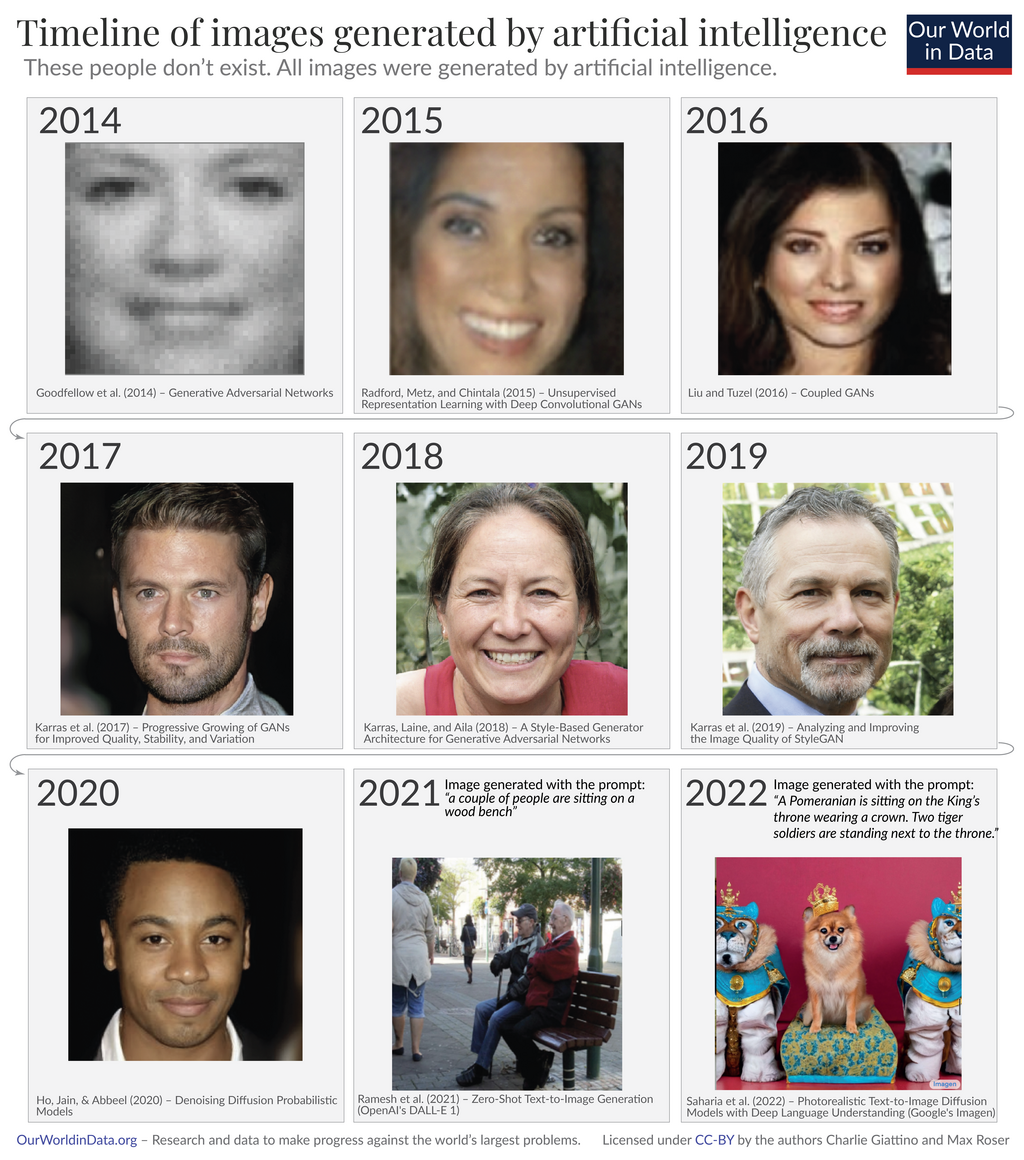
This leap forward wasn't just about making prettier pictures. It signaled a fundamental shift in what AI was capable of, moving it from a tool for analysis to a partner in creation.
Key Characteristics
So, what makes generative AI tick? While the underlying technology is complex, its core characteristics are straightforward.
First, it learns from vast datasets. A model that generates text, like ChatGPT, might be trained on a massive portion of the internet—articles, books, and websites. An image generator like Midjourney learns from billions of images and their text descriptions. This data is the raw material for its understanding of the world.
Second, it identifies and internalizes patterns. The AI doesn't memorize the data. Instead, it learns the statistical relationships between elements. For text, it learns grammar, facts, and conversational styles. For images, it learns about objects, textures, lighting, and composition.
Finally, it uses these learned patterns to generate new content based on a prompt or input. It samples from its statistical understanding to assemble something new, whether that's a paragraph of text, a line of code, or a photorealistic image.
Generative AI is a subset of broader machine learning and deep learning fields, which are themselves part of the overall discipline of artificial intelligence.
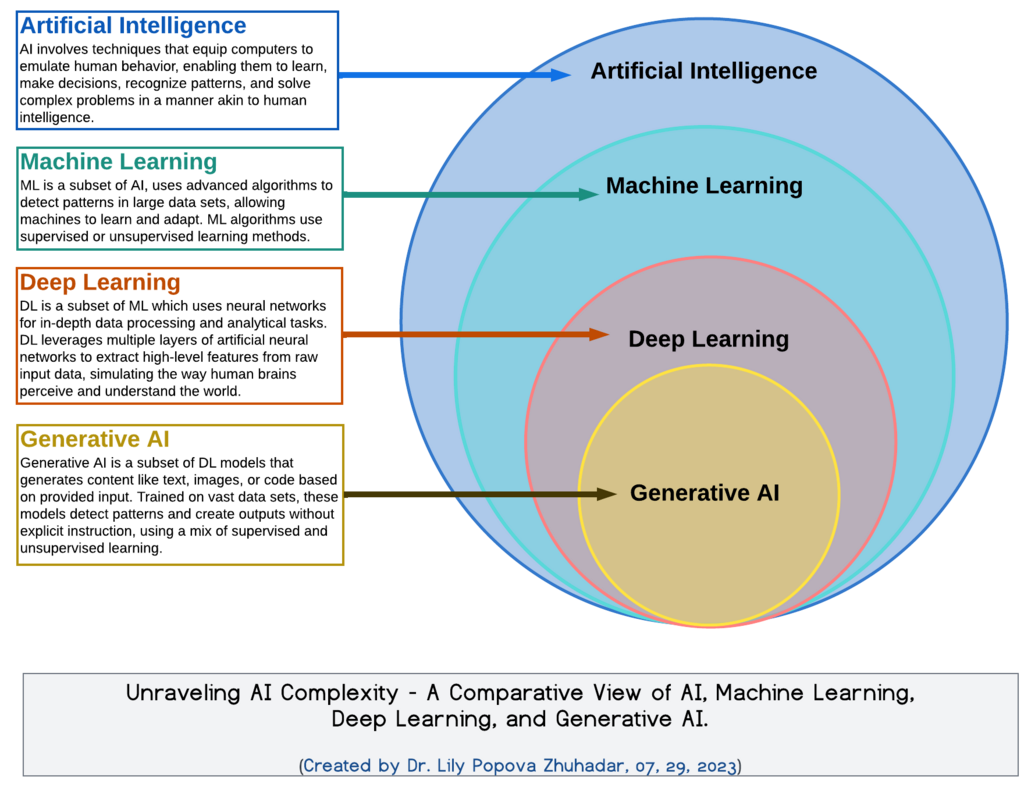
This unique combination of learning and creating is what makes generative AI one of the most significant technological developments in recent memory. It provides a new way to interact with information and computers, moving from simple instruction-following to a more collaborative, creative process.