Generative AI Explained
Introduction to Generative AI
The Creative Machine
Artificial intelligence is often described as a tool for analysis. It can spot patterns, classify data, and make predictions. A different kind of AI, however, doesn't just analyze what already exists. It creates something entirely new. This is generative AI.
Generative AI models learn the patterns and structures from a set of training data, and then use that knowledge to produce new, original data that shares similar characteristics.
Think of it like studying thousands of paintings by a specific artist. After a while, you'd understand their style, color choices, and brushstrokes so well that you could create a new painting in their style. Generative AI does this, but with massive datasets of text, images, code, or music. Its significance lies in this ability to generate, not just interpret. It's a tool for creation, opening up new possibilities in fields from art to scientific research.
Creator vs. Critic
To understand what makes generative AI unique, it helps to compare it with other forms of AI. Most AI we've encountered in daily life is discriminative or predictive.
A discriminative model is like a critic. It learns to distinguish between different categories of data. A spam filter, for example, looks at an email and decides if it's “spam” or “not spam.” It classifies existing data. A predictive model uses past data to forecast future events, like a weather app predicting tomorrow's temperature.
Generative AI is different. It’s like an artist or an author. It doesn't just classify or predict; it creates. Instead of just identifying spam, it could write a new spam email from scratch. Instead of identifying a cat in a photo, it could generate a brand new image of a cat that has never existed.
| AI Type | Primary Function | Example |
|---|---|---|
| Discriminative | Classifies or categorizes data | Identifying spam in your inbox |
| Predictive | Forecasts future outcomes | Predicting a stock's price |
| Generative | Creates new data instances | Generating an image from a text prompt |
A Rapid Evolution
The idea of machines that can create isn't new, but the technology has evolved rapidly. Early models in the mid-20th century were based on rules and could generate simple patterns or text, but lacked originality.
A major breakthrough came in 2014 with the invention of Generative Adversarial Networks (GANs). In a GAN, two neural networks, a “generator” and a “discriminator,” compete. The generator creates fake data (like an image), and the discriminator tries to tell if it's real or fake. This competition pushes the generator to create increasingly realistic outputs.
Another key milestone was the development of the Transformer architecture in 2017. This model was exceptionally good at understanding context in sequential data, like text. It became the foundation for the Large Language Models (LLMs) we know today, such as those that power chatbots like ChatGPT.
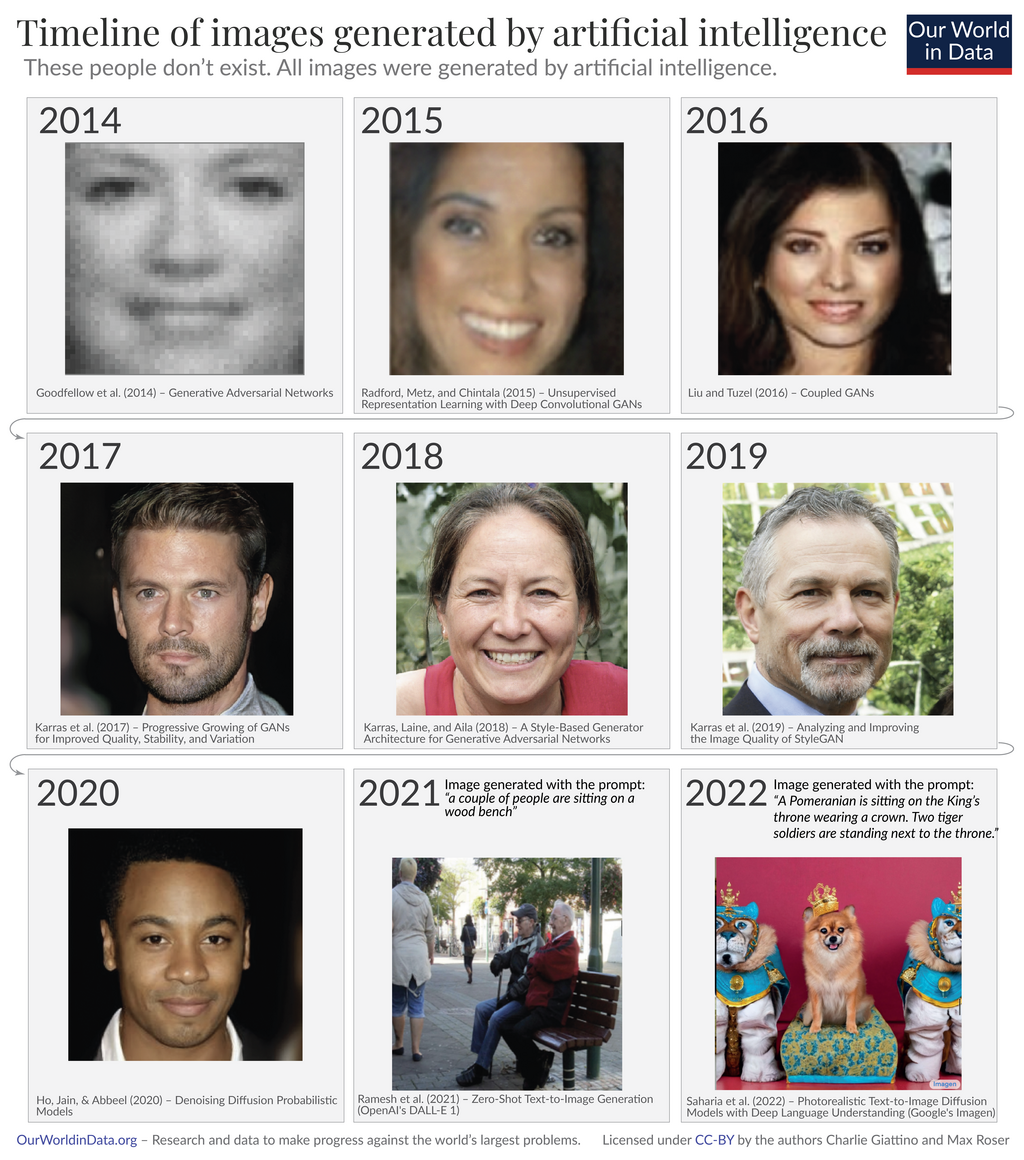
This rapid progress has brought generative AI from a niche academic field to a globally recognized technology in just a few years. Let's review these core concepts.
What is the primary function that distinguishes generative AI from other types of AI like discriminative or predictive models?
A spam filter that decides whether an incoming email is 'spam' or 'not spam' is an example of what kind of AI model?