Generative AI Explained
Introduction to Generative AI
What is Generative AI?
Generative AI is a type of artificial intelligence that creates new, original content. Instead of just analyzing or categorizing existing data, it generates something entirely new. This could be an image, a piece of music, lines of code, or a story.
Think of it like a musician who has spent years listening to classical, jazz, and rock music. They don't just learn to identify which genre a song belongs to. They absorb the patterns, structures, and styles of each one. Then, they can sit down and compose a completely new piece of music that might blend those influences or sound authentically like one of them. Generative AI does something similar, but with data.
Generative AI models learn the underlying patterns from a vast amount of data to produce novel content.
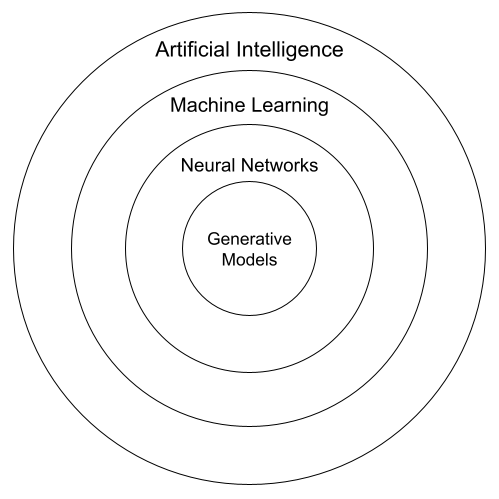
This ability to create is what separates generative AI from other forms of artificial intelligence. It's not just a tool for understanding the world as it is, but for imagining what could be. It sits within the broader field of AI, often as a specialized application of machine learning and neural networks.
Creating vs. Classifying
To really understand what makes generative AI special, it helps to compare it to its counterpart: discriminative AI. Most of the AI we've interacted with for years, like spam filters or image recognition apps, is discriminative.
A discriminative model is trained to make decisions by finding the boundary between different categories of data. It answers questions like, "Is this email spam or not spam?" or "Does this picture contain a cat or a dog?" It learns to discriminate between options.
A generative model, on the other hand, learns the distribution of the data itself. Instead of just learning the line that separates cats from dogs, it learns what cats look like and what dogs look like. Because it understands the essence of "cat-ness," it can then try to generate a brand new image of a cat that has never existed.
| Model Type | Goal | Example Question |
|---|---|---|
| Generative | Create new data based on learned patterns. | "Generate an image of a cat." |
| Discriminative | Classify existing data into categories. | "Is this an image of a cat?" |
In more technical terms, discriminative models learn the conditional probability, , which is the probability of a label given an input . Generative models learn the joint probability distribution, , which allows them to generate new pairs of data.
A Brief History
The idea of machines that can create isn't new. Early concepts date back to the 1950s and 60s with simple programs like ELIZA, a chatbot that could simulate conversation by rearranging a user's sentences. These were rule-based systems, clever but not truly generative in the modern sense.
True generative AI began to take shape with the development of more complex statistical models. In the 1980s and 90s, models like Hidden Markov Models (HMMs) were used to generate sequences, finding applications in speech recognition. But the outputs were often limited and lacked coherence.
The modern era of generative AI was kickstarted by two major breakthroughs in the 2010s.
Variational Autoencoders (VAEs), introduced in 2013, provided a principled way for models to learn a compressed representation of data and then use it to generate new, similar data.
Generative Adversarial Networks (GANs), introduced in 2014, created a system where two neural networks, a generator and a discriminator, compete against each other. The generator creates fake data, and the discriminator tries to tell it apart from real data. This competition pushes the generator to produce incredibly realistic outputs.
The latest leap forward came with the rise of Transformer architecture, first introduced in 2017. This model was exceptionally good at handling sequences of data, like text. It became the foundation for the Large Language Models (LLMs) like GPT (Generative Pre-trained Transformer) that power today's most advanced text-based AI.
These milestones have rapidly transformed generative AI from a niche academic interest into a powerful, widely accessible technology.
Time to review what you've learned.
What is the primary function of generative AI that sets it apart from other types of AI?
An email service uses an AI model to automatically sort incoming messages into 'Spam' and 'Not Spam' folders. What kind of AI model is this?