Generative AI Demystified
Introduction to Generative AI
What is Generative AI?
Generative AI is a type of artificial intelligence that creates new, original content. Instead of just analyzing or categorizing information that already exists, it generates something that wasn't there before. This could be an email, a poem, a song, a piece of code, or a photorealistic image.
Think of it as the difference between a critic and an artist. A critic analyzes existing art, while an artist creates new art. Generative AI is the artist.
This technology works by learning from enormous amounts of existing data. It studies the patterns, structures, and relationships within that data. Once trained, it can use that knowledge to produce novel outputs that are similar in style and form to the data it learned from, but are entirely new creations.
Not Your Usual AI
The term "AI" covers a lot of ground. For decades, most of what people meant by AI was what we can call traditional, or discriminative, AI. Its main job is to make predictions or classify data. For example, a traditional AI might look at a photo and decide if it's a cat or a dog. It sorts information into predefined categories.
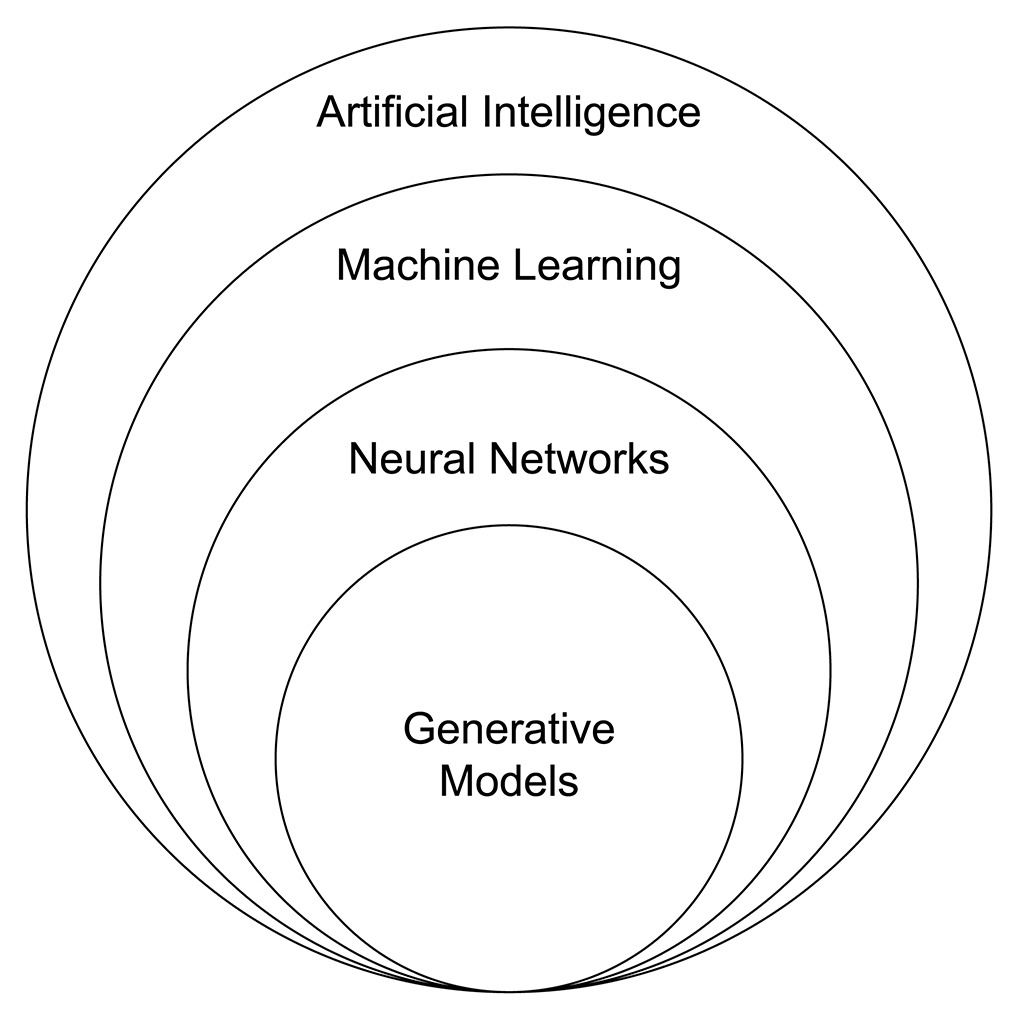
Generative AI does the opposite. If you ask it to create a picture of a cat, it will generate a brand-new image of a cat that has never existed. It's not finding a picture of a cat; it's creating one from scratch. This fundamental difference—creation versus classification—is what sets generative AI apart.
| Feature | Traditional AI (Discriminative) | Generative AI |
|---|---|---|
| Primary Goal | Classify or predict from input data | Create new data |
| Output | A label or a number (e.g., "spam") | New content (e.g., an email) |
| Example | Identifying a tumor in a medical scan | Generating a summary of a research paper |
A Quick Trip Through Time
The idea of machines that can generate content isn't brand new. Early attempts in the mid-20th century relied on strict, human-written rules. A famous example is ELIZA, a chatbot from the 1960s that could simulate a conversation by recognizing keywords and responding with programmed phrases. It was clever, but it couldn't create anything truly new.
The real breakthrough came with machine learning and, more recently, deep learning. Instead of being given explicit rules, models began learning patterns directly from data. This shift was monumental. Models could now learn the underlying structure of language, images, or sound.
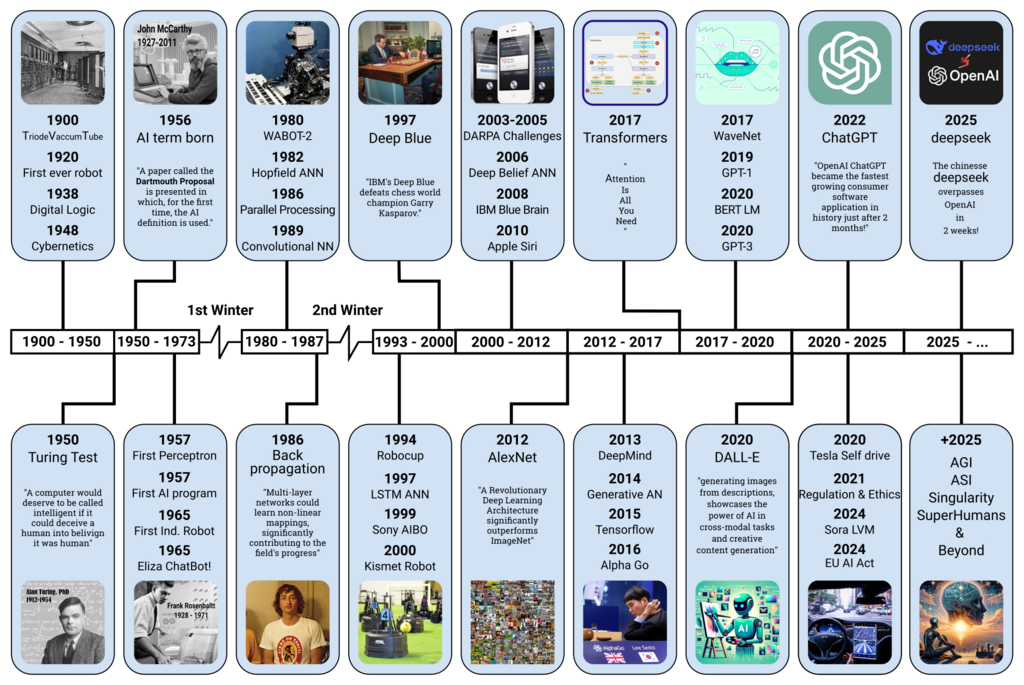
In the last decade, powerful architectures like Generative Adversarial Networks (GANs) and Transformers have accelerated progress. These models can handle vastly more complex patterns, leading to the sophisticated AI tools we see today that can write convincing essays, create stunning art, and compose music.
How Does It Create?
At its heart, generative AI is a master of pattern recognition and probability. Imagine showing an apprentice thousands of paintings by a specific artist. The apprentice would start to understand the artist's style: their typical subjects, color palette, and brushstroke techniques. Eventually, the apprentice could create a new painting that looks like the master's work, but isn't a direct copy of any single piece.
Generative AI does something similar, but with data and mathematics. When you feed it a massive dataset of text from the internet, it learns the statistical relationships between words and sentences. It learns that "the sky is" is very likely to be followed by "blue." By calculating these probabilities on a massive scale, it can string words together to form coherent paragraphs on almost any topic.
Generative AI is a subfield of artificial intelligence focused on creating new content such as text, images, audio, video, or code by learning patterns and structures from large datasets.
This same principle applies to other types of content. For images, it learns the relationships between pixels. For music, it learns the relationships between notes. The model doesn't "understand" what it's creating in a human sense, but it's exceptionally good at mimicking the patterns of its training data to produce something new and often surprising.
What is the primary function of generative AI?
Which of the following scenarios is an example of generative AI at work?
By understanding these basic concepts, you're ready to explore the specific models and applications that make this field so revolutionary.