Generative AI and LLMs Explained
Introduction to Generative AI
What Is Generative AI?
Generative AI is a type of artificial intelligence that creates new, original content. Instead of just analyzing or classifying existing information, it generates something entirely new. Think of it like a musician who listens to thousands of hours of jazz. They don't just learn to recognize songs; they absorb the patterns, rhythms, and styles. Eventually, they can improvise a completely new jazz solo that sounds authentic because it's built on that deep understanding.
This AI works in a similar way. It's trained on vast amounts of data—text, images, code, or music—and learns the underlying patterns. Then, it uses that knowledge to produce novel outputs that mimic the style and structure of the training data.
Generative AI refers to a type of artificial intelligence whose core function is to create new content—text, audio, images, video, or data—based on patterns it has learned from existing data.
A Brief History
The idea of machines that can create isn't new, but the technology has evolved rapidly. Early versions in the 1960s were simple chatbots that followed rigid rules. They could string words together, but they didn't truly understand language. For decades, progress was slow and confined to research labs.
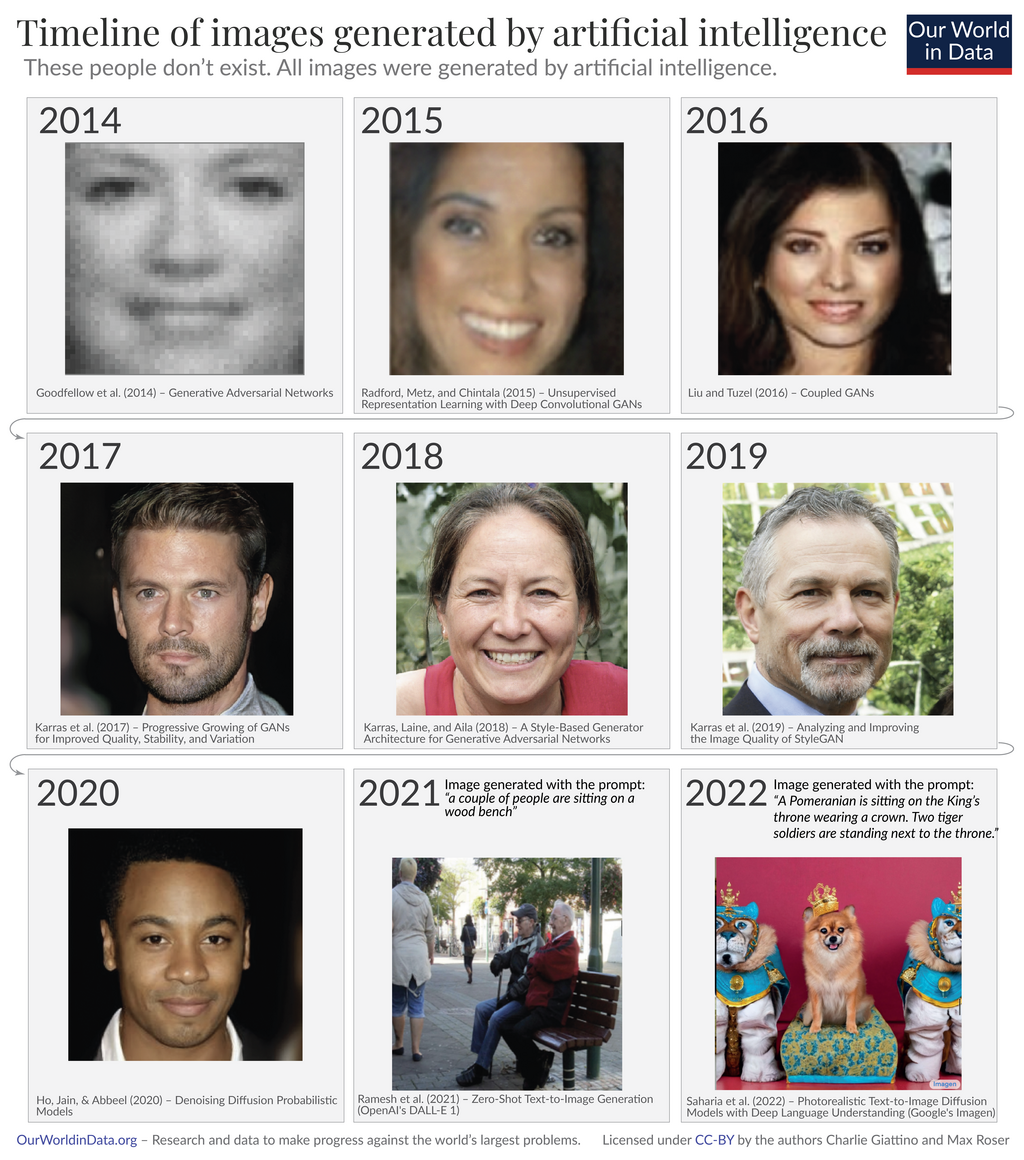
The real turning point came in the 2010s with advancements in machine learning and a massive increase in computing power and data. New techniques allowed AI models to learn from data in more sophisticated ways, leading to a boom in generative capabilities.
Two Key Models
Many types of generative models exist, but two have been particularly influential: Generative Adversarial Networks (GANs) and Variational Autoencoders (VAEs). They approach the task of creation in different ways.
A Generative Adversarial Network (GAN) uses a competitive process to create. Imagine a forger trying to create a fake Picasso and an art expert trying to spot it. The forger (the 'generator') creates an image, and the expert (the 'discriminator') judges its authenticity. This back-and-forth pushes the forger to create increasingly convincing fakes until the expert can no longer tell the difference.
Variational Autoencoders (VAEs) work differently. They learn to compress data into a simplified representation and then reconstruct it back to its original form. Think of it as creating a summary of a book. Once the VAE knows how to write a good summary, it can also create a new, similar story by starting from a slightly modified summary. VAEs are great for generating variations on a theme.
Real-World Applications
Generative AI is no longer just a research topic; it's being used in many industries. Chatbots and virtual assistants use it to have more natural conversations. Artists use it to generate stunning images and designs. Musicians experiment with AI to compose new melodies and harmonies.
| Industry | Application |
|---|---|
| Technology | Writing code, debugging, generating text |
| Entertainment | Creating special effects, music, and art |
| Healthcare | Discovering new drugs, generating reports |
| Marketing | Writing ad copy, personalizing content |
From summarizing complex documents to creating entirely new virtual worlds, generative AI is a powerful tool for creativity and productivity. Its ability to generate novel content is reshaping how we work and create.
Ready to check your understanding?
What is the primary characteristic that distinguishes Generative AI from other types of artificial intelligence?
The provided text uses an analogy of a jazz musician improvising a new solo. What key aspect of Generative AI does this analogy highlight?
As we've seen, generative AI is a dynamic field with a rich history and a wide range of applications. It's a technology that learns from the old to create the new.