GCSE Circle Theorems Explained
Circle Basics
What Makes a Circle?
A circle is a shape made of all the points that are the exact same distance from a central point. Think of it like a perfectly round fence. Every post in the fence is the same distance from a single point in the middle of the yard. That middle point is crucial.
center
noun
The single point inside a circle that is the same distance from all the points on the circle's edge.
This simple rule, that every point on the edge is equidistant from the center, gives circles their unique properties. It's the foundation for everything else we can measure about them.
The Building Blocks
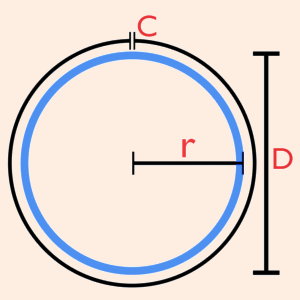
Two of the most important measurements for any circle are its radius and its diameter. They tell you the circle's size.
radius
noun
The distance from the center of a circle to any point on its edge. The plural of radius is radii.
The diameter is closely related to the radius. It's the distance straight across the circle, passing directly through the center.
diameter
noun
A straight line segment that passes through the center of a circle and whose endpoints lie on the circle. It is the longest distance across a circle.
If you look closely, you'll see that the diameter is simply two radii placed end-to-end. This gives us a straightforward relationship between the two.
This means if you know the radius, you can find the diameter by multiplying by two. If you know the diameter, you can find the radius by dividing by two.
Measuring a Circle
Now that we have the radius and diameter, we can measure two other key properties: the distance around the circle and the space it covers.
The distance around the outside of a circle is called the circumference. The space inside the circle is called the area.
To calculate these, we need a special number called pi (pronounced like "pie"). Pi is a constant, which means its value never changes. It's the ratio of any circle's circumference to its diameter. Its value is approximately 3.14159, but it's an irrational number, meaning its decimal representation goes on forever without repeating. For calculations, we represent it with the Greek letter .
The formula for the circumference is:
The formula for the area of a circle involves squaring the radius:
So, for a circle with a radius of 5 cm, its area would be square cm, and its circumference would be cm. These simple formulas, built on the radius and pi, unlock the measurements of any circle you'll encounter.
Let's check your understanding of these foundational concepts.
What is the defining property of a circle?
If a circle has a diameter of 14 cm, what is its radius?