Gastrulation Mechanisms in Model Organisms
Gastrulation Overview
The Great Migration
An early embryo is a bit like a hollow ball of cells, a simple structure called a blastula. While it has potential, it lacks a plan. To become a complex organism, this simple ball must undergo a dramatic transformation. This process of reorganization is called gastrulation.
Gastrulation is the single most important event in your life. It is not birth, marriage, or death, but gastrulation.
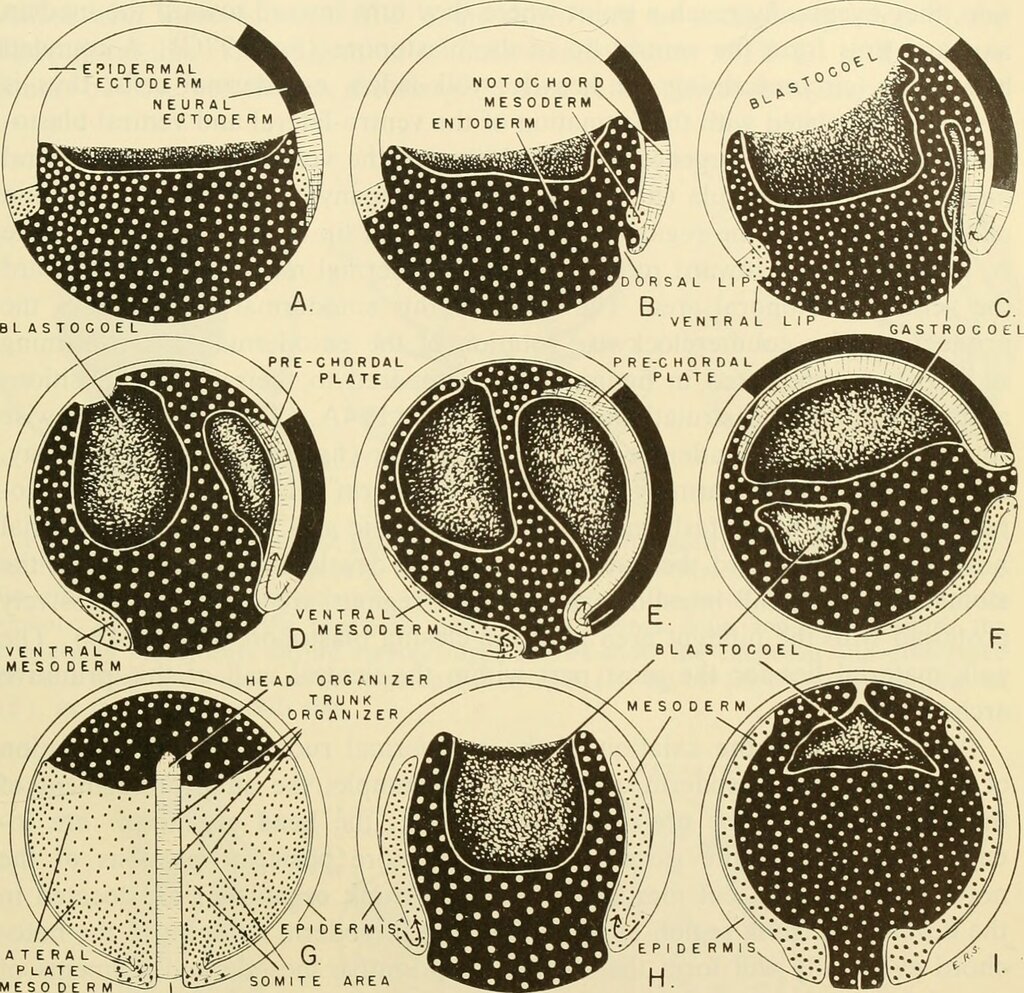
This quote from biologist Lewis Wolpert highlights just how fundamental this stage is. It's where the blueprint of an animal's body is laid down. During gastrulation, cells embark on a massive, coordinated migration. They move from the surface of the embryo to new locations inside, forming three distinct layers. These layers are the foundation for every single tissue and organ in the body.
Gastrulation
noun
A phase early in the embryonic development of most animals, during which the single-layered blastula is reorganized into a multilayered structure known as the gastrula.
The Three Foundational Layers
The outcome of gastrulation is the formation of three primary germ layers. Think of them as the primary materials for building a house. Each layer has a specific destiny, a set of instructions for what it will become.
| Germ Layer | Location | Eventual Tissues |
|---|---|---|
| Ectoderm | Outer | Skin, nervous system, eyes, hair |
| Mesoderm | Middle | Muscle, skeleton, kidneys, blood, heart |
| Endoderm | Inner | Lining of digestive and respiratory tracts, liver, pancreas |
This sorting process is incredibly precise. A cell that becomes part of the ectoderm is set on a path to form your brain or the skin on your arm. A mesoderm cell might become part of your heart muscle, while an endoderm cell could end up lining your stomach. All this complexity arises from the simple act of cells moving to the right place.
How Cells Move
These cellular migrations aren't random. They are highly choreographed movements, like a complex dance. Biologists have identified several key types of movement that cells use to get into position.
One key movement is epiboly, where a sheet of cells spreads out, like pulling a beanie over your head. This is often how the ectoderm covers the entire embryo.
Another is involution, where a sheet of cells turns inward and folds back on itself, creating a new interior layer. Imagine tucking the cuff of a sleeve inside itself.
Finally, convergent extension is a process where cells rearrange themselves to narrow and lengthen a tissue. It’s like a crowd of people in a wide hallway shuffling past each other to form a single-file line, making the line longer and narrower. This helps form structures like the notochord, a precursor to the spine.
The Molecular GPS
How do cells know where to go? They follow molecular signposts. The embryo is flooded with chemical signals that create gradients, like a treasure map where 'X' marks the spot. Cells can sense these signals and move toward or away from them.
Several major signaling pathways act as the master coordinators. The Wnt, BMP, and Nodal pathways are three of the most important. They work together to tell cells which germ layer to become and where to move. For instance, high levels of Nodal signaling might instruct cells to become endoderm, while different levels of BMP signaling help pattern the ectoderm and mesoderm.
These signals establish the basic body axes—head to tail (anterior-posterior) and back to belly (dorsal-ventral). Gastrulation isn't just about making layers; it's about setting up the entire coordinate system for the future animal.
Let's check your understanding of these foundational concepts.
What is the primary and most immediate outcome of the gastrulation process in an embryo?
Which type of cellular movement involves a sheet of cells turning inward and folding back on itself, much like tucking in the cuff of a sleeve?
Through this incredible journey of cellular migration and signaling, a simple ball of cells transforms into a structured embryo with a clear plan, ready to build the tissues and organs that make up a complete organism.