GARP SCR Exam Mastery Zero to Hero
Climate Science Basics
The Greenhouse Effect and Radiative Forcing
The Earth's climate is regulated by a delicate energy balance. Energy from the sun, known as solar radiation, warms the planet. The Earth, in turn, radiates heat back into space as infrared radiation. Certain gases in the atmosphere, called greenhouse gases (GHGs), trap some of this outgoing heat, acting like a blanket and keeping the planet's surface warmer than it would otherwise be. This is the natural greenhouse effect.
Key GHGs include carbon dioxide (), methane (), and nitrous oxide (). While they occur naturally, human activities since the Industrial Revolution have drastically increased their concentrations. This enhancement of the natural greenhouse effect leads to what is known as radiative forcing: a change in the Earth’s energy balance. Positive radiative forcing means the Earth receives more incoming energy than it radiates back to space, causing warming.
Carbon Cycles and Warming Trends
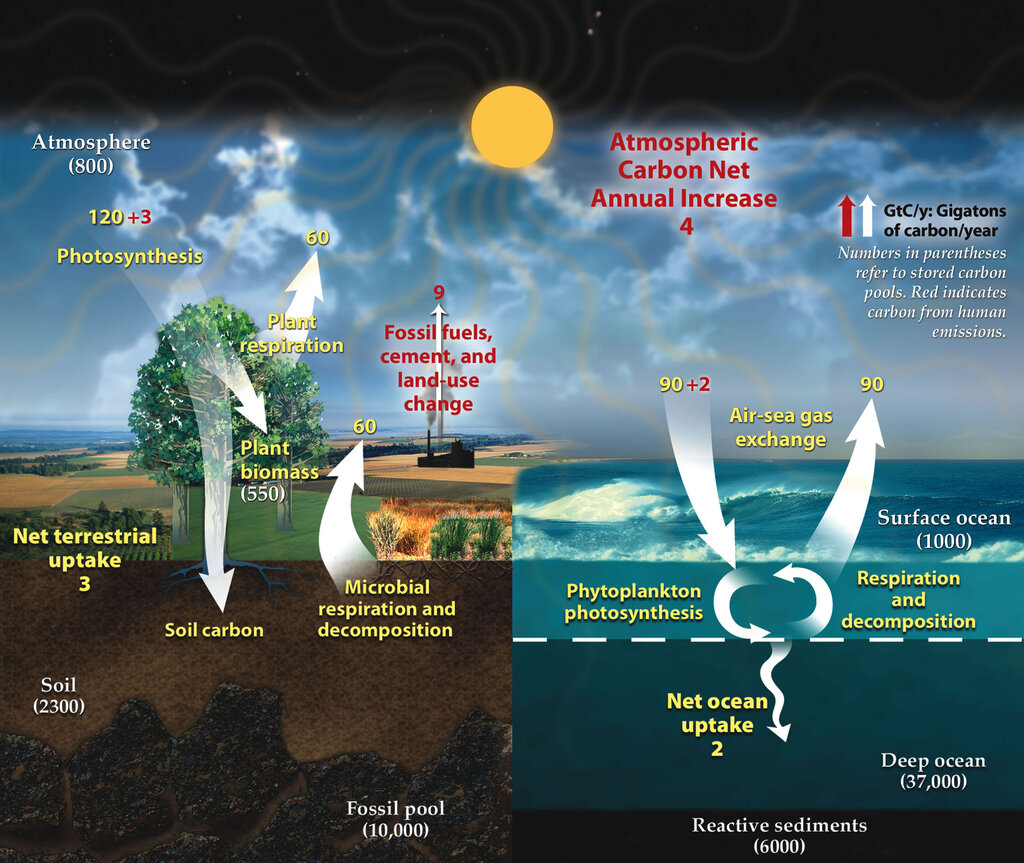
Carbon is constantly moving between the atmosphere, oceans, land, and living organisms in a process called the carbon cycle. For millennia, this cycle kept atmospheric levels relatively stable. However, the burning of fossil fuels and changes in land use have released vast amounts of stored carbon into the atmosphere, disrupting this balance far faster than natural processes can absorb it.
Scientific evidence for this comes from various sources, including ice cores that trap ancient air bubbles, providing a direct record of past atmospheric composition. This data shows a clear correlation between the rise in GHG concentrations and the increase in global average temperatures, a trend that has accelerated sharply in recent decades.
The leading international body for assessing this science is the Intergovernmental Panel on Climate Change (IPCC). Its comprehensive assessment reports, with the latest being the Sixth Assessment Report (AR6), synthesize the work of thousands of scientists to provide a robust consensus on the state of the climate.
The IPCC's AR6 concluded it is "unequivocal that human influence has warmed the atmosphere, ocean and land."
Feedback Loops and Tipping Points
The climate system is complex and contains many interconnected processes, including feedback loops. These are cycles where an initial change leads to a further change that either amplifies the original effect (a positive feedback) or dampens it (a negative feedback). A critical positive feedback loop is the ice-albedo effect. As global temperatures rise, sea ice in the Arctic melts. Ice is highly reflective (high albedo), bouncing sunlight back into space. The darker ocean water that replaces it absorbs more sunlight, which in turn causes more warming and more ice melt.
This raises concerns about tipping points, which are critical thresholds in the Earth's system. Once a tipping point is crossed, a small change can trigger a large, often irreversible response. Potential tipping points include the collapse of the Greenland ice sheet, the dieback of the Amazon rainforest, or the disruption of major ocean circulation patterns like the Atlantic Meridional Overturning Circulation (AMOC).
Projecting the Future
To understand potential future climates, scientists use a set of scenarios developed for the IPCC. These scenarios are not predictions, but plausible futures based on different assumptions about human development and GHG emissions. They combine two key frameworks.
Representative Concentration Pathways (RCPs) describe different levels of greenhouse gases and other climate drivers in the atmosphere by the year 2100. Each RCP corresponds to a specific amount of radiative forcing. For example, RCP8.5 represents a high-emissions future with significant warming, while RCP2.6 represents a stringent mitigation pathway.
Shared Socioeconomic Pathways (SSPs) describe how society might evolve over the rest of the century. They consider factors like population growth, economic development, technological change, and policies. There are five SSPs, ranging from a sustainable, cooperative world (SSP1) to a world of resurgent nationalism and high inequality (SSP3).
By combining an SSP with an RCP, researchers can model the physical impacts of a specific socioeconomic trajectory and its resulting emissions. For example, the scenario 'SSP1-2.6' represents a world that takes a sustainable path to achieve the climate outcome of RCP2.6, limiting warming to around 1.5°C.
| Pathway | Radiative Forcing (2100) | Best Estimate Temp. Rise (vs 1850-1900) |
|---|---|---|
| RCP2.6 | ~2.6 | ~1.6°C |
| RCP4.5 | ~4.5 | ~2.4°C |
| RCP6.0 | ~6.0 | ~2.8°C |
| RCP8.5 | ~8.5 | ~4.4°C |
Ready to test your knowledge?
What is the primary role of greenhouse gases in the Earth's natural climate system?
The melting of Arctic sea ice exposes darker ocean water. This darker water absorbs more solar energy, which in turn causes more warming and more ice melt. This entire process is an example of a:
Understanding these scientific foundations is the first step. It provides the necessary context for evaluating the financial risks and opportunities that arise from a changing climate.