Game Theory Fundamentals
Introduction to Game Theory
What is Game Theory?
Life is full of decisions. Many are simple, like choosing what to have for breakfast. But some are more complex because the best choice depends on what someone else does. Think about two coffee shops on the same street. If one lowers its prices, it might attract more customers. But this move will almost certainly cause the other shop to react, maybe by lowering its prices too. Suddenly, both shops are in a situation where their profits depend not just on their own decisions, but on their competitor's as well.
Game theory is the study of strategic decision-making in situations where the outcome depends on the choices of multiple players.
This isn't just about chess or board games, though they are great examples. Game theory is a way of thinking about strategic interactions in economics, politics, biology, and everyday life. It gives us a framework to analyze situations where people's fates are intertwined.
The Building Blocks
Every situation analyzed with game theory, whether it's a corporate merger or a simple negotiation, can be broken down into three core components:
Players: The decision-makers in the game. These can be individuals, companies, or even countries.
Strategies: The complete plan of action a player will take. It's the set of possible moves a player can make.
Payoffs: The outcome or consequence for each player for every possible combination of strategies. This is often represented as a number, like profit, but it can be any measure of success or failure.
Let's return to our two competing coffee shops, The Daily Grind and Bean Around Town. They are the players. Each has to decide on a pricing strategy: either 'Lower Price' or 'Maintain Price'.
The payoffs are the daily profits they'll make, which depend on the combination of strategies they both choose. We can map this out in a payoff matrix.
| Bean Around Town: Lower Price | Bean Around Town: Maintain Price | |
|---|---|---|
| The Daily Grind: Lower Price | Grind: $500, Bean: $500 | Grind: $1200, Bean: $200 |
| The Daily Grind: Maintain Price | Grind: $200, Bean: $1200 | Grind: $1000, Bean: $1000 |
Each box shows the outcome. For example, if The Daily Grind lowers its price but Bean Around Town maintains its price, The Daily Grind makes $1200 and Bean Around Town makes only $200. If they both maintain their prices, they each make $1000. By laying out the options this way, we can start to analyze the strategic situation.
Different Kinds of Games
Not all strategic situations are the same. Game theorists classify them into different types to better understand their dynamics. Two of the most basic distinctions are zero-sum versus non-zero-sum, and cooperative versus non-cooperative.
Zero-Sum Game
noun
A situation where one player's gain is exactly equal to the other players' losses. The total gains and losses for all players sum to zero.
In a zero-sum game, the pie is fixed. If I get a bigger slice, you must get a smaller one. Chess is a zero-sum game: there can be one winner and one loser, or a draw (where the payoffs are zero for both).
Most real-life interactions, however, are non-zero-sum. In these games, the size of the pie can change. It's possible for all players to win, or for all players to lose. Our coffee shop example is non-zero-sum. If both shops start a price war and lower prices, they both end up with a lower profit of $500, a worse outcome for both than if they had both maintained their prices. But it's also possible for them to coordinate on an outcome that's good for both.
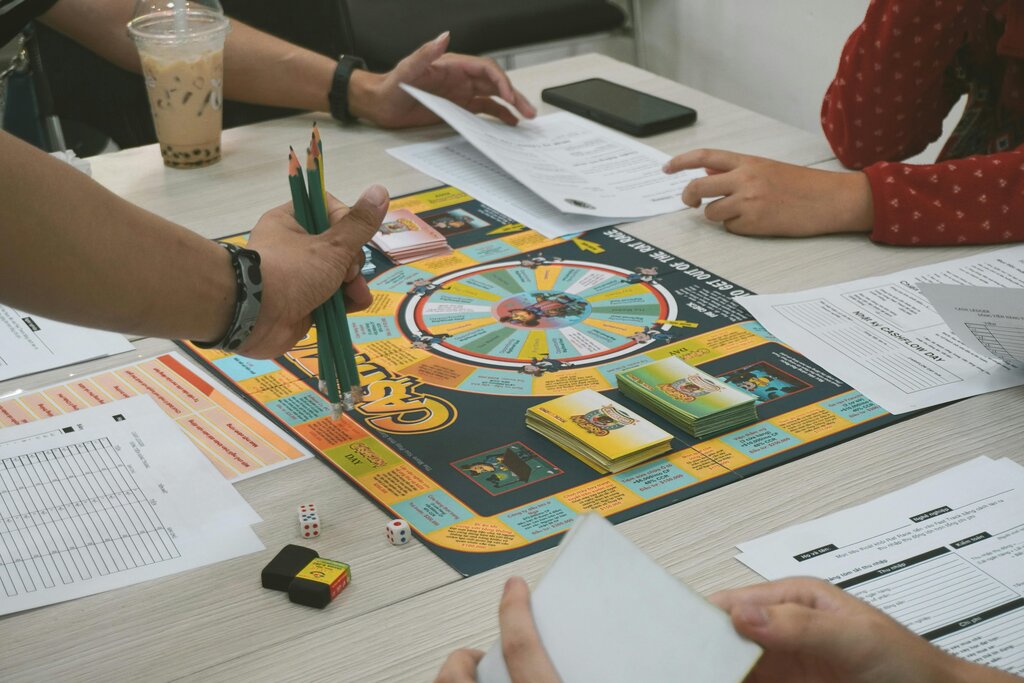
The other key distinction is whether players can work together.
A cooperative game is one where players can form binding agreements and plan their strategies together. Think of business partners negotiating the terms of a joint venture. They can sign a contract that legally binds them to their agreed-upon actions.
In a non-cooperative game, players cannot form these binding agreements. They must make their decisions independently, even if they can communicate. The coffee shop scenario is a non-cooperative game. The owners might talk, but there's nothing stopping one of them from promising to maintain prices and then secretly lowering them to gain an advantage.
Most of game theory focuses on non-cooperative games, as they model situations where trust is limited and individuals act in their own self-interest.
Understanding these basic building blocks—players, strategies, payoffs, and the type of game—is the first step into the world of strategic thinking. It provides a powerful language for describing and analyzing the complex web of interactions that shape our world.