Game Theory for Strategic Business Advantage
Iterated Prisoner's Dilemma
Beyond a Single Move
The classic Prisoner's Dilemma presents a bleak scenario. When two players interact only once, the most logical choice is to betray the other, even though this leads to a worse outcome for both. But what happens if they know they'll face each other again? And again? This is the Iterated Prisoner's Dilemma (IPD).
The game changes completely when you add the element of time. Suddenly, your actions have consequences that ripple into the future. A betrayal today might lead to retaliation tomorrow. Cooperation, on the other hand, could be rewarded with future cooperation. This "shadow of the future" is a powerful motivator, turning a simple game of betrayal into a complex dance of trust, retaliation, and forgiveness.
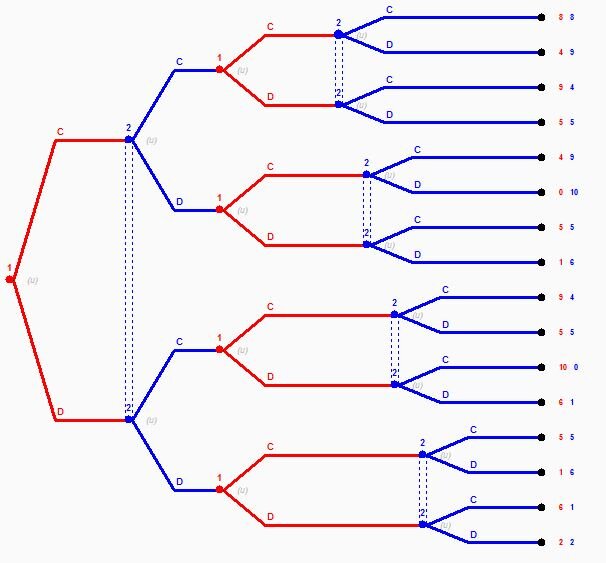
Keohane suggests that whether or not defection is the dominant strategy within a Prisoner’s Dilemma depends on the number of times the game is played.
In the IPD, the goal isn't just to win a single round but to maximize your payoff over the entire series of interactions. A long-term strategy becomes essential. This is where the potential for cooperation emerges, not from altruism, but from enlightened self-interest.
The Tit-for-Tat Strategy
Over the years, researchers have tested countless strategies for the IPD. One of the simplest, yet most effective, is called Tit-for-Tat. It's built on a clear and straightforward set of rules.
Tit-for-Tat
noun
A strategy in which a player's first move is to cooperate, and every subsequent move mimics the opponent's previous move.
Let's break down how Tit-for-Tat behaves:
- It's nice: It starts by cooperating, signaling a willingness to work together from the very beginning.
- It's retaliatory: If the other player defects, Tit-for-Tat immediately defects on the next round, punishing the betrayal.
- It's forgiving: If a defecting player returns to cooperation, Tit-for-Tat immediately forgives and cooperates on the next move. It doesn't hold a grudge.
- It's clear: The rules are so simple that the other player can quickly figure out the strategy, making the consequences of their actions predictable.
Imagine two businesses, Firm A (using Tit-for-Tat) and Firm B, setting prices. Cooperation means keeping prices stable, while defection means undercutting the other. Let's see how a few rounds might play out. The payoffs are (Firm A, Firm B).
| Round | Firm A's Move | Firm B's Move | Payoff | Reasoning |
|---|---|---|---|---|
| 1 | Cooperate | Cooperate | (3, 3) | Firm A is 'nice' and starts with cooperation. Firm B responds in kind. |
| 2 | Cooperate | Defect | (-1, 5) | Firm A mimics B's previous move (cooperate). B gets greedy and defects. |
| 3 | Defect | Cooperate | (5, -1) | Firm A retaliates for B's defection. B, wanting to restore cooperation, goes back. |
| 4 | Cooperate | Cooperate | (3, 3) | Firm A 'forgives' B's past defection because B just cooperated. Stability is restored. |
As you can see, the strategy punishes betrayal but quickly rewards a return to good faith, steering the interaction back toward a mutually beneficial outcome.
Building Trust in Business
The principles of the IPD are not just theoretical; they are the foundation of long-term business relationships, especially in emerging markets where formal contracts can be weak or difficult to enforce. Trust is the primary currency.
A new supplier relationship often starts with a small, cooperative move, like a pilot project or a small order. This is the equivalent of the first 'cooperate' move in Tit-for-Tat. If the supplier delivers on time and on quality (cooperates), the buyer places a larger order (cooperates back). If the supplier fails (defects), the buyer might reduce the next order or switch suppliers (retaliates).
This cycle of reciprocal actions builds a reputation. Consistent cooperation leads to a strong, trusting partnership where both sides benefit. A single act of opportunism can destroy that trust and lead to a cycle of mutual defection, hurting both businesses in the long run. The logic of the IPD shows that in a long-term relationship, cooperation isn't just nice, it's profitable.
In markets with weak legal systems, a company's reputation for being a reliable partner is its most valuable asset. This reputation is built one transaction, or one 'move,' at a time.
Now, let's test your understanding of these repeated interactions.
What is the primary factor that introduces the potential for cooperation in the Iterated Prisoner's Dilemma (IPD) compared to the classic, single-round version?
A player using the Tit-for-Tat strategy has just been defected against. According to the strategy's rules, what will their very next move be?
Understanding the dynamics of repeated games helps explain how cooperation can emerge and stabilize, even among self-interested parties. It's a powerful lens for viewing everything from business partnerships to international relations.