Game Theory and Design Fundamentals
Introduction to Game Theory
What is Game Theory?
Imagine two coffee shops on the same street. If one shop lowers its prices, the other might lose customers. The second shop could respond by also lowering prices, starting a price war. Or maybe it could introduce a new specialty drink to attract a different crowd. Each owner's decision depends on what they think the other will do. This is a strategic situation.
Game theory is the study of these situations. It’s a way to mathematically analyze how people, companies, or even countries make decisions when their outcomes depend on the choices of others.
Game Theory – the study of behavior in situations of interdependence.
The key word is interdependence. Your best move often depends on my best move, and my best move depends on yours. Game theory provides a framework to think through these complex interactions, whether in economics, politics, or everyday life.
The Building Blocks
To analyze a strategic situation, we first need to break it down into its core components. Every 'game' has three basic elements:
1. Players: These are the decision-makers in the game. In our example, the two coffee shop owners are the players. A game must have at least two players.
2. Strategies: These are the possible actions each player can take. For a coffee shop, strategies might include 'Lower Prices' or 'Keep Prices Same'.
3. Payoffs: This is the outcome each player receives for a given set of strategy choices. Payoffs can be measured in profit, market share, or even just personal satisfaction.
Payoff
noun
The outcome or consequence of a particular set of choices made by the players in a game.
We can organize these components into a payoff matrix. Let's return to our coffee shops, 'Bean Scene' and 'Daily Grind'. Let's say they each have two strategies: 'Lower Prices' or 'Hold Prices'. The matrix shows the daily profit (the payoff) for each shop based on the combination of their choices. Bean Scene's profit is listed first.
| Daily Grind: Hold | Daily Grind: Lower | |
|---|---|---|
| Bean Scene: Hold | ($1000, $1000) | ($700, $1200) |
| Bean Scene: Lower | ($1200, $700) | ($800, $800) |
If both hold their prices, they each make $1000. If Bean Scene lowers its prices while Daily Grind holds, Bean Scene captures more customers and makes $1200, while Daily Grind's profit drops to $700. If both lower prices, the extra customers are split and increased costs lead to both making only $800.
Types of Games
Games come in different varieties, and classifying them helps us understand the nature of the strategic interaction.
First, we can distinguish between cooperative and non-cooperative games. In cooperative games, players can form alliances and make binding agreements. Think of business partners negotiating a contract. In non-cooperative games, players act in their own self-interest, and any cooperation must be self-enforcing. Our coffee shop rivalry is a non-cooperative game.
Another key distinction is between zero-sum and non-zero-sum games.
In a zero-sum game, one player's gain is exactly equal to another player's loss. The total gains and losses add up to zero. Poker is a classic example; the money one person wins is the money other players have lost.
Most real-world situations, however, are non-zero-sum. In these games, the sum of the payoffs is not constant. It's possible for all players to win (a win-win situation) or for all players to lose (a lose-lose situation). The coffee shop price war, where both end up with lower profits, is a lose-lose outcome in a non-zero-sum game.
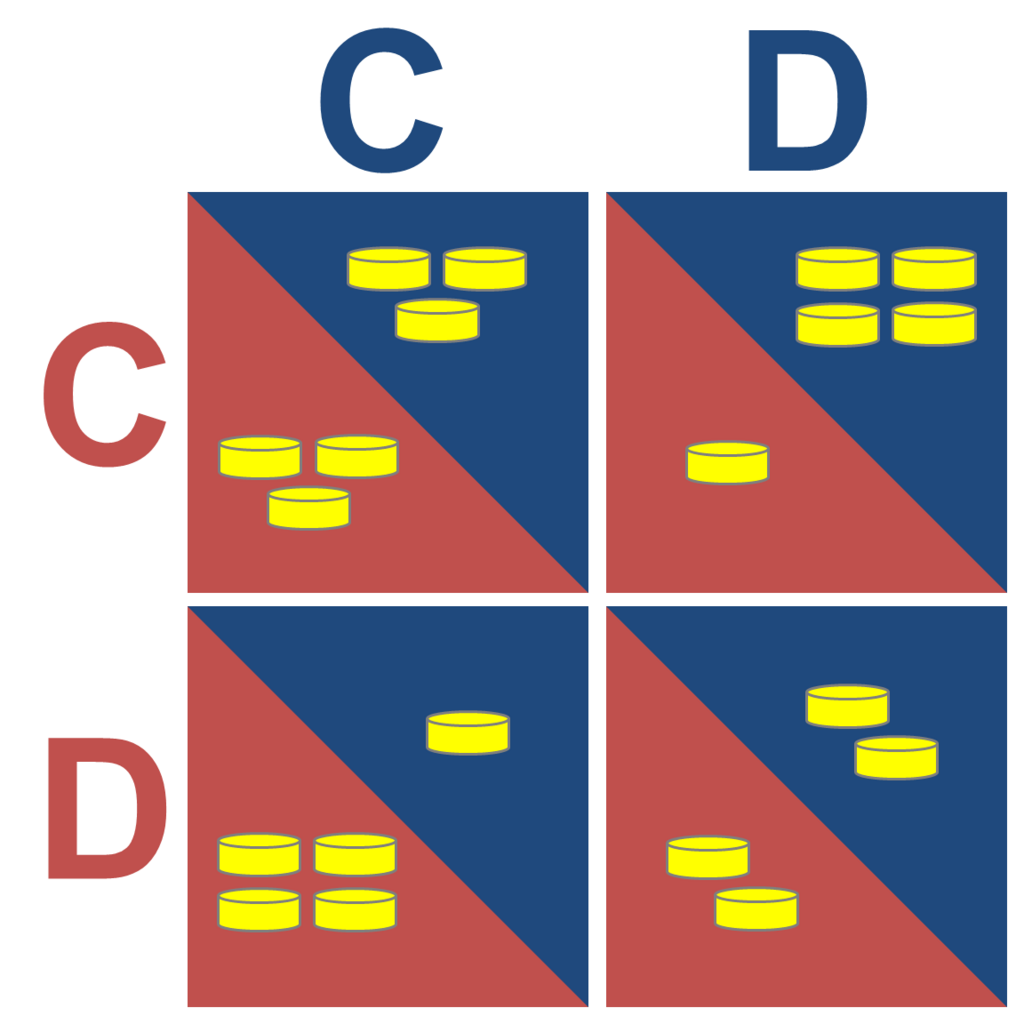
The famous Prisoner's Dilemma illustrates this perfectly. Two partners in crime are arrested and interrogated separately. Each has the choice to stay silent (cooperate with their partner) or betray them (defect). If both stay silent, they each get a short sentence. If one betrays and the other stays silent, the betrayer goes free and the silent one gets a long sentence. If both betray each other, they both get a medium sentence. The players can't communicate, so it's a non-cooperative game.
Finding the Balance
In a game, we often want to predict the outcome. What will the players do? A key concept for this is the Nash Equilibrium, named after mathematician John Nash.
A Nash equilibrium is a set of strategies, one for each player, where no player can get a better payoff by unilaterally changing their own strategy, assuming the other players' strategies remain unchanged.
Let's look at the Prisoner's Dilemma again. No matter what the other prisoner does, each prisoner is individually better off betraying. If Prisoner B stays silent, Prisoner A gets a better deal by betraying (going free vs. a short sentence). If Prisoner B betrays, Prisoner A is still better off betraying (a medium sentence vs. a long one). The same logic applies to Prisoner B.
So, both prisoners betraying is the Nash Equilibrium. Neither can improve their situation by changing their mind alone. This is true even though they would both be better off if they had both stayed silent.
This powerful concept helps explain why rivals in business might engage in costly advertising wars, or why countries might end up in arms races, even when cooperation would lead to a better outcome for everyone.
Now, let's test your understanding of these foundational concepts.
What is the central characteristic of a 'strategic situation' as defined by game theory?
In the coffee shop rivalry, the decision to 'Lower Prices' or 'Hold Prices' represents which core component of a game?
Game theory provides a powerful lens for viewing the world, showing how strategic interdependence shapes the decisions we see all around us, from the checkout line to the international stage.