Future of Defense Swarm Drones Strategy
Introduction to Swarm Drones
What is a Drone Swarm?
Think of a flock of birds turning in unison or a school of fish moving as one. No single leader tells them what to do. Instead, each member follows simple rules, and from these interactions, coordinated group behavior emerges. A drone swarm operates on the same principle, but with robots.
drone swarm
noun
A group of unmanned aerial vehicles (UAVs) that work together to accomplish a shared objective, communicating and coordinating their actions without direct human control for every decision.
Unlike a collection of individually piloted drones, a swarm is a single, intelligent system. Hundreds or even thousands of drones can act as a cohesive unit. This collective power comes from a few key characteristics.

First is decentralized control. There's no central pilot or single point of failure. Each drone makes decisions based on its own observations and communication with its neighbors. This makes the swarm incredibly resilient. If one drone fails, the others adapt and continue the mission.
Second is autonomy. While a human operator might set the overall goal, the swarm figures out the best way to achieve it. The drones can react to their environment, avoid obstacles, and adjust their formation on their own.
Finally, swarms are scalable. The same basic software can control a dozen drones or a thousand. Adding more drones increases the swarm's capability without requiring a complete system redesign.
Coordinating the Chaos
How do individual drones create such sophisticated group behavior? It all comes down to a few simple rules and constant communication.
Imagine three basic instructions programmed into each drone:
- Separation: Don't get too close to your neighbors.
- Alignment: Try to match the average heading of your neighbors.
- Cohesion: Steer toward the average position of your neighbors.
These rules, inspired by studies of bird flocks, are enough to create organized, fluid movement. The drones don't need to know the entire plan; they just need to pay attention to the drones immediately around them.
Communication is the glue that holds the swarm together. Drones constantly share data with each other: their position, speed, and sensor readings. This creates a shared awareness of the environment. Using this network, the swarm can do things no single drone could, like triangulating the source of a signal or creating a 3D map of an area from multiple perspectives at once.
A Brief History
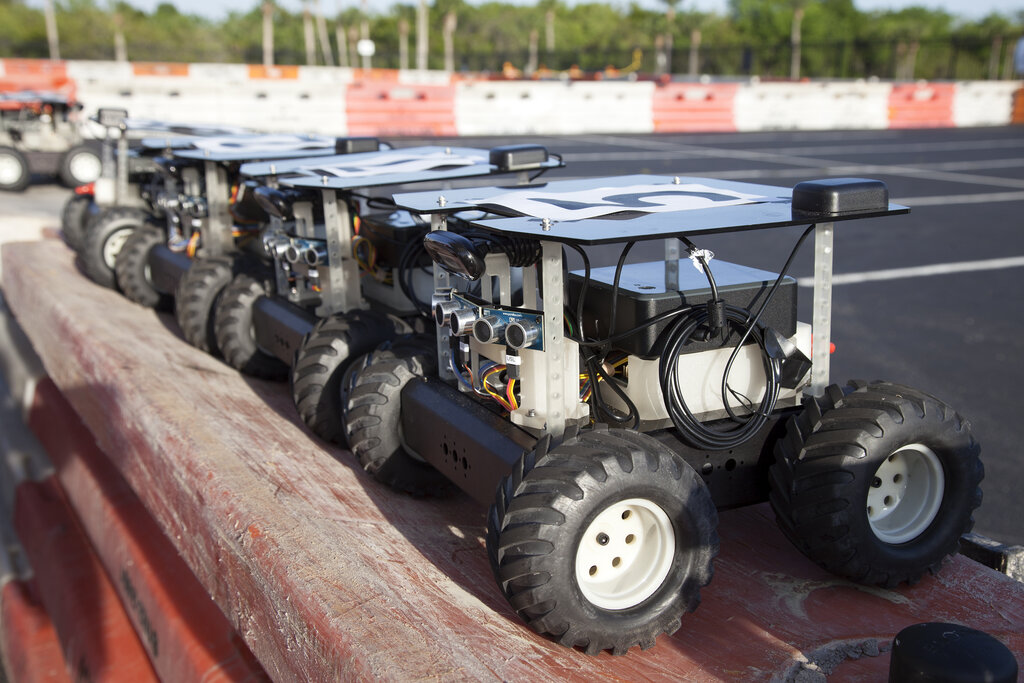
The idea of swarming robots isn't new. It dates back to the 1980s, when computer scientists first began creating simulations of artificial life. They were fascinated by how complex, organized behavior could arise from simple, local interactions in nature. By the 1990s, researchers were building small, simple ground robots that could mimic the foraging behavior of ants.
The real breakthrough for drone swarms came with the miniaturization of electronics. As GPS, processors, and sensors became smaller, cheaper, and more powerful, it became possible to build small, affordable drones. In 2011, the University of Pennsylvania's GRASP Lab demonstrated some of the first quadcopter swarms capable of flying in complex formations.
Since then, progress has accelerated rapidly. Military research agencies like DARPA in the United States began investing heavily in swarm technology, seeing its potential for overwhelming enemy air defenses. In 2017, the U.S. military successfully demonstrated a swarm of 103 Perdix micro-drones launched from a fighter jet. This marked a major milestone, proving that large-scale, autonomous drone swarms were no longer just a laboratory experiment but a viable real-world technology.
From academic labs to military exercises, drone swarms have evolved from a theoretical concept into a powerful new capability in just a few decades.
Now that we understand what a drone swarm is and how it functions, we can begin to explore its specific applications in modern defense.