Fusion Energy Fundamentals
Introduction to Nuclear Fusion
The Sun's Secret Recipe
Every second, the sun converts about 600 million tons of hydrogen into helium. This process, called nuclear fusion, is what makes stars shine. It’s the ultimate source of nearly all energy on Earth. But what exactly is it?
Nuclear fusion is the process of combining two light atomic nuclei to form a heavier nucleus, releasing a tremendous amount of energy in the process.
Imagine trying to push the north poles of two strong magnets together. They resist, pushing each other apart. Atomic nuclei do the same thing. Because they are all positively charged, they naturally repel one another with a powerful electrostatic force. Getting them to fuse requires overcoming this fundamental resistance.
Creating a Star on Earth
To force nuclei together, you need incredible heat and pressure, conditions similar to the core of a star. We're talking temperatures over 100 million degrees Celsius, hotter than the center of the sun. At these temperatures, matter doesn't exist as a solid, liquid, or gas. It becomes a plasma, a superheated soup of free-floating electrons and atomic nuclei.
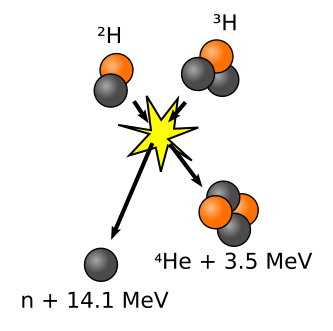
Once the nuclei are hot enough and squeezed together tightly enough, another force takes over: the strong nuclear force. It’s incredibly powerful but only works over very short distances. When the nuclei get close enough for the strong force to engage, it pulls them together, fusing them into a single, heavier nucleus. The new nucleus, however, has slightly less mass than the two original nuclei combined. This tiny bit of lost mass isn't actually lost. It's converted into a massive amount of energy, as described by Albert Einstein's famous equation.
Here, is energy, is the lost mass, and is the speed of light. Because the speed of light is such a huge number (and it's squared!), even a minuscule amount of mass can release an enormous amount of energy.
Fission vs. Fusion
Fusion is often confused with nuclear fission, but they are opposites. Fission splits a large, unstable nucleus (like uranium) into two smaller ones. This is the process used in today's nuclear power plants. Fusion, on the other hand, joins two small nuclei together.
| Feature | Nuclear Fission | Nuclear Fusion |
|---|---|---|
| Process | Splits a heavy nucleus | Fuses two light nuclei |
| Fuel | Uranium, Plutonium | Hydrogen isotopes |
| Byproducts | Long-lived radioactive waste | Primarily helium, neutrons |
| Conditions | Chain reaction | Extreme heat and pressure |
The distinction in their byproducts is a key reason scientists are pursuing fusion.
A Cleaner Energy Future
Harnessing fusion on Earth could revolutionize how we power our world. The fuel for the most common fusion reactions, isotopes of hydrogen called deuterium and tritium, is abundant. Deuterium can be extracted from seawater, and tritium can be produced from lithium, which is also plentiful.
Fusion power plants would not produce greenhouse gases. They also wouldn't generate the long-lasting radioactive waste that fission plants do. The main byproduct of the deuterium-tritium reaction is helium, an inert and harmless gas. While the reactor materials would become radioactive, this radioactivity would decay much faster than the waste from fission.
Fusion offers the prospect of a nearly limitless, safe, and clean source of energy to meet global demand.
While the scientific and engineering challenges are immense, the potential payoff is a game-changer for humanity's energy needs and the health of our planet.
Let's check your understanding of these core concepts.
What fundamental force must be overcome for two atomic nuclei to get close enough to fuse?
The process of nuclear fusion, which powers the sun, is the opposite of nuclear fission, which is used in today's nuclear power plants.
Understanding fusion brings us one step closer to appreciating the powerful forces that shape our universe, from the stars above to the potential energy sources of the future.