Fusion Energy Explained
Introduction to Fusion Energy
The Sun's Secret Recipe
Every second, the sun converts about 600 million tons of hydrogen into helium, releasing an enormous amount of energy in the process. This is nuclear fusion. At its core, fusion is about combining light elements to create heavier ones. It's the same process that powers every star in the sky.
Fusion is the energy-generating mechanism that makes the stars shine.
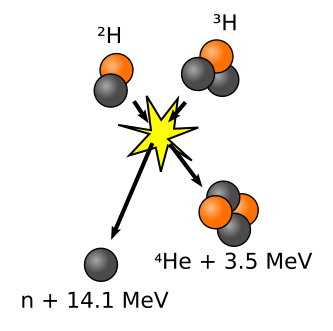
On Earth, scientists are focused on fusing two specific isotopes, or versions, of hydrogen: deuterium (D) and tritium (T). Deuterium can be found in ordinary seawater, while tritium can be produced from lithium, an abundant light metal. When these two isotopes are forced together under extreme conditions, they merge to form a helium nucleus and release a high-energy neutron. Most importantly, this reaction unleashes a massive amount of energy.
Recreating a Star
Fusing atomic nuclei is not easy. Because all nuclei are positively charged, they naturally repel each other, much like trying to push the north poles of two strong magnets together. To overcome this repulsion, the fuel must be heated to extraordinary temperatures, over 100 million degrees Celsius, which is many times hotter than the core of the sun. At these temperatures, the fuel turns into a plasma, a superheated state of matter where electrons are stripped from their atoms.
Plasma
noun
A state of matter, often called the fourth state, where a gas is heated to such a high temperature that its atoms lose their electrons, creating a mixture of charged particles (ions and electrons).
Besides extreme heat, we also need to keep this plasma dense enough and contained for a long enough period for fusion reactions to occur. This challenge, known as confinement, involves using powerful magnetic fields or intense lasers to hold the plasma in place without it touching and melting the walls of the reactor.
To achieve fusion, you need three things: extreme temperature, sufficient density, and a long enough confinement time.
Fusion vs. Fission
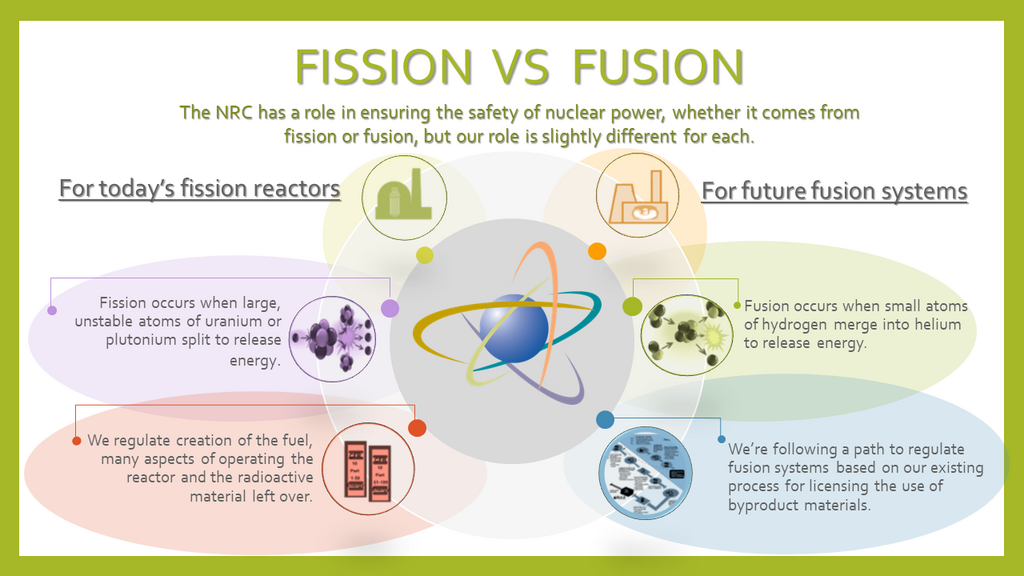
Fusion is often confused with nuclear fission, the process used in today's nuclear power plants. They are, in fact, opposites. Fusion joins light atomic nuclei together, while fission splits heavy, unstable nuclei apart. Think of fusion as building something new and fission as breaking something apart. Both processes release energy, but they do so in fundamentally different ways, with different fuels and byproducts.
| Feature | Nuclear Fusion | Nuclear Fission |
|---|---|---|
| Process | Joins light nuclei (e.g., hydrogen) | Splits heavy nuclei (e.g., uranium) |
| Fuel Source | Deuterium (from water), Lithium | Uranium, Plutonium (mined) |
| Byproducts | Mainly helium, neutrons | Long-lived radioactive waste |
| Safety | Reaction stops if conditions fail | Potential for chain reactions |
The Promise of Fusion
So why pursue such a difficult goal? The potential payoff is enormous. Fusion power promises a clean, safe, and virtually limitless energy source for the future.
The fuel is abundant. The deuterium in one gallon of seawater, fused with tritium, could produce as much energy as 300 gallons of gasoline. The lithium needed to create tritium is also plentiful in the Earth's crust.
Fusion is also inherently safer than fission. There's no possibility of a meltdown or a runaway chain reaction. The fusion process is incredibly difficult to start and maintain; if any part of the system fails, the plasma cools down and the reaction simply stops. Finally, fusion doesn't produce greenhouse gases or long-lived radioactive waste. The primary byproduct is helium, which is harmless. While the reactor materials can become activated by neutrons, this radioactivity is shorter-lived and less hazardous than the waste from fission plants.
Hitting this milestone is a critical step in addressing the steeply increasing global energy demand, as fusion energy has the potential to provide an abundant, carbon-free source of power.
For decades, fusion has been a grand scientific challenge. But recent breakthroughs and increased investment have brought us closer than ever to achieving net energy gain, where a fusion reaction produces more energy than it consumes. Projects like ITER in France and numerous private ventures are pushing the boundaries of science and engineering, paving the way for a future powered by the same energy that lights up the stars.
Ready to test your knowledge? Let's see what you've learned about the basics of fusion energy.
What is the fundamental process of nuclear fusion?
What are the two hydrogen isotopes primarily used as fuel in Earth-based fusion research?
By harnessing the power of fusion, we are not just developing a new energy source; we are learning to replicate the fundamental process that drives the universe.