Fundamentals of Molecular Biology
DNA Structure
The Twisted Ladder
At the core of nearly every living cell is a molecule that holds the instructions for building and operating an organism. This molecule is deoxyribonucleic acid, or DNA. Its structure is famously a double helix, which looks like a long, twisted ladder.
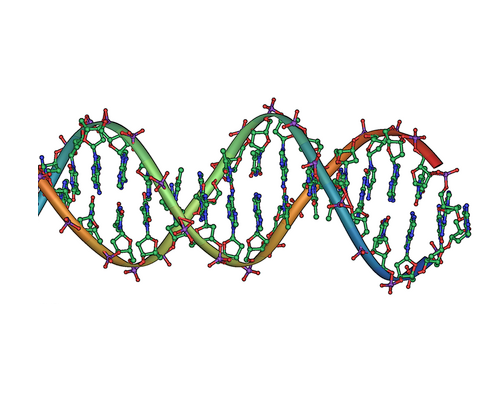
The two long, spiraling sides are called the backbones, and the rungs connecting them are made of smaller molecules. This elegant shape is not just for show; it's a highly efficient and stable way to store a vast amount of information.
DNA is breathtakingly simple in structure and yet capable of directing the way we grow, reproduce and survive; hence it is often referred to as the genetic blueprint — the plan — of human life.
The specific sequence of the rungs in the ladder forms a code that directs everything from your eye color to how your body fights off a cold. Let's break down this ladder to see what it's made of.
The Building Blocks
Each side of the DNA ladder is a chain of repeating units. These units, the fundamental building blocks of DNA, are called nucleotides.
nucleotide
noun
The basic structural unit of nucleic acids such as DNA, consisting of a sugar, a phosphate group, and a nitrogenous base.
Every nucleotide has three parts:
- A phosphate group.
- A sugar molecule called deoxyribose.
- A nitrogenous base.
The phosphate and sugar molecules link together to form the long, sturdy backbone of the DNA strand. The nitrogenous base faces inward, ready to connect to a base on the opposite strand.
There are four different types of nitrogenous bases in DNA: Adenine (A), Guanine (G), Cytosine (C), and Thymine (T). The order of these four bases along the sugar-phosphate backbone is what stores genetic information.
The Base Pairing Rule
The rungs of the DNA ladder are formed by pairs of these bases. However, they don't pair up randomly. There is a strict rule they must follow, discovered by biochemist Erwin Chargaff. It's known as the base pairing rule, and it's remarkably simple.
Adenine (A) always pairs with Thymine (T). Cytosine (C) always pairs with Guanine (G).
These pairs are held together by hydrogen bonds. A and T are connected by two hydrogen bonds, while C and G are connected by three. This makes the C-G pair slightly stronger than the A-T pair.
| Base 1 | Base 2 | Number of Bonds |
|---|---|---|
| Adenine (A) | Thymine (T) | 2 Hydrogen Bonds |
| Cytosine (C) | Guanine (G) | 3 Hydrogen Bonds |
This complementary pairing is crucial. It means that the sequence of bases on one strand of DNA automatically determines the sequence on the other. If one strand reads A-T-T-G-C-A, the opposite strand must read T-A-A-C-G-T. This feature is the key to how DNA copies itself.
A Perfect Copy Every Time
When a cell divides, it needs to make an exact copy of its DNA for the new cell. The structure of the double helix makes this process, called replication, incredibly efficient.
The DNA molecule "unzips" down the middle, separating the two strands. Each strand then serves as a template for building a new, complementary strand. Since A only pairs with T and C only pairs with G, the new strands are perfect copies of the originals.
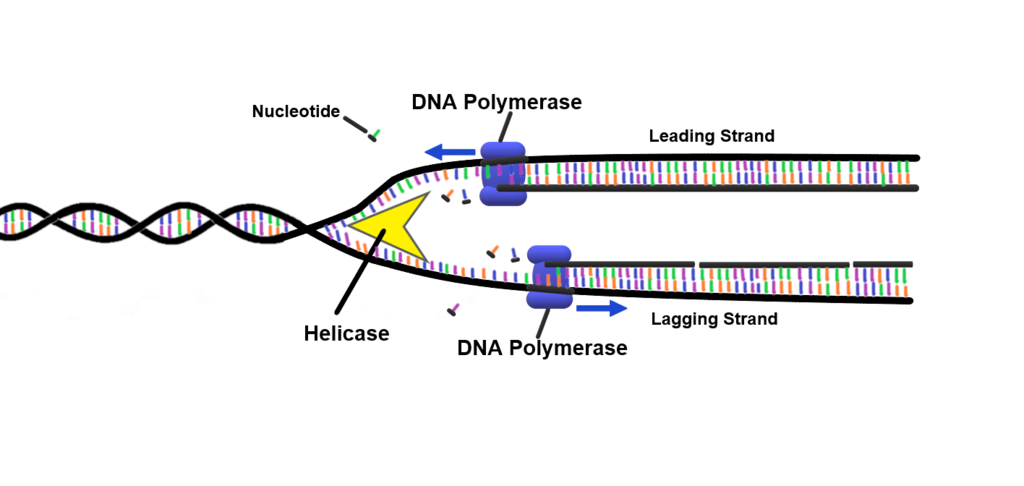
This mechanism ensures that genetic information is passed down accurately from one cell generation to the next. The elegant structure of the DNA molecule is directly responsible for the stability and continuity of life.
Ready to check your understanding of DNA's structure?
What is the famous shape of the DNA molecule often compared to?
Which of the following is NOT one of the three components of a DNA nucleotide?
Understanding this structure is the first step in decoding the language of life itself.