Fundamentals of Lift-Off Gas Mechanical Seals
Introduction to Mechanical Seals
Sealing a Moving Target
Pumps, compressors, and mixers all have a common challenge: a rotating shaft that enters a stationary housing. How do you stop the fluid inside from leaking out around the spinning shaft? That's the job of a mechanical seal.
A mechanical seal is a device that prevents leakage between a rotating shaft and a stationary housing. Think of it like a highly engineered lid for a jar, but one that has a spinning rod sticking through the middle of it. Its goal is to contain the fluid inside the equipment, whether it's water, oil, or a volatile chemical, while allowing the shaft to rotate freely.
The Core Components
While designs vary, nearly all mechanical seals share a few key parts. The real sealing action happens at the two primary seal faces. One face is stationary and mounted to the equipment housing, while the other is mounted on the shaft and rotates with it. These faces are lapped to be incredibly flat, often within a few millionths of an inch.
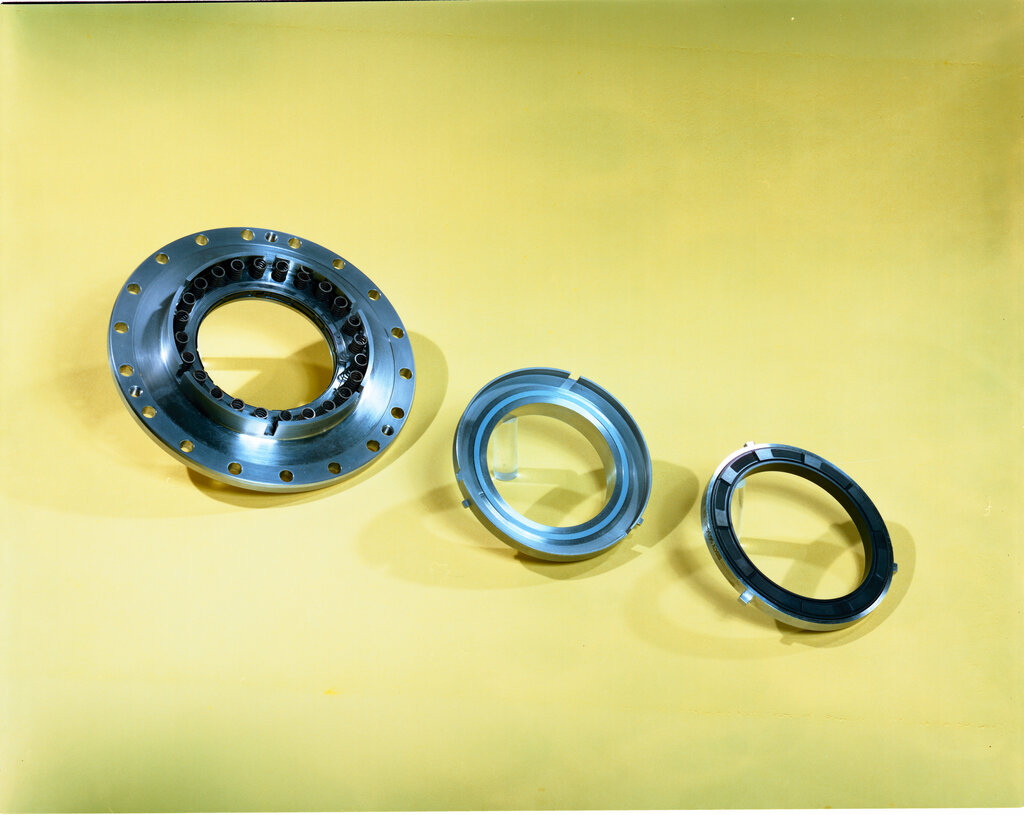
Of course, there are other potential leak paths. That's where secondary seals come in. These are typically O-rings, gaskets, or flexible bellows that seal the non-moving gaps, like the one between the stationary seal face and the housing.
Finally, a spring mechanism and other hardware hold everything together. The springs provide an initial closing force, pushing the two primary seal faces together to create a seal even when the equipment isn't running or pressurized.
The Principle of Operation
A mechanical seal works by creating a precise, controlled leak path between the two primary faces. When the equipment starts, the spring and the pressure of the sealed fluid push the rotating and stationary faces together.
A microscopic film of the process fluid—just a few molecules thick—works its way between the lapped faces. This is crucial. This fluid film lubricates the faces, preventing them from overheating and destroying each other from friction. It also acts as the final barrier, as the surface tension and fluid dynamics within this tiny gap prevent significant leakage.
The small amount of fluid that does get across the faces typically vaporizes into the atmosphere due to the heat from friction. For most seals, this "leakage" is so small it's invisible and amounts to just a few drops per day.
The secret of a mechanical seal isn't a perfect, zero-leak barrier. It's a precisely controlled, self-lubricating system that allows for near-zero leakage.
Common Seal Designs
While there are many specialized designs, most mechanical seals fall into two broad categories based on how they handle wear on the primary faces.
Pusher Seal
noun
A type of mechanical seal where the secondary seal (usually an O-ring) must slide along the shaft or sleeve to compensate for face wear.
Pusher seals are the most common type. They use a spring to push the entire rotating assembly, including a sliding secondary seal, forward as the primary faces wear down over time. This design is simple and effective for many general applications.
Bellows Seal
noun
A type of mechanical seal that uses a flexible bellows, made of metal or elastomer, as both the spring and the secondary seal.
Bellows seals, also known as non-pusher seals, use a flexible bellows to provide the closing force. The bellows compresses to compensate for face wear. Since there's no sliding O-ring, these seals are often better for fluids that are sticky or contain solids, as there's no risk of the secondary seal getting stuck on the shaft.
| Feature | Pusher Seal | Bellows Seal |
|---|---|---|
| Secondary Seal | Slides on shaft/sleeve | Static (part of bellows) |
| Spring Mechanism | Separate coil spring(s) | Bellows acts as spring |
| Common Use | General purpose, clean fluids | Sticky, abrasive, or high-temp fluids |
Understanding these basic building blocks is the first step in seeing how engineers contain immense pressures and high speeds in all kinds of industrial equipment.
What is the primary function of a mechanical seal?
The microscopic fluid film that forms between the two primary seal faces is essential for proper operation.