Fundamentals of Alcohols and Phenols
Introduction to Alcohols and Phenols
The Key Player: The Hydroxyl Group
In organic chemistry, we often look for specific arrangements of atoms called functional groups. These groups give molecules their characteristic properties. One of the most important functional groups is the hydroxyl group, which consists of one oxygen atom bonded to one hydrogen atom.
When you attach a hydroxyl group to a carbon-based chain, you create an alcohol. If you attach it to a specific type of ring structure, you get a phenol. This one small group has a huge impact on how these molecules behave.
Alcohol
noun
An organic compound in which a hydroxyl (-OH) group is bonded to a saturated carbon atom.
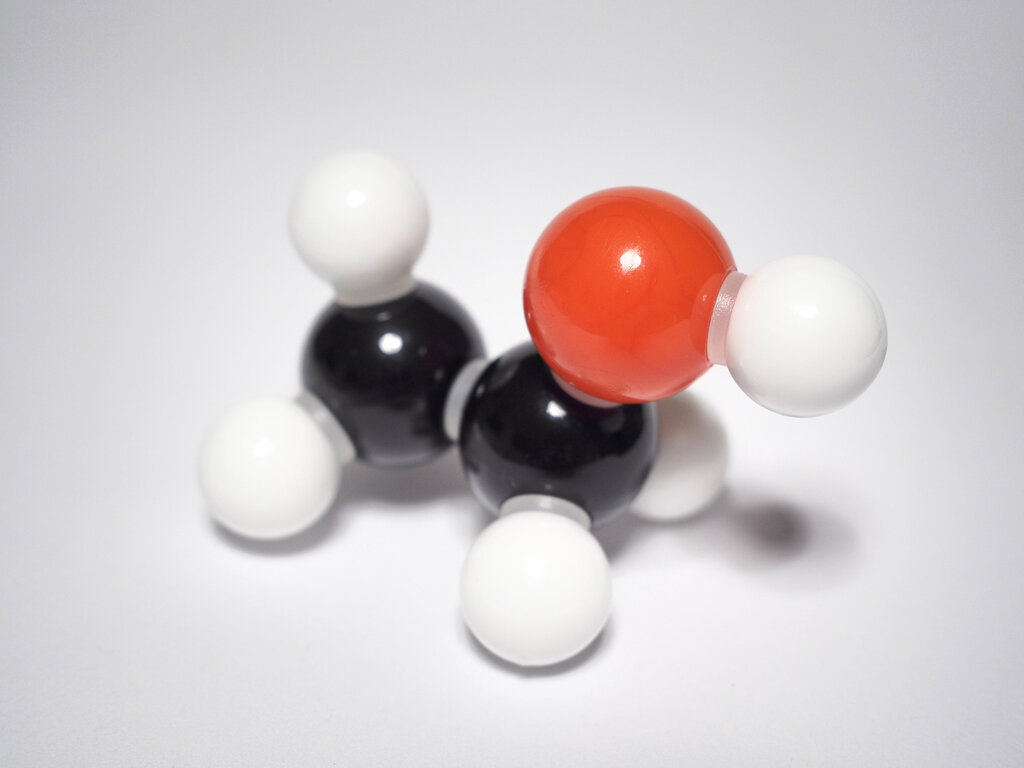
The general structure for an alcohol is , where 'R' stands for an alkyl group—a chain of carbon and hydrogen atoms. Think of it as a hydrocarbon chain with a hydroxyl group tacked on. Ethanol, the alcohol in alcoholic drinks, is a simple example. It has a two-carbon chain.
Phenols are a bit different. They also contain a hydroxyl group, but it's attached directly to a special, stable ring of carbon atoms called an aromatic ring.
Phenol
noun
An organic compound in which a hydroxyl (-OH) group is bonded directly to a carbon atom in an aromatic ring.
The key difference lies in what the group is attached to: a regular carbon chain (alcohol) or an aromatic ring (phenol). This distinction is crucial because the aromatic ring changes the properties of the hydroxyl group, making phenols more acidic than alcohols.
Classifying Alcohols
Not all alcohols are created equal. We can categorize them based on the carbon atom that the hydroxyl group is attached to. This carbon is sometimes called the carbinol carbon.
We look at how many other carbon atoms are directly bonded to this carbinol carbon. This gives us three main classes: primary, secondary, and tertiary.
The number of carbons attached to the carbinol carbon determines the alcohol's class.
A primary (1°) alcohol has its hydroxyl group attached to a carbon that is bonded to only one other carbon atom. Ethanol is a classic example of a primary alcohol.
A secondary (2°) alcohol's hydroxyl group is on a carbon bonded to two other carbon atoms. An example is isopropanol, or rubbing alcohol.
A tertiary (3°) alcohol has its hydroxyl group on a carbon atom bonded to three other carbon atoms. These are often more bulky molecules.
This classification is more than just a naming convention. It directly influences the reactivity of the alcohol. The number of carbon atoms around the carbinol carbon affects how easily the alcohol can participate in chemical reactions.
Why the Hydroxyl Group Matters
The hydroxyl group is the center of action for both alcohols and phenols. The oxygen atom in the group is more electronegative than both the carbon and hydrogen it's bonded to. This means it pulls the shared electrons closer to itself, creating a slight negative charge on the oxygen and slight positive charges on the carbon and hydrogen. This property is called polarity.
The polarity of the O-H bond makes it a reactive site, ready to interact with other molecules.
This unequal sharing of electrons makes the molecule polar, which allows alcohols to form hydrogen bonds. This is a special type of attraction between molecules that influences many of their properties, like their boiling points and ability to dissolve in water.
The group can act as a weak acid by donating its proton (), or it can be removed entirely in other types of reactions. How it reacts depends on its environment, whether it's attached to an alkyl group (alcohol) or an aromatic ring (phenol), and whether it's primary, secondary, or tertiary.
Ready to check your understanding of these fundamental structures?
What is the defining feature of an alcohol's structure?
An alcohol is classified as secondary () if the hydroxyl group is attached to a carbon atom that is bonded to how many other carbon atoms?
Understanding these basic definitions and classifications is the first step. Next, we can explore the specific properties and reactions that make these compounds so important in chemistry and biology.