Functions Relations and Polynomials
Understanding Functions
What Is a Function?
Think of a function as a well-behaved machine. You put something in, and it gives you exactly one thing out. A vending machine is a perfect example. You press a button for a specific snack (the input), and the machine gives you that one snack (the output). It wouldn't give you two different snacks for one button press, and it wouldn't give you nothing. That reliability is the key idea behind a function.
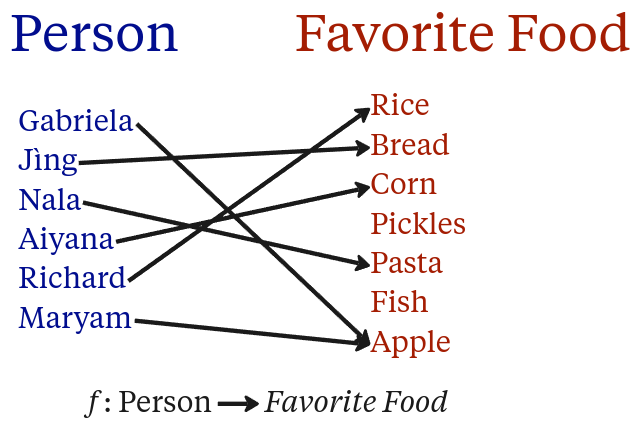
In math, a function is a rule that assigns each input to exactly one output.
Every input must have an output, and it can only be one output. An input can't be paired with two or more different outputs. However, different inputs can lead to the same output. For instance, in a vending machine, the button for diet cola and the button for regular cola are different inputs, but they might both cost $1.50, which would be the same output if our function was calculating price.
Domain and Range
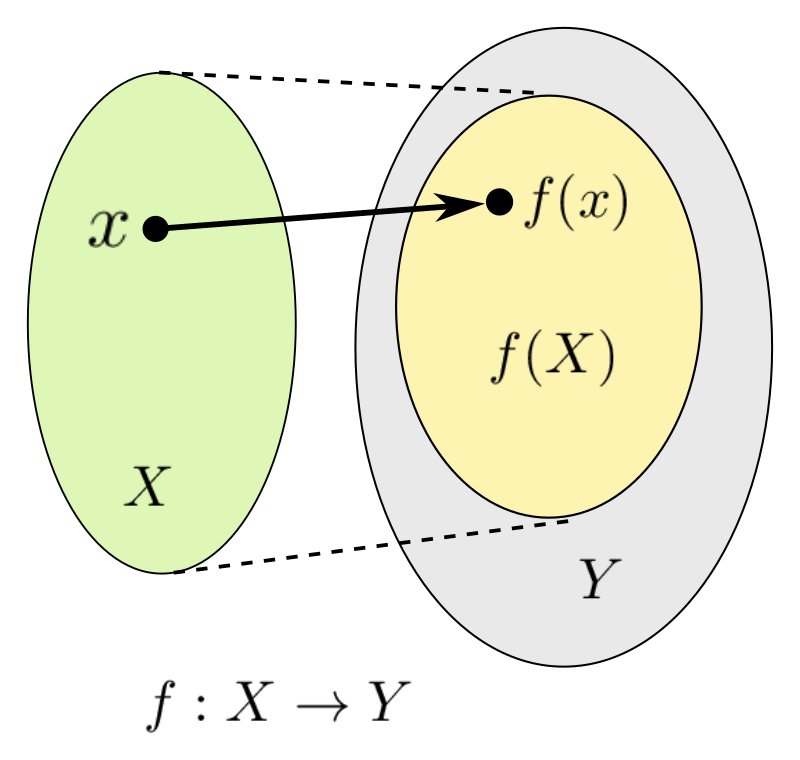
Functions have specific terms for their inputs and outputs. The set of all possible inputs for a function is called the domain. The set of all possible outputs is called the range.
Domain
noun
The set of all possible input values for a function.
Range
noun
The set of all actual output values of a function.
Going back to our vending machine, the domain is all the buttons you can press that correspond to an item. The range is the collection of all the items available to be dispensed. If the potato chip slot is empty, that button is no longer in the function's domain.
Speaking the Language of Functions
We have a special way of writing functions called function notation. It's a compact way to show the relationship between an input and its output.
You'll most often see it written like this:
We read this as "f of x." It does not mean f multiplied by x. It means we're applying the function rule, named f, to an input, named x.
For example, if we have a function that doubles any number you give it, we can write the rule as:
Here, f is the name of our function, and x is the input. The expression 2x is the rule that tells us what to do with the input. To find the output for a specific input, we just replace x with that number.
If the input is 3, we write:
This tells us that for the function f, an input of 3 gives an output of 6.
Common Types of Functions
Functions come in many varieties, but a few types show up frequently. Let's look at three common ones.
Linear Functions These are the simplest functions. Their graphs are straight lines. A linear function has the general form . For example, is a linear function. They model situations with a constant rate of change, like calculating the total cost of items that have a fixed price per item plus a service fee.
Quadratic Functions These functions include a variable raised to the second power (). Their graphs are parabolas, which are U-shaped curves. The general form is . An example is . Quadratic functions are used to model things like the path of a thrown ball or the shape of a satellite dish.
Polynomial Functions This is a broader category that includes linear and quadratic functions. Polynomials involve variables raised to non-negative integer powers, like . The highest power of the variable is called the degree of the polynomial. They can model more complex relationships, such as the growth of a population over time or the trajectory of a roller coaster.
From calculating your phone bill to designing a bridge, functions are a fundamental tool for describing relationships in the world around us. Understanding them is a key step into the broader world of mathematics.
Which of the following relationships represents a function?
For a function that calculates the total cost of items in a shopping cart, the set of all possible total costs you could end up with is called the ________.