Fructose Metabolism and Uric Acid Production
Fructose Metabolism
Fructose's Backdoor Pathway
When you consume fructose, most of it heads straight to your liver for processing. Unlike glucose, which can be used by almost every cell in your body, fructose has a special, more direct route that starts in the liver. This pathway is fast, efficient, and has some important consequences for your metabolism.
The first step is a chemical commitment. An enzyme called fructokinase traps fructose inside the liver cell by attaching a phosphate group to it. This reaction uses one molecule of ATP, the cell's energy currency.
This initial step is very rapid. Fructokinase works much faster than the equivalent enzyme for glucose, causing the liver to quickly burn through its local ATP supply. This can signal a state of low energy in the cell, even when plenty of fuel is available.
Splitting the Molecule
Once fructose is converted to fructose 1-phosphate, it's ready for the next stage. Another liver-specific enzyme, aldolase B, steps in and splits the six-carbon fructose 1-phosphate molecule into two smaller, three-carbon molecules: dihydroxyacetone phosphate (DHAP) and glyceraldehyde.
These two molecules, DHAP and glyceraldehyde, are key intersections in metabolism. DHAP is already an intermediate in the glycolysis pathway. Glyceraldehyde can be quickly converted into another glycolytic intermediate, glyceraldehyde 3-phosphate. At this point, the products of fructose metabolism have successfully entered the main sugar-processing pipeline.
Bypassing the Gatekeeper
Here's the most important difference between fructose and glucose metabolism. The breakdown of glucose via glycolysis has a major regulatory checkpoint, an enzyme called phosphofructokinase-1 (PFK-1). This enzyme acts like a gatekeeper, slowing down glycolysis when the cell has plenty of energy (high ATP levels).
Fructose metabolism completely sidesteps this checkpoint. By entering the pathway after the PFK-1 step, the products of fructose breakdown can flood the system unchecked, regardless of the cell's energy status.
Think of it like traffic. Glucose has to go through a carefully controlled toll booth (PFK-1) that manages the flow of cars onto the highway. Fructose uses a side entrance that merges directly onto the highway, bypassing the toll booth entirely.
This unregulated flow has significant consequences. With a sudden influx of three-carbon molecules, the glycolysis pathway can become overwhelmed. The excess intermediates have to go somewhere. One major destination is the pathway for creating new fats, a process called de novo lipogenesis. The building blocks are readily converted into fatty acids, which are then assembled into triglycerides. This is why high fructose consumption is strongly linked to the accumulation of fat in the liver.
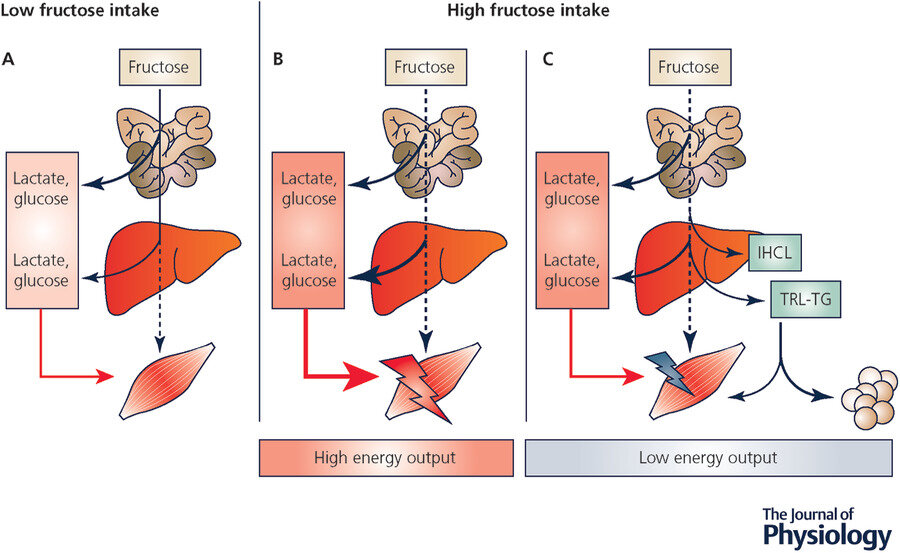
So, to recap the journey: fructose enters the liver, is rapidly phosphorylated using ATP, split into two pieces, and then enters the lower part of the glycolysis pathway. This process bypasses the main control point, leading to a rapid and unchecked flow of intermediates that can be easily diverted to fat synthesis.
Let's test your understanding of how the liver processes fructose.
Where in the body is the vast majority of dietary fructose metabolized?
What is the critical regulatory enzyme in glycolysis that fructose metabolism bypasses?
Understanding this unique metabolic route is key to seeing how different sugars can have very different effects on the body.