Frontiers of Theoretical and Computational Astrophysics
GRMHD in Accretion Flows
MRI Saturation and Turbulence
In a weakly magnetized accretion disk, the magneto-rotational instability (MRI) is the primary driver of angular momentum transport. The linear growth phase is well-understood, but the crucial physics lies in its non-linear saturation. The instability saturates when the amplified magnetic field becomes strong enough to disrupt the channel flows that feed its growth. This process establishes a state of sustained magnetohydrodynamic (MHD) turbulence.
This turbulence is inherently anisotropic, with energy concentrated in toroidal and radial magnetic field components. The saturation amplitude, often characterized by the plasma beta parameter, , is determined by a complex interplay between the MRI growth rate and dissipative processes. Critically, the net vertical magnetic flux threading the disk governs the saturation level. Disks with zero net flux saturate at lower magnetic field strengths, with turbulence maintained by a self-sustaining dynamo process within the shearing box. Conversely, a non-zero net vertical flux allows the field to be continuously stretched by shear, leading to a much stronger saturated state and more efficient angular momentum transport.
The convergence of GRMHD simulations is a significant challenge. Numerical resistivity must be low enough to resolve the fastest growing MRI mode, whose characteristic wavelength depends on the local Alfvén speed and orbital frequency . Insufficient resolution can artificially suppress the instability or lead to incorrect saturation levels. Modern simulations employing high-order numerical schemes and adaptive mesh refinement are essential for accurately capturing the turbulent cascade and energy dissipation.
Dynamo Action and Jet Launching
In accretion disks with negligible net magnetic flux, a dynamo mechanism is required to sustain the magnetic fields against turbulent decay. The mean-field dynamo model provides a framework for understanding this process. Turbulent motions (the -effect) convert toroidal field back into poloidal field, while differential rotation (the -effect) shears poloidal field into toroidal field, completing the cycle.
This dynamo can amplify a weak seed field to equipartition strength, where the magnetic pressure is comparable to the gas pressure. The efficiency of this dynamo is critical for powering the coronal activity and winds observed in many accretion systems. For a thick, radiation-supported disk, this process can generate fields on the order of G for supermassive black holes and up to G around stellar remnants like neutron stars.
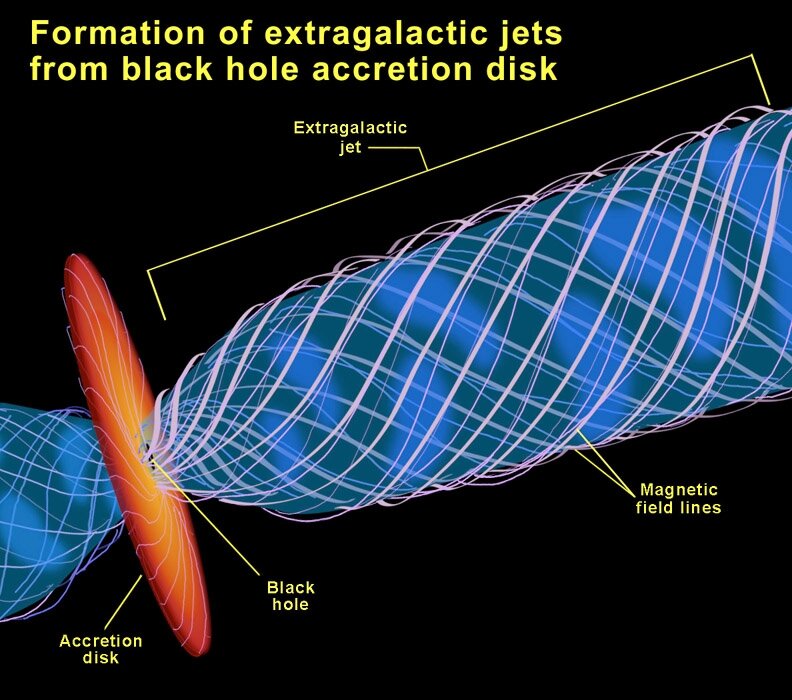
For rapidly rotating black holes, the extraction of rotational energy is a powerful mechanism for launching relativistic jets. Global GRMHD simulations have robustly demonstrated that the is a viable process for this. It requires a strong poloidal magnetic field threading the black hole's event horizon. The frame-dragging effect of the spinning spacetime forces the magnetic field lines to rotate, creating a Poynting flux that carries energy and angular momentum away from the black hole along the polar axis.
The efficiency of this process scales with the square of the black hole's dimensionless spin parameter, . Simulations show that for a near-maximally spinning Kerr black hole (), the jet power can exceed the accretion luminosity of the disk itself, explaining the immense power of jets observed from active galactic nuclei (AGN) and microquasars.
Disk Stability and Oscillations
The inner regions of luminous accretion disks, particularly in AGN, are often dominated by radiation pressure rather than gas pressure. These regions are subject to thermal and viscous instabilities. Radiation pressure amplifies small temperature fluctuations, potentially leading to a thermal runaway that alters the disk structure. Furthermore, the opacity in these regions, dominated by electron scattering and augmented by UV absorption lines, plays a key role. The effective viscosity, driven by MHD turbulence, can behave differently in radiation-dominated plasma, a phenomenon known as that can impact the disk's stability.
These instabilities are thought to be connected to the quasi-periodic oscillations (QPOs) observed in high-resolution X-ray timing data from accreting black holes and neutron stars. QPOs manifest as distinct peaks in the power spectrum of the X-ray variability. GRMHD simulations of tilted or warped disks can reproduce some of these features, where Lense-Thirring precession of the inner flow provides a natural clock mechanism. The interplay between magnetic stresses, radiation pressure, and general relativistic effects creates a complex, time-variable structure that emits the fluctuating X-rays we observe.
Understanding these phenomena provides the theoretical underpinning for interpreting the electromagnetic signatures from compact object mergers and other high-energy events. The GRMHD framework connects the central engine's dynamics to the observable radiation, forming a crucial component of multi-messenger astronomy.