Frontiers of AI: Transformers, LLMs, Diffusion, JEPA, and AGI
Introduction to Transformers
A New Way to Process Language
For a long time, artificial intelligence models read text the same way many people do: one word at a time, from left to right. Models like Recurrent Neural Networks (RNNs) would process the first word, remember a little bit about it, then move to the next word, and so on. This sequential approach makes sense, but it's slow. It also struggles to connect words that are far apart in a long sentence.
Imagine trying to remember the very first word of a long paragraph by the time you reach the end. It's tough, and it was a major bottleneck for AI.
In 2017, a new architecture called the Transformer changed everything. Instead of processing text word by word, it was designed to look at the entire sentence all at once. This parallel processing was a massive leap forward, making models faster and much better at understanding context.
Transformers revolutionized NLP by replacing RNNs with self-attention mechanisms, allowing models to process entire sentences in parallel and capture long-range dependencies efficiently.
This new parallel ability is powered by a clever mechanism called self-attention.
The Power of Self-Attention
Self-attention allows a model to weigh the importance of different words in a sentence when processing a specific word. It helps the model understand how words relate to each other, no matter how far apart they are.
Consider the sentence: "The cat drank the milk because it was thirsty." When the model processes the word "it," self-attention helps it determine what "it" refers to. Is it the cat or the milk? By analyzing the relationships between words, the model can calculate that "it" has a very strong connection to "cat."
This is done by creating three special vectors for each word: a Query (Q), a Key (K), and a Value (V). The Query vector is like a question about the current word. The Key vectors of all other words act like labels for what they can offer. The model compares the Query of one word with the Key of every other word to find a match. Words with a closer match get a higher "attention score." The Value vectors are then used to create a new representation for the current word, emphasizing the words that scored high.
This ability to dynamically link words is what gives Transformers such a deep understanding of context.
Keeping Track of Order
If a Transformer looks at every word at once, how does it know the order of the sentence? After all, "The dog chased the cat" means something very different from "The cat chased the dog."
This is a real problem for parallel processing. The model has no inherent sense of word position. To solve this, Transformers use positional encodings. This is a bit of extra information, a vector of numbers, that gets added to the representation of each word. This vector gives the model a signal about the word's position in the sequence, like a unique timestamp or address.
This simple addition allows the model to learn the importance of word order while still enjoying the speed benefits of processing everything at once.
Thinking Deeper
After the self-attention mechanism has figured out the relationships between words and positional encodings have added context about order, the information is passed through a feedforward neural network (FFN).
This part of the Transformer is relatively simple. Each word's representation is processed independently through the same network. You can think of it as a processing step that allows the model to think more deeply about the information it has gathered. It adds computational depth, transforming the attention outputs into a more refined representation that's easier for the next layer of the model to use.
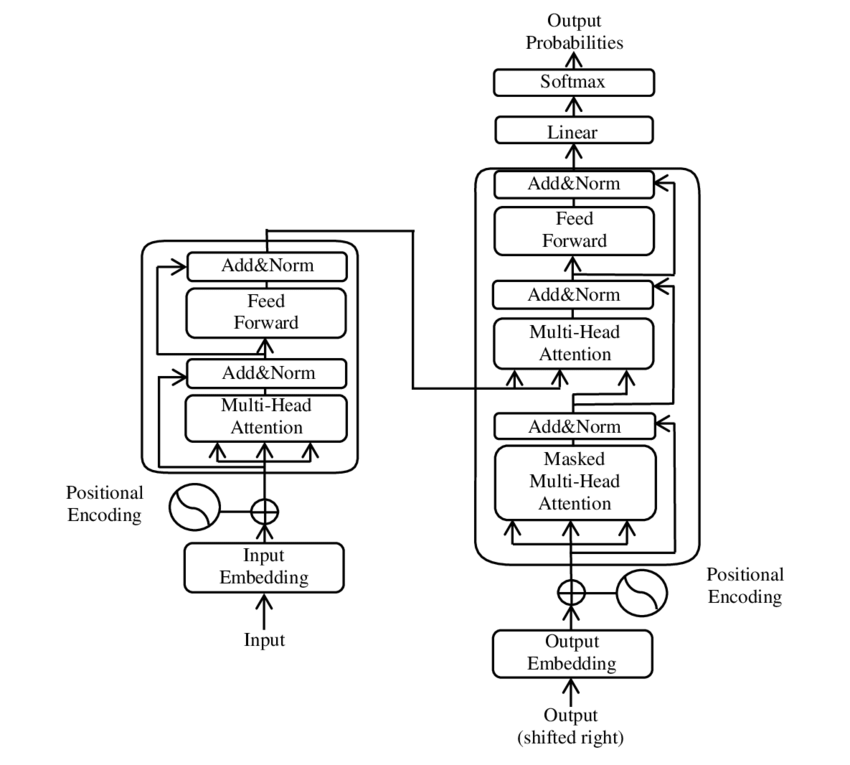
Together, self-attention, positional encodings, and feedforward networks create a powerful layer that can be stacked multiple times. This stacking allows the model to build increasingly complex and abstract understandings of the language, all while processing text in a highly efficient, parallel way.
Ready to check your understanding of these core components?
What is the primary architectural innovation of the Transformer model that allows it to process text more efficiently than older models like Recurrent Neural Networks (RNNs)?
Within the self-attention mechanism, which three vectors are created for each word to determine its relationship with other words in the sentence?
These foundational ideas are the building blocks for most modern large language models.