Front End Back End and Full Stack Development
Introduction to Web Development
The Two Sides of a Website
Think of a website like a restaurant. When you walk in, you experience the dining area. You see the tables, the decor, and the menu. You interact with a waiter who takes your order. This is the “front-end” of the restaurant—everything you, the customer, see and interact with.
But behind the scenes, there’s a kitchen. This is where your order is received, the food is cooked, and all the ingredients are stored. You don't see the kitchen, but it’s essential for the restaurant to function. This is the “back-end.”
Web development is split into these same two parts: front-end and back-end. They are different but work together to create a complete, functioning website or application.
The Front-End: What You See
Front-end development covers everything a user sees and interacts with in their browser. It's the visual part of the web. This includes the layout of a page, the colors, the fonts, the buttons you click, and the forms you fill out.
The primary job of a front-end developer is to translate a designer's vision into a live, interactive website.
They make sure the website looks good on all devices, from a large desktop monitor to a small smartphone screen. They're also responsible for the user experience, ensuring the site is easy to navigate and use. Returning to our restaurant analogy, the front-end developer is like the interior designer and the host, creating a pleasant and functional environment for guests.
The Back-End: What You Don't See
Back-end development is the work that happens behind the scenes. It's the server, the database, and the application logic that powers the website. When you log into an account, submit a form, or save an item to your shopping cart, the back-end is doing the work.
While frontend focuses on user interfaces and experience, backend development handles the behind-the-scenes logic, databases, and server-side processes that power web applications.
Back-end developers are responsible for building and maintaining the technology that powers the front-end. They manage the database where all the data is stored, write the code that runs on the server, and ensure that the front-end has the information it needs. In our restaurant analogy, the back-end developers are the chefs, the kitchen staff, and the inventory managers. They make sure every order is prepared correctly and the kitchen has all the necessary ingredients.
How They Work Together
A website can't function without both the front-end and the back-end. They are two sides of the same coin, constantly communicating with each other.
Imagine you're on a social media site and you click the 'like' button on a photo. Your click happens on the front-end. The front-end then sends a request to the back-end, saying, "This user just liked this photo." The back-end receives this request, updates the database to record the 'like', and then sends a response back to the front-end, confirming that the action was successful. The front-end then updates the interface, maybe by changing the color of the 'like' button and increasing the like count.
This communication happens through something called an API (Application Programming Interface), which acts as the messenger between the two sides. The waiter in our restaurant is the API, carrying orders to the kitchen and bringing food back to the table.
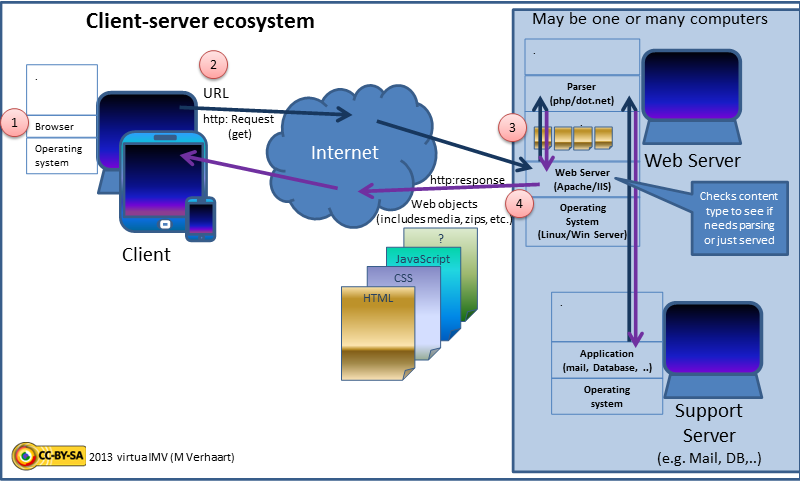
Understanding this separation is key. Front-end developers focus on making the user's experience smooth and visually appealing, while back-end developers focus on making the site's logic, data, and performance robust and efficient. Both roles are critical to building the web applications we use every day.
Using the restaurant analogy from the text, what part of a website is comparable to the kitchen?
Which of the following tasks is primarily a front-end development responsibility?