From Maquette to Monument Scaling Metal Sculptures
Scaling Up Measurements
From Small to Large
Your detailed clay maquette is complete. It holds the essence of your final piece, but in miniature. The next challenge is to enlarge it to its final size without losing any of the detail or, more importantly, the correct proportions. This scaling-up process is a crucial bridge between your small-scale vision and your large-scale reality.
A small error on the maquette—a nose that's a millimeter too long, a shoulder that's slightly too broad—might be barely noticeable. But when you scale that model up ten times, that one-millimeter mistake becomes a full centimeter. Suddenly, the error is glaring. The key is to use precise methods to transfer every point and curve accurately.
Scaling by Hand
Before advanced tools existed, artists relied on simple, effective techniques to scale their work. One of the most common is the grid method. You can place a grid over your maquette (or a photograph of it) and draw a proportionally larger grid on the surface where you'll build the final piece. By transferring the contents of each small square to its corresponding large square, you can systematically build up the enlarged form.
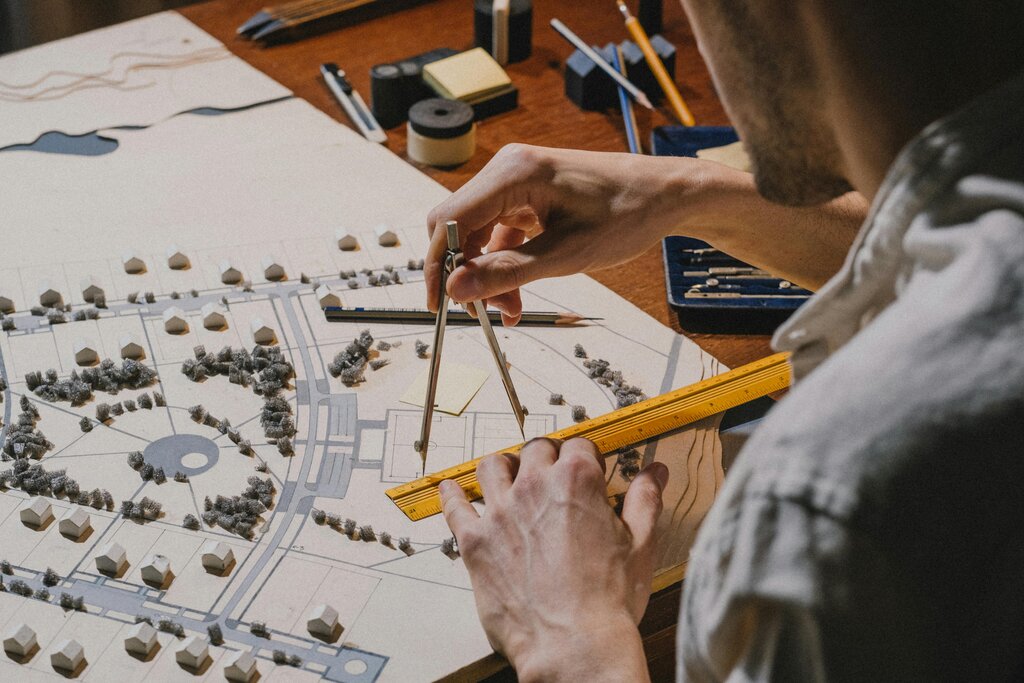
Another manual approach involves calipers and simple math. First, you decide on your scaling factor. If your maquette is 1 foot tall and you want the final sculpture to be 10 feet tall, your scaling factor is 10. Then, you measure a specific distance on the maquette—say, the width of the head—and multiply it by your scaling factor to find the corresponding measurement for the large version.
This method requires careful, repeated measurements. While effective, it can be time-consuming, and the risk of human error increases with the complexity of the sculpture.
The Pointing Machine
For more complex or large-scale projects, artists often turn to a specialized tool to ensure accuracy: the 3D pantograph, also known as a pointing machine. This device is a mechanical tool used to transfer the proportions of a model to a larger or smaller block of stone, wood, or clay.
A pointing machine works by physically linking the maquette to the large-scale armature. It has an adjustable arm that can pivot and extend. You place the maquette and the full-size armature side-by-side. You then touch a specific point on the maquette with one end of the machine's arm. The other end of the arm will then indicate the exact corresponding point on the full-size version.
By taking hundreds or even thousands of such point measurements, you can build up a highly accurate, scaled-up version of your maquette, ensuring that every contour and detail is faithfully reproduced.
Regardless of the method you use, the goal is the same: maintain the integrity of your design. Always step back and compare the large piece to the maquette from various angles to ensure the proportions feel right.
With your measurements accurately scaled up, you're ready to start building the full-size model, confident that it will be a true representation of your original artistic vision.