From Ebers Papyrus to Hippocratic Psychopathology
Ebers Papyrus Heart Pathologies
The Heart's Thoughts
In ancient Egypt, the heart was not just a pump. It was the absolute centre of a person's being: the source of intellect, emotion, and memory. The Ebers Papyrus, one of the oldest medical texts in existence, dedicates a significant section, often called the 'Treatise on the Heart', to this idea. For the Egyptians, the physical state of the heart was inseparable from one's mental and emotional state.
The heart, or ib, was believed to be the origin point for a network of vessels called the metu. These weren't simply veins and arteries as we understand them today. The were channels that carried everything essential for life and consciousness, branching out from the heart to every part of the body. They transported not only blood but also air, tears, saliva, and even thoughts and feelings. A blockage or disturbance in a metu could cause physical illness just as easily as it could cause mental distress.
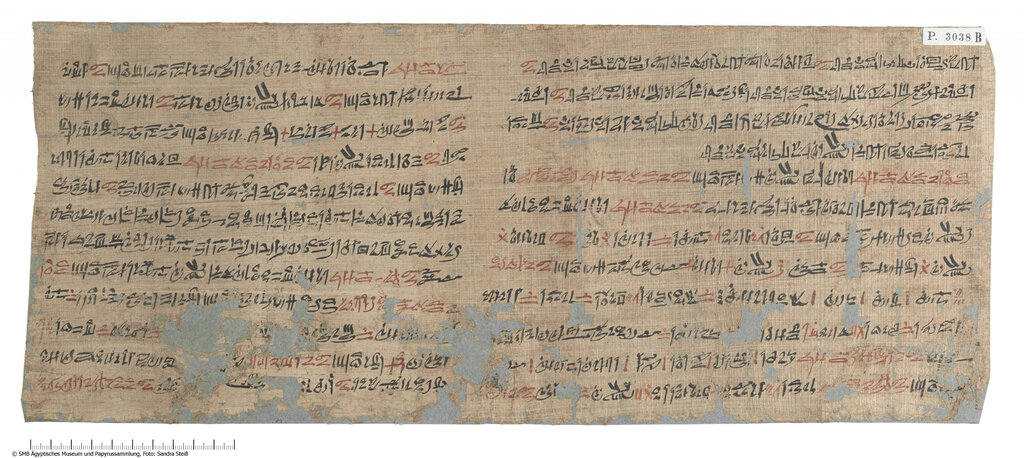
When the Heart Ails
Because the heart and its vessels were central to both mind and body, the Egyptians didn't distinguish between physiological and psychological disorders in the way we do. Conditions we might now label as dementia, depression, or anxiety were understood as physical ailments of the heart. The papyrus uses vivid, descriptive language for these states.
Forgetfulness, for example, was described as the heart 'growing tired'. Agitation or severe anxiety was called 'the heart dancing' or 'the heart overflowing'.
These conditions fell under a general category of 'Heart-Weakness' or 'Distress'. The diagnosis was physical. If the heart was weary, memory would fail. If the heart was agitated, a person would feel distressed. The cause might be a physical imbalance, but it could equally be the influence of a malevolent spirit or god. For the Egyptians, these were not mutually exclusive explanations.
A Dual Approach to Healing
The Ebers Papyrus reflects this dual worldview in its treatments. A remedy for a distressed heart often involved two parts: a physical prescription and a magical incantation. The physician would prepare a pharmacopoeial remedy, perhaps a mixture of herbs, minerals, and animal products, to be ingested or applied to the body. This addressed the physical aspect of the illness.
Simultaneously, an incantation would be spoken over the patient or the medicine itself. This was not a secondary or superstitious act; it was a core part of the healing process. The incantation was meant to expel the malevolent influence or spiritual cause of the affliction. For example, a spell for 'driving out tremblings in the limbs' would be recited alongside the administration of a herbal remedy. This integrated approach tackled both the seen and unseen causes of the heart's distress, aiming to restore holistic balance.
| Egyptian Term | Modern Interpretation | Description in Papyrus |
|---|---|---|
| 'Heart Dancing' | Anxiety / Agitation | The heart leaps, trembles, or overflows. |
| 'Heart Growing Tired' | Depression / Dementia | The heart is forgetful, weak, or heavy. |
| 'Distress' | General mental suffering | A state caused by affliction from gods or spirits. |
| 'Heart-Weakness' | Cognitive decline | A general term for failing memory and focus. |
According to ancient Egyptian belief as described in the Ebers Papyrus, what was the primary function of the heart, or ib?
An ancient Egyptian is experiencing what we would today call depression. How would a physician using the Ebers Papyrus likely diagnose this condition?
This ancient understanding of the heart as the seat of the mind provides a fascinating window into early medical and psychological thought. It was a system where the physical and the spiritual were two sides of the same coin.