French Language Basics
French Alphabet and Pronunciation
The Alphabet and Its Sounds
The French alphabet uses the same 26 letters as English, but many of them sound quite different. Learning the French names for the letters is the first step to spelling words out loud and understanding spoken French.
Start with the French alphabet and core pronunciation rules to build a rock-solid foundation.
Here’s a quick guide to how each letter is pronounced. Pay close attention to the vowels, as they are key to the sound of French.
| Letter | French Name | Pronunciation Guide |
|---|---|---|
| A | a | 'ah' as in father |
| B | bé | 'bay' |
| C | cé | 'say' |
| D | dé | 'day' |
| E | e | 'uh' as in the |
| F | effe | 'eff' |
| G | gé | 'zhay' |
| H | hache | 'ash' |
| I | i | 'ee' as in see |
| J | ji | 'zhee' |
| K | ka | 'kah' |
| L | elle | 'ell' |
| M | emme | 'em' |
| N | enne | 'en' |
| O | o | 'oh' as in boat |
| P | pé | 'pay' |
| Q | qu | 'koo' |
| R | erre | (a guttural sound) |
| S | esse | 'ess' |
| T | té | 'tay' |
| U | u | (no English equivalent) |
| V | vé | 'vay' |
| W | double vé | 'doo-bluh vay' |
| X | ixe | 'eeks' |
| Y | i grec | 'ee grek' |
| Z | zède | 'zed' |
A few letters are worth special attention. The French 'e' is often a soft 'uh' sound, unlike the English 'e'. The letter 'h' is always silent, so a word like hôtel sounds like 'oh-tel'. The letter 'u' is unique; to make the sound, shape your lips as if you're saying 'oo' but try to say 'ee' instead. It takes practice!
Accent Marks Change Everything
You'll quickly notice little marks on top of or below some letters. These are called accents, or diacritics, and they're not just for decoration. They change how a letter is pronounced or distinguish between words that are spelled the same.
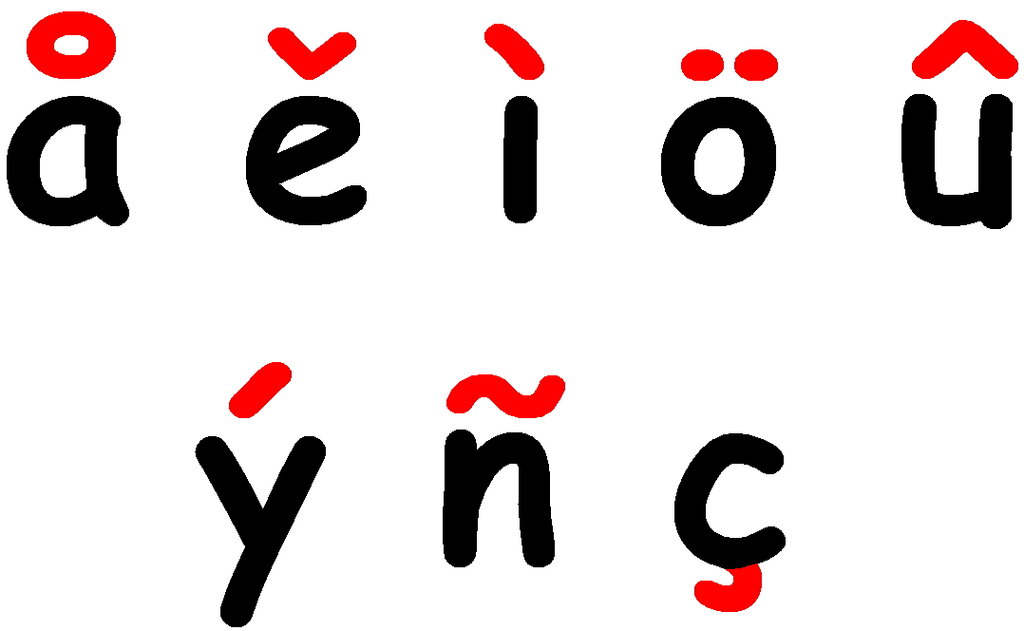
There are five accents in French.
-
The acute accent (l'accent aigu) only appears on the letter 'e'. It creates an 'ay' sound, like in the English word 'hay'. Example: école (school).
-
The grave accent (l'accent grave) can appear on 'a', 'e', or 'u'. On an 'e', it makes an 'eh' sound, like in 'bed'. Example: mère (mother). On 'a' or 'u', it doesn't change the sound but helps tell words apart, like ou (or) and où (where).
-
The circumflex (l'accent circonflexe) looks like a little hat and can be on any vowel. It often makes the vowel sound longer. Example: forêt (forest).
-
The trema (le tréma) looks like two dots over a vowel. It tells you to pronounce two adjacent vowels separately. Example: Noël (Christmas), pronounced 'no-el', not 'nole'.
-
The cedilla (la cédille) is a small tail under the letter 'c'. It only appears before 'a', 'o', or 'u' and softens the 'c' from a hard 'k' sound to a soft 's' sound. Example: garçon (boy).
The French 'R' and Nasal Vowels
Two sounds often give English speakers trouble: the French 'r' and the nasal vowels. Let's break them down.
The French 'r' is not rolled with the tip of the tongue like in Spanish. It's produced in the back of the throat. Imagine lightly gargling or the sound of clearing your throat.
To pronounce the 'r' in a word like rue (street), keep the tip of your tongue down behind your bottom teeth and vibrate your uvula at the back of your throat. It will feel strange at first, but listening to native speakers and imitating them is the best way to learn.
Nasal vowels are created when air passes through both your mouth and your nose. In English, we do this at the end of words like 'sing', but in French, it's part of the vowel itself. You don't actually pronounce the 'n' or 'm' that follows the vowel. Instead, it signals that the vowel is nasal.
| Spelling | Sound Guide | Example Word |
|---|---|---|
| an, en | 'ahn' | enfant (child) |
| in, ain, ein | 'an' as in can't | vin (wine) |
| on, om | 'ohn' | bon (good) |
| un, um | 'uhn' | un (one) |
To make a nasal sound, try saying the vowel while smiling, and feel the vibration in your nose. The key is to stop the airflow before your tongue touches the roof of your mouth to make the 'n' or 'm' sound.
Linking Words Together
One of the keys to making your French sound smooth and natural is a concept called liaison. This is when the normally silent final consonant of a word is pronounced at the beginning of the next word if that word starts with a vowel or a silent 'h'.
liaison
noun
The linking of a word's final consonant sound to the initial vowel sound of the following word.
Think about the phrase les amis (the friends). The word les ends with a silent 's'. The word amis starts with a vowel. Through liaison, we connect them. The 's' is no longer silent and takes on a 'z' sound.
Without liaison: les / amis (lay / a-mee) With liaison: les amis (lay-za-mee)
Another example is un an (one year). The 'n' in un links to the 'a' in an. It sounds like one word: 'uh-nahn'.
Not all connections are possible, but the most common liaisons involve words like les, des, mes, vous, nous, and un. Listening for these links will dramatically improve your ability to understand spoken French.
Ready to check your understanding? Let's see what you've learned about French sounds.
What is the primary function of the cedilla (la cédille) in French, such as in the word 'garçon'?
The French concept of 'liaison' occurs when...
Mastering French pronunciation takes time and a lot of listening. Keep practicing these fundamentals, and you'll build a strong foundation for speaking confidently.