French for Beginners
French Pronunciation
Sounds Over Letters
When learning French, it's tempting to sound out words just like you would in English. But this can lead you astray. French spelling has its own logic, and a single letter can represent multiple sounds, while some letters aren't pronounced at all. The key is to stop thinking about letters and start thinking about sounds.
To do this, we use a helpful tool called the International Phonetic Alphabet, or IPA. The IPA is a system where each symbol represents exactly one sound. Learning a few key IPA symbols for French will help you pronounce any word correctly, no matter how it's spelled.
The secret to French pronunciation is consistency. Once you learn the sound a letter or group of letters makes, that rule applies almost everywhere.
The Vowels
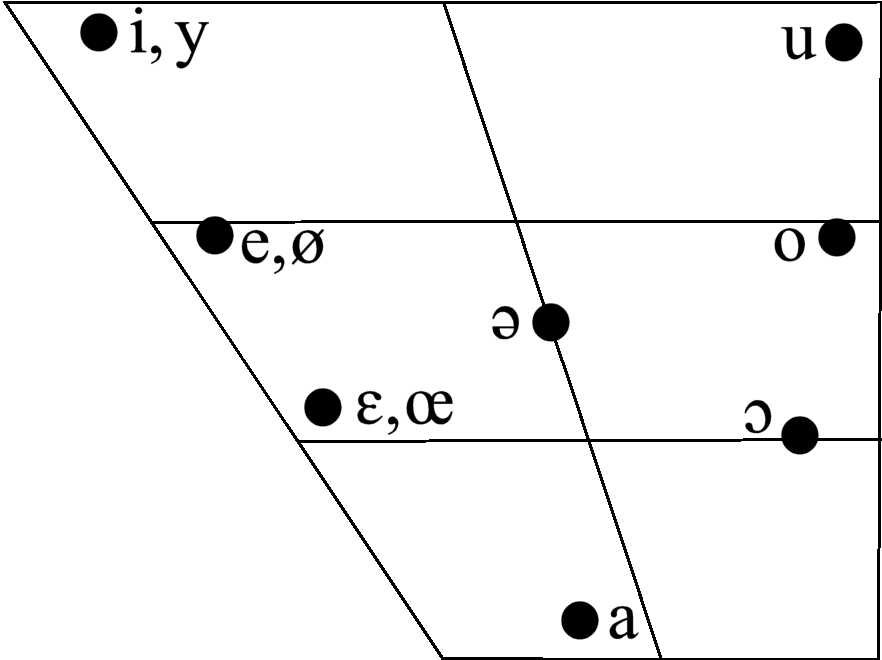
French has a richer variety of vowel sounds than English. Many of these sounds are made with the tongue further forward in the mouth, and the lips are often more rounded and tense. Let's look at a few common ones.
| IPA Symbol | Example Word | English Approximation |
|---|---|---|
| [i] | lit (bed) | The 'ee' in 'see' |
| [e] | été (summer) | The 'ay' in 'say', but shorter |
| [ɛ] | lait (milk) | The 'e' in 'let' |
| [a] | patte (paw) | The 'a' in 'father' |
| [u] | tout (all) | The 'oo' in 'food' |
| [o] | mot (word) | The 'o' in 'go', but shorter |
| [ɔ] | sort (fate) | The 'o' in 'for' |
Notice how some sounds, like [e] and [ɛ], seem very similar. The difference is in how open your mouth is. For [e], your mouth is more closed, and for [ɛ], it's more open. Practicing these pairs will sharpen your ear and your accent.
Nasal Sounds and Consonants
Nasal vowels are a signature of the French language and often a challenge for English speakers. They are produced by passing air through both the mouth and the nose. The trick is to not pronounce the 'n' or 'm' that follows the vowel. Instead, that consonant just tells you to make the preceding vowel nasal.
Think of it like this: the letters 'n' and 'm' can act as signals to change the vowel's quality, not as consonants to be pronounced themselves.
| Nasal Vowel | IPA | Example Word |
|---|---|---|
| an, am, en, em | [ɑ̃] | enfant (child) |
| on, om | [ɔ̃] | bon (good) |
| in, im, ain, aim, ein, eim | [ɛ̃] | vin (wine) |
Many French consonants are similar to their English counterparts, but a few stand out. The French 'r' is probably the most famous. It's not rolled like in Spanish or tapped like in some English accents. It's produced in the back of the throat.
To practice, try making a gargling sound without any liquid. Start gently, just by vibrating your uvula (the little thing that hangs down in the back of your throat). That's the spot. Now, try to incorporate that sound into words like rue (street) or très (very).
Rhythm and Flow
Finally, let's talk about the music of French. Unlike English, where we stress certain syllables in a word (like pho-to-graph), French has a more even rhythm. Stress is typically placed on the last syllable of a word or, more importantly, on the last syllable of a group of words that belong together in a phrase.
This creates a smooth, flowing sound. Sentences are linked together in a continuous stream of syllables, without the choppy start-and-stop rhythm of English. This is called liaison, where a normally silent consonant at the end of a word is pronounced at the beginning of the word that follows it if that word starts with a vowel.
For example, les amis (the friends) is not pronounced 'lay a-mee'. Instead, the 's' links the two words, and it sounds like 'lay za-mee'.
Although all those silent letters can seem confusing at first, once you learn the rules and patterns, you’ll realise that French pronunciation is actually a lot more logical and regular than English pronunciation.
Let's review the main ideas we've covered.
Now, test your understanding of these concepts.
In French, when a vowel is followed by an 'n' or 'm' at the end of a syllable (like in 'bon' or 'temps'), what is the primary function of the 'n' or 'm'?
The French 'r' sound is most accurately described as being produced where?
Mastering these fundamentals will make a huge difference in how you sound and how well you're understood. It takes practice, but the logic is consistent.