French Fluency B2
Introduction to French Phonetics
The French Alphabet
The French alphabet uses the same 26 letters as English, but their names are quite different. Learning how to pronounce the letters themselves is the first step to being able to spell out words and names in French.
Unlike in English, where a letter can have many different sounds (think of the 'a' in 'cat,' 'car,' and 'cake'), French pronunciation is much more consistent. Once you learn the rule for a letter or combination of letters, it usually stays the same.
| Letter | French Name | Pronunciation Guide |
|---|---|---|
| A | a | ah |
| B | bé | bay |
| C | cé | say |
| D | dé | day |
| E | e | uh |
| F | effe | eff |
| G | gé | zhay |
| H | ache | ash (the 'h' is silent) |
| I | i | ee |
| J | ji | zhee |
| K | ka | kah |
| L | elle | ell |
| M | emme | emm |
| N | enne | enn |
| O | o | oh |
| P | pé | pay |
| Q | qu | koo |
| R | erre | air (with a guttural 'r') |
| S | esse | ess |
| T | té | tay |
| U | u | (no English equivalent) |
| V | vé | vay |
| W | double vé | DOO-bluh vay |
| X | ixe | eeks |
| Y | i grec | ee-GREK ('Greek i') |
| Z | zède | zed |
Pay special attention to letters like G and J, which have soft sounds similar to the 's' in 'measure.' The French R is also famously tricky; it's a throaty sound produced in the back of the throat, not with the tip of the tongue like in English.
Signature French Sounds
Beyond individual letters, French is known for a few key sounds that don't really exist in English. The most important of these are the nasal vowels.
Nasal sounds are created by passing air through both the nose and the mouth. To get a feel for it, try humming with your mouth open. That vibration in your nose is part of what makes a nasal vowel.
In French, when a vowel is followed by an 'n' or 'm' at the end of a syllable, the vowel becomes nasal, and the 'n' or 'm' itself isn't pronounced. The most common nasal sounds are:
| Sound Combination | Example | Pronunciation Tip |
|---|---|---|
| an / en | maman (mom) | Sounds like the 'on' in 'song', but more open. |
| in / ain / ein | vin (wine) | Sounds a bit like the 'an' in 'sang', but higher pitched. |
| on | bon (good) | Similar to the 'own' in 'sown', but don't close your lips at the end. |
| un | un (a/one) | A nasalized 'uh' sound. No close English equivalent. |
Another classic French sound is the vowel u, as in tu (you). To make this sound, try saying the English sound "ee" as in "see," but keep your tongue in that position while rounding your lips tightly as if you were about to whistle.
The Role of Accents
You've probably seen French words with little marks above or below the letters. These are called diacritics, or accent marks, and they are not just for decoration. They change how a letter is pronounced or distinguish between two words that are spelled the same.
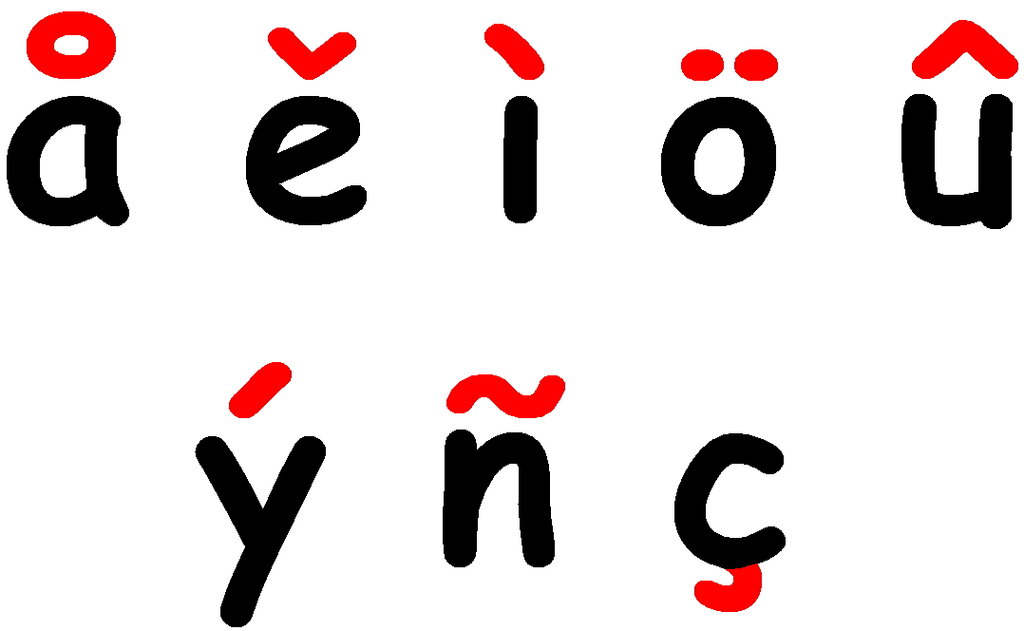
Here are the five accent marks you'll encounter in French.
Accent Aigu (´)
other
Used only on the letter 'e' (é), it creates an "ay" sound, like in 'say' or 'café'.
This is the most common accent in French.
Accent Grave (` )
other
On an 'e' (è), it makes an "eh" sound, like in 'get'. On an 'a' or 'u', it doesn't change the sound but distinguishes words, like a (has) from à (to/at).
Think of it as opening up the vowel sound.
Accent Circonflexe (^)
other
The 'hat' can appear over any vowel (â, ê, î, ô, û). It slightly lengthens the vowel sound. Often, it indicates that a letter 's' used to follow the vowel in Old French.
For example, forêt used to be spelled forest.
Cédille (¸)
other
This little tail is only used on the letter 'c' (ç). It softens the 'c' to an 's' sound when it comes before the vowels a, o, or u. Without it, 'ca' would sound like 'ka'.
It ensures the 's' sound is maintained where it otherwise wouldn't be.
Tréma (¨)
other
The two dots appear over the second of two consecutive vowels (e, i, or u) to show that both vowels should be pronounced separately.
Without the tréma, 'Noel' would be pronounced like one syllable, 'nohl'. With it, it's two syllables: 'no-el'.
Ready to test what you've learned about French sounds?
How are the letters 'G' and 'J' in French typically pronounced?
Under what condition does a vowel sound typically become nasal in French?
Getting comfortable with these sounds and symbols is a huge step. They form the foundation of everything you'll say and hear in French.