Free Question Paper Creation Tools
Introduction to Assessment Design
The Blueprint for Measuring Learning
Designing an assessment is like drawing up a blueprint before building a house. You wouldn't start hammering nails without knowing what you want the final structure to look like. In education, the “final structure” is what you want students to know or be able to do. These are your learning objectives.
Assessment design is the process of creating tools and methods to measure whether those learning objectives have been met. It’s not just about creating tests to grade students. It’s a purposeful way to gather evidence of learning. A well-designed assessment tells you not just if a student learned, but how well they learned it.
Every assessment—formative or summative—should be directly related to one or more learning objectives for your course.
This principle of alignment is the foundation of effective assessment. If your objective is for students to learn how to bake a cake, you wouldn't test them by asking them to write an essay on the history of flour. You'd ask them to bake a cake. The assessment must directly reflect the desired skill or knowledge.
Formative vs. Summative
Assessments generally fall into two categories, distinguished by their purpose and timing: formative and summative.
Formative assessments are checks for understanding during the learning process. Think of them as a check-up. They are ongoing, often informal, and low-stakes. The goal isn't to assign a final grade, but to provide feedback to both the student and the instructor. This feedback helps guide the next steps in teaching and learning. Examples include in-class polls, short ungraded quizzes, or asking a student to summarize a concept in their own words.
Summative assessments evaluate student learning at the end of an instructional unit. This is the final inspection. They are used to measure how much students have learned against a standard or benchmark. Final exams, term papers, and major projects are classic examples of summative assessments. They are typically higher-stakes and contribute significantly to a final grade.
| Feature | Formative Assessment | Summative Assessment |
|---|---|---|
| Purpose | To monitor learning and provide feedback | To evaluate learning at the end of a unit |
| Timing | During the learning process | At the end of the learning process |
| Stakes | Low (usually ungraded or low-grade) | High (heavily graded) |
| Analogy | A chef tasting the soup while cooking | A customer eating the soup in the restaurant |
A balanced course uses both. Formative assessments help you steer the ship, while summative assessments tell you if you've reached your destination.
Aligning Assessments with Objectives
The key to effective assessment is ensuring it matches the cognitive level of your learning objective. If your objective is for students to simply remember facts, a multiple-choice quiz might be fine. But if your objective requires them to analyze, evaluate, or create, your assessment must give them an opportunity to demonstrate those higher-order skills.
A useful tool for thinking about these different levels is Bloom's Taxonomy, which categorizes cognitive skills in a hierarchy.
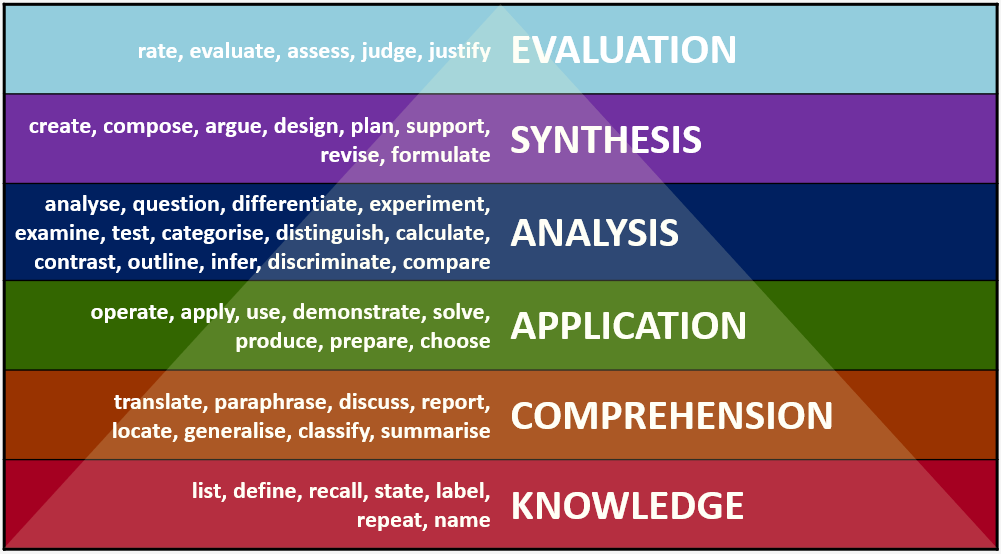
Let's see this in action. Consider this learning objective: Students will be able to evaluate the effectiveness of different renewable energy sources for a given city.
An unaligned assessment might ask: "List three types of renewable energy." This only tests the 'Remember' level, not the 'Evaluate' level required by the objective.
A well-aligned assessment would be a project: "Research the climate and resources of City X. Write a report recommending the most effective renewable energy source, justifying your choice with data and addressing potential drawbacks."
This second assessment directly measures the student's ability to evaluate, analyze, and apply their knowledge, perfectly matching the objective.
Creating Effective Assessments
Beyond alignment, good assessments share a few key characteristics. They should be valid, reliable, and fair.
Validity
noun
The extent to which an assessment accurately measures what it is intended to measure.
An assessment has validity if it truly tests the learning objective. A test on algebra that is full of complex word problems might be testing reading comprehension more than math skills, thus lowering its validity.
Reliability refers to the consistency of an assessment. If the same students took the same test on different days (without any new learning), they should get roughly the same scores. Vague questions or subjective grading criteria can reduce reliability.
Fairness means the assessment is equitable and free from bias. It should not disadvantage any group of students. The language should be clear, and cultural references should be universally understood or avoided. A fair assessment gives every student an equal opportunity to demonstrate what they know.
To bring these ideas together, think about how you might test something yourself. If you wanted to see if a friend learned how to play a song on the guitar, you wouldn't give them a written quiz. You'd hand them the guitar and say, "Play it for me." That's the essence of good assessment design: clear objectives leading to direct, fair, and meaningful measurement.
What is the most fundamental principle of effective assessment design?
A professor for a public speaking course requires students to deliver a persuasive speech as their final project. This is an example of a summative assessment.
By focusing on these core principles, you can create assessments that are not just tools for grading, but powerful instruments for enhancing learning itself.