Fractions Unveiled
Introduction to Fractions
Parts of a Whole
Imagine you have a pizza that you need to share with friends. If you cut it into equal slices, each slice is a part of the whole pizza. A fraction is just a way to talk about these parts. It's a number that represents a piece of a whole thing, whether that's a pizza, a chocolate bar, or even a group of people.
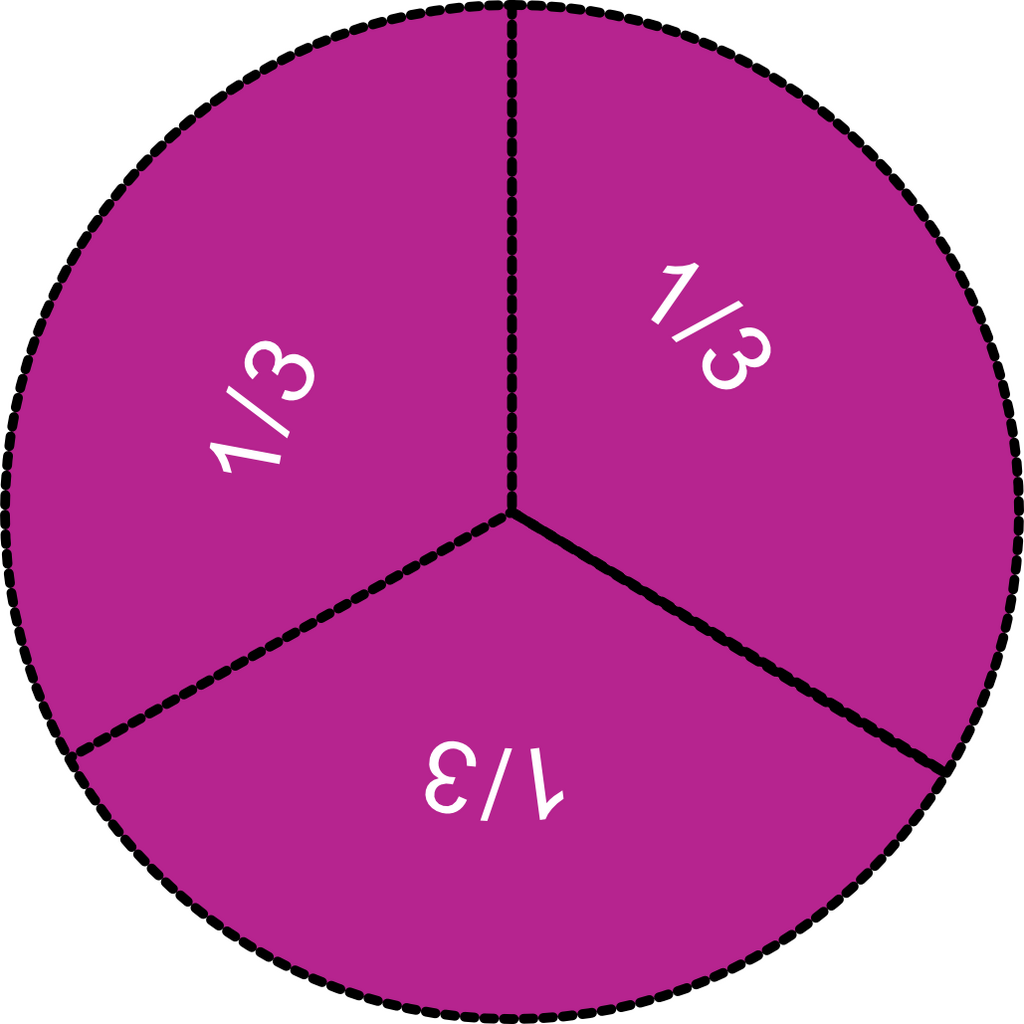
When we write a fraction, we use two numbers stacked on top of each other, separated by a line. For example, if your pizza is cut into 8 slices and you eat 1, you've eaten $1/8$ of the pizza. Each number has a special name and job.
Numerator
noun
The top number in a fraction. It tells you how many equal parts of the whole you have.
Denominator
noun
The bottom number in a fraction. It tells you the total number of equal parts the whole is divided into.
So, in our fraction $1/8$, the denominator (8) tells us the pizza was cut into eight total slices. The numerator (1) tells us we're talking about just one of those slices. It's that simple.
The denominator names the fraction (e.g., eighths), and the numerator counts how many you have.
Seeing Fractions
Fractions can be represented in different ways. Seeing them visually makes the concept much clearer. Besides circles, we can use rectangular bars, often called fraction strips.
This strip is divided into 8 equal parts (the denominator), and 3 of them are shaded (the numerator). So, the shaded portion represents the fraction $3/8$.
Another powerful tool is the number line. We're used to seeing whole numbers on a line, like 0, 1, 2, and 3. But what about the spaces in between? That's where fractions live.
To find $3/4$ on a number line, you first look at the denominator, 4. This tells you to divide the space between 0 and 1 into four equal parts. Then, you use the numerator, 3, to count three of those parts starting from 0. This shows that a fraction is a real number with a specific value and position.
In the fraction , what does the number 4, the denominator, represent?
A chocolate bar is divided into 10 equal squares. If you eat 7 of them, what fraction of the chocolate bar is left?
Understanding what fractions are and how to see them is the first big step. These ideas are the foundation for everything else you'll do with them.