Fractions to Decimals Made Easy
Understanding Fractions
Parts of a Whole
A fraction is just a way to talk about a piece of something. Imagine you have a chocolate bar. If you break it into four equal pieces and eat one, you've eaten a fraction of the bar. Specifically, you've eaten one out of four pieces.
Fractions represent parts of a whole.
To write this down, we use two numbers stacked on top of each other, separated by a line. This is how we write one-fourth:
The top number is called the numerator, and the bottom number is the denominator. They each have a specific job.
numerator
noun
The top number in a fraction. It tells you how many parts of the whole you have.
denominator
noun
The bottom number in a fraction. It tells you how many equal parts the whole is divided into.
So, in our example of , the denominator (4) tells us the chocolate bar was split into four equal pieces. The numerator (1) tells us we have one of those pieces.
Seeing Fractions
Visualizing fractions can make them much easier to understand. Let's look at the fraction . The denominator tells us to divide a whole into 5 equal parts, and the numerator tells us to consider 3 of those parts.
We can also place fractions on a number line. They are the numbers that live between the whole numbers like 0, 1, 2, and so on. Here is on a number line between 0 and 1.
Same Value, Different Look
Sometimes, different fractions can represent the exact same amount. These are called equivalent fractions. Think about a pizza. If you eat half of it, that's . But what if that same pizza was cut into four slices and you ate two of them? You'd have eaten of the pizza, which is the same amount as .
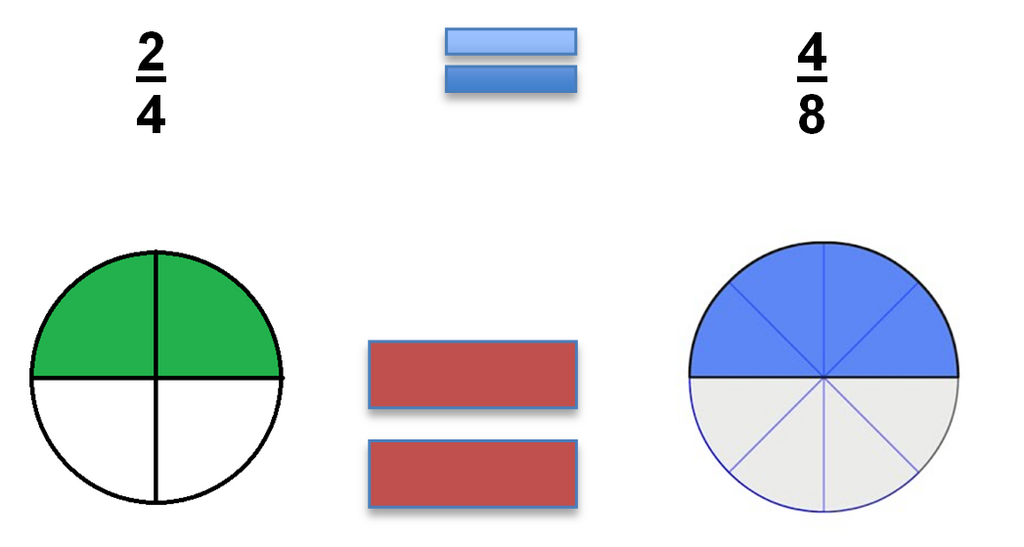
This shows that and are equivalent fractions. They look different, but their value is identical. You can find an equivalent fraction by multiplying the numerator and the denominator by the same number.
For example, to get from to , we multiply both the top and bottom by 2:
You can also divide the numerator and denominator by the same number to find a simpler equivalent fraction. This is called simplifying a fraction. For example, with , we can divide both the top and bottom by 4:
Let's review these new concepts before we finish.
Now, check your understanding.
In the fraction , what does the number 10 represent?
Which of the following fractions is equivalent to ?
Understanding these basics—what a fraction is, the roles of the numerator and denominator, and the idea of equivalent fractions—sets the stage for everything else you'll learn in math.