Fractions Refresher for Adults
Fraction Basics
Parts of a Whole
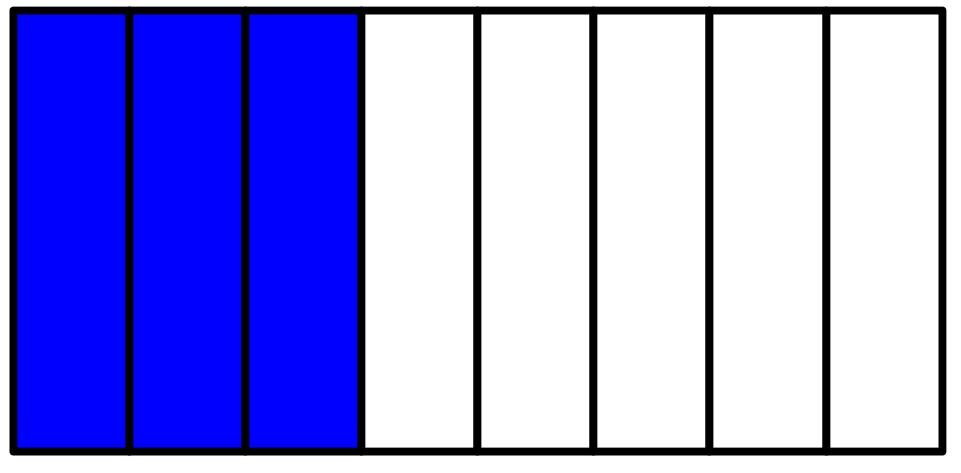
Imagine you have a pizza cut into 8 equal slices. If you eat 3 of those slices, you haven't eaten the whole pizza, just a part of it. A fraction is simply a way to describe a part of a whole. In this case, you ate $3/8$ of the pizza.
Every fraction has two parts: a numerator on top and a denominator on the bottom.
Numerator: How many parts you have. Denominator: The total number of equal parts the whole is divided into.
So, in our $3/8$ example, 3 is the numerator, and 8 is the denominator. It's a simple way of saying "three out of eight equal pieces."
Types of Fractions
Not all fractions look the same. They fall into a few different categories based on the relationship between the numerator and the denominator.
Proper Fraction
noun
A fraction where the numerator is smaller than the denominator. Its value is always less than 1.
Think back to the pizza. If you eat 1, 2, or even 7 slices, you’re eating a proper fraction of the whole pie ($1/8$, $2/8$, $7/8$). You haven't eaten the whole thing yet.
Improper Fraction
noun
A fraction where the numerator is greater than or equal to the denominator. Its value is 1 or more.
What if you were really hungry and ate a whole 8-slice pizza and 3 slices from another one? You've eaten 11 slices in total, and each pizza was cut into 8. You could represent this as the improper fraction $11/8$. Any time the top number is bigger than the bottom number, like $5/4$ or $10/3$, it's an improper fraction.
When the numerator and denominator are the same, like $8/8$ or $4/4$, the fraction is equal to exactly one whole.
This brings us to our last type: mixed numbers.
Mixed Number
noun
A number consisting of a whole number and a proper fraction.
A mixed number is just a more intuitive way to write an improper fraction. Instead of saying you ate pizzas, you could say you ate 1 whole pizza and of another. We write this as . It's the same amount, just written differently.
Seeing Fractions on a Number Line
Fractions aren't just for pizzas and pies. They are numbers, just like 1, 2, and 3. They live on the number line, filling in the gaps between the whole numbers.
As you can see, proper fractions are the values between 0 and 1. Once you hit 1 or go beyond it, you're in the territory of improper fractions and mixed numbers. For example, is the same as two wholes and one quarter more, or .
Now, let's test your understanding of these fundamental concepts.
In the fraction , what is the number 4 called?
Which of the following is an improper fraction?
Grasping what fractions are and the different forms they take is the first and most important step. Once you're comfortable with these ideas, you'll be ready to see what else they can do.