Fractions Fundamentals
Understanding Fractions
What is a Fraction?
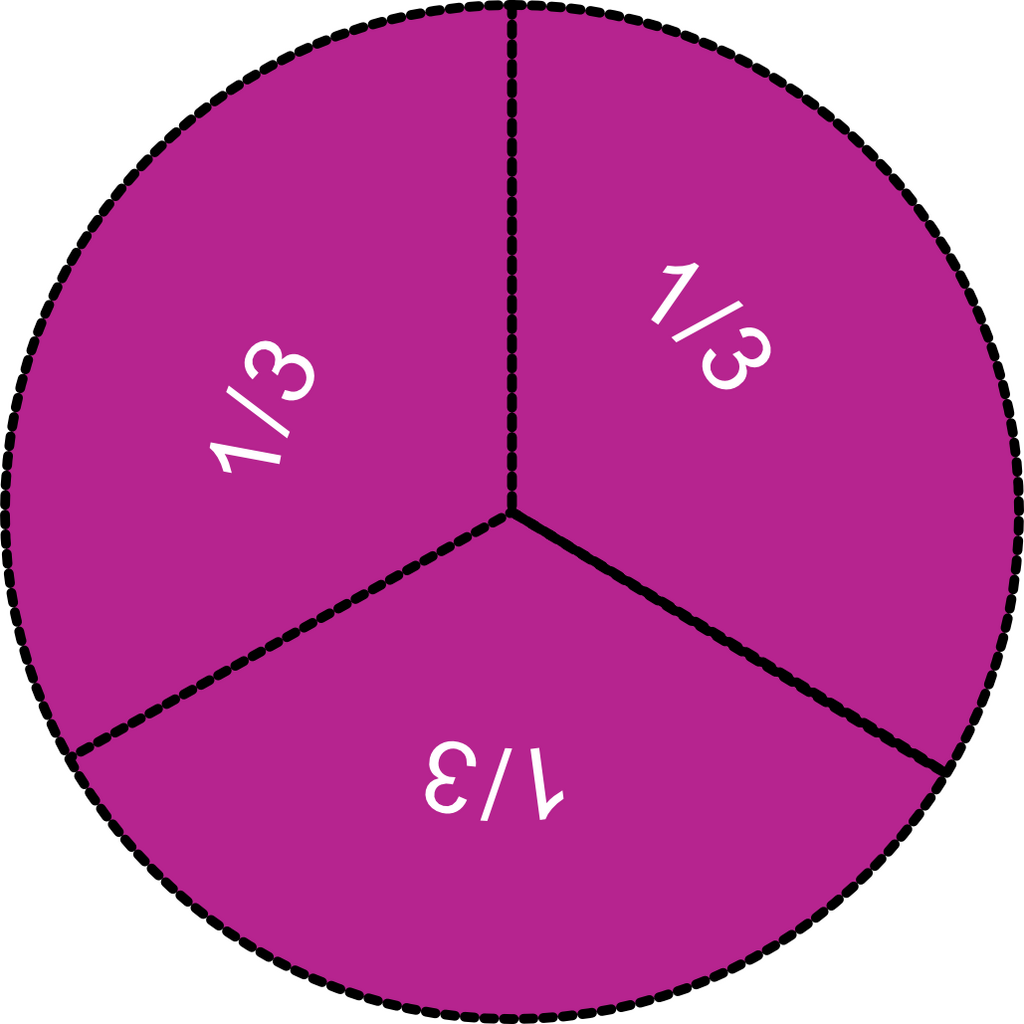
Imagine you have a pizza that you're sharing with two friends. You cut it into three equal slices. If you each take one slice, you've each taken a part of the whole pizza. A fraction is simply a way to describe a part of a whole.
Whether it's a slice of pizza, a piece of a chocolate bar, or a section of a garden, fractions help us talk about portions of things. They are numbers that represent parts of a whole item or a whole set.
The Parts of a Fraction
Every fraction has two key parts: a top number and a bottom number, separated by a line. Each number has a specific job.
Let's break down what each part means.
Numerator
noun
The top number in a fraction. It tells you how many parts of the whole you have.
If you ate two slices of a pizza cut into three, the numerator would be 2 because you have two parts.
Denominator
noun
The bottom number in a fraction. It tells you how many equal parts the whole is divided into.
For that same pizza, the denominator is 3 because the whole pizza was cut into three equal slices.
A simple way to remember: The denominator is down at the bottom, and it tells you how the whole was divided.
Types of Fractions
Fractions come in a few different forms, depending on the relationship between the numerator and the denominator. Understanding these types helps you know if you're dealing with less than a whole, exactly one whole, or more than one whole.
Proper Fractions A proper fraction is a fraction where the numerator is smaller than the denominator. This means it always represents a quantity less than one whole.
Examples include $1/2$, $3/4$, and $5/8$. If you have $3/4$ of a pie, you have less than one whole pie.
Improper Fractions An improper fraction is the opposite: its numerator is greater than or equal to the denominator. This means it represents a quantity that is one whole or more than one whole.
For instance, $5/4$ is an improper fraction. It means you have five pieces, but a whole is only made of four pieces. So you have one full whole and one extra piece.
Other examples are $3/3$ (which is exactly one whole) and $11/6$.
Mixed Numbers A mixed number is another way to write an improper fraction. It combines a whole number and a proper fraction.
For example, instead of writing , we can write it as . This is read as "one and one-fourth." It's often easier to understand the size of a mixed number at a glance. You know immediately that you have one whole thing and a small part of another.
To get a feel for fractions, it helps to see where they fall on a number line.
This number line shows that proper fractions live in the space between 0 and 1. Improper fractions start at 1 and continue on, representing values equal to or greater than a whole.
Time to check what you've learned.
In the fraction , what does the number 3 represent?
Which of the following is an improper fraction?
Understanding these basic building blocks—what fractions are and the different types—is the first step. Once you're comfortable with these ideas, you'll be ready to see what else you can do with them.