Fractions Fun for Fourth Graders
Understanding Fractions
Parts of a Whole
Imagine you have a pizza and you want to share it equally with a friend. You cut it right down the middle. You each get one piece. That one piece you have is a part of the whole pizza. That's a fraction! Fractions are a way to talk about parts of a whole thing, whether it's a pizza, a candy bar, or even a group of people.
Fractions are a way to represent parts of a whole.
We write fractions using two numbers, one on top of the other, separated by a line. For example, if your pizza was cut into two equal slices and you have one, your share is written as .
Numerator and Denominator
Every fraction has two special parts: the numerator and the denominator. They each tell us something important.
denominator
noun
The bottom number in a fraction. It shows the total number of equal parts the whole is divided into.
numerator
noun
The top number in a fraction. It shows how many of the equal parts you are talking about.
Let's look at the fraction . The denominator is 5, so we know the whole is cut into five equal pieces. The numerator is 3, which tells us we have three of those pieces.
A good way to remember is Denominator is Down at the bottom. The numerator is the number up top.
Seeing Fractions
Sometimes the easiest way to understand a fraction is to see it. We can draw fractions in a few different ways.
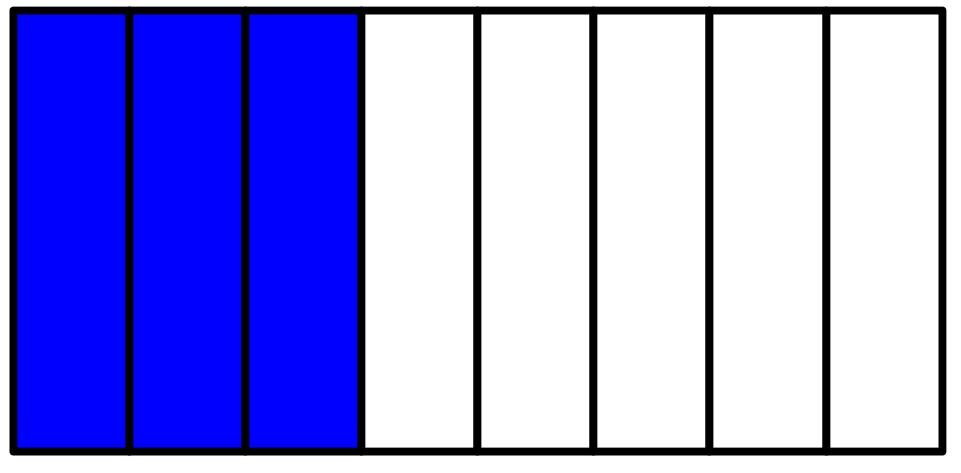
One way is with an area model. This is when we take a shape, like a rectangle or a circle, and divide it into equal parts. The shaded parts show the fraction.
Another way is with a set model. Instead of one whole thing, we look at a group of items. The fraction can tell us about a part of that group. For example, if you have a bag with 5 marbles and 3 of them are blue, then of the marbles are blue.
Finally, we can find fractions on a number line. Think about the space between 0 and 1. We can split that space into equal parts. Each mark represents a fraction.
Understanding these models will help you picture what fractions mean and get you ready for working with them in new ways.
What does the top number in a fraction, the numerator, tell us?
In the fraction , what does the number 4 represent?