Fractions Foundations for Young Learners
Understanding Fractions
What Are Fractions?
Have you ever shared a pizza with a friend? Or eaten just one part of a chocolate bar? If you have, you already know about fractions! Fractions are a way to talk about parts of a whole thing.
Think about a birthday cake. If you cut it into 4 equal slices and eat one slice, you've eaten a fraction of the cake. Fractions help us understand and count pieces that are smaller than one whole.
Fraction
noun
A number that represents a part of a whole.
Parts of a Fraction
Every fraction has two parts: a top number and a bottom number. They are separated by a line.
- The top number is called the numerator.
- The bottom number is called the denominator.
Numerator
noun
The top number in a fraction. It tells you how many parts of the whole you have.
So, if you have a pizza cut into 4 slices and you eat 1 slice, you ate 1/4 of the pizza. The numerator, 1, tells you how many slices you ate.
Denominator
noun
The bottom number in a fraction. It tells you how many equal parts the whole is divided into.
The denominator, 4, tells you that the whole pizza was cut into 4 equal pieces. The more pieces you cut, the bigger the denominator gets!
An easy way to remember: Denominator is down at the bottom.
Seeing Fractions
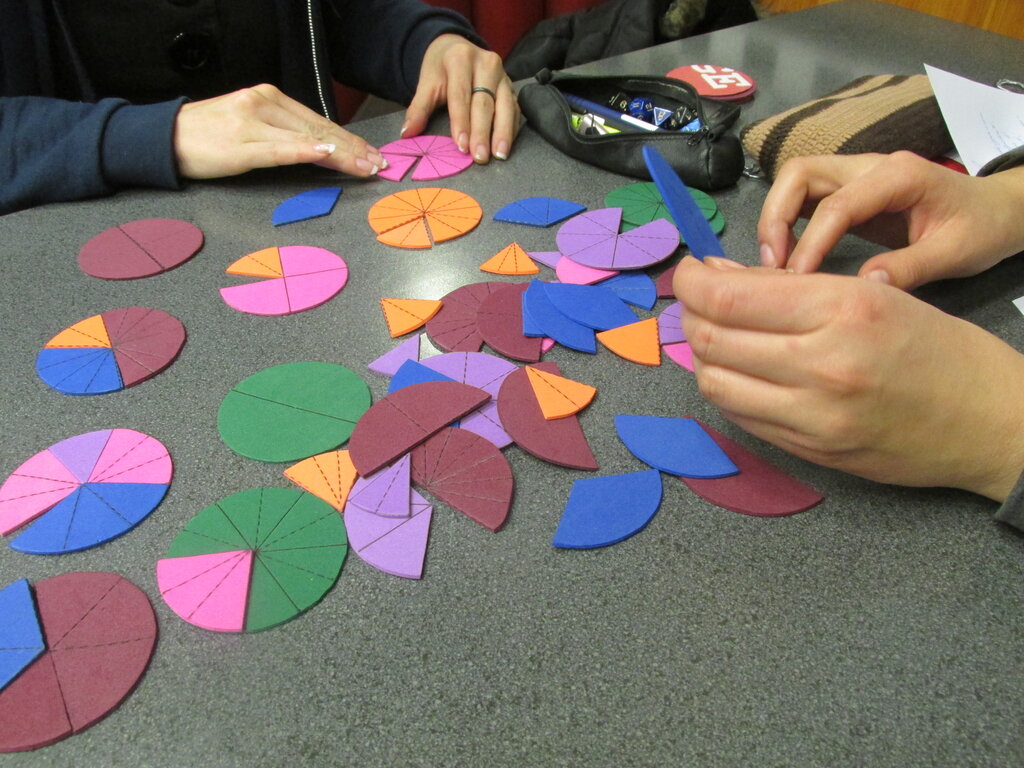
It's easiest to understand fractions when you can see them. Let's look at a few examples using shapes.
Imagine a circle. If we cut it into two equal parts and shade one part, we have shaded 1/2 of the circle.
Now let's take a rectangle, or a bar. If we divide it into three equal parts and shade two of them, we have shaded 2/3 of the bar.
Using shapes, blocks, or even folding paper can help you see what a fraction looks like. It's a great way to practice!
Let's check what you've learned about fractions!
In a fraction, what is the top number called?
A pizza is cut into 8 equal slices. If you eat 3 slices, what fraction of the pizza did you eat?
Great work! Now you know what fractions are and how to name their parts.