Fractal Analysis for Investment Strategies
Introduction to Fractal Geometry
Beyond Smooth Lines
Look around you. Most objects aren't perfect spheres, cones, or squares. A tree isn't a cylinder with lines branching off. A cloud isn't a simple sphere. Coastlines aren't smooth curves. For centuries, traditional geometry was the language of these ideal shapes. But it struggled to describe the rough, complex, and irregular forms we see in the real world.
Fractal geometry is the language of this complexity. A fractal is a shape that exhibits intricate detail at any level of magnification. If you zoom in on a piece of a fractal, you’ll often find smaller versions of the larger shape, repeated over and over.
Fractal
noun
A complex, never-ending pattern that is self-similar across different scales. Fractals are created by repeating a simple process over and over in an ongoing feedback loop.
This property separates them from the shapes of classical geometry. A smooth curve, when magnified, eventually looks like a straight line. A fractal, no matter how much you zoom in, will always reveal more jaggedness and detail.
The Rule of Self-Similarity
The core idea behind most fractals is self-similarity. This means that a small part of the object, when magnified, looks just like the whole object. Think of a fern leaf. Each frond is a miniature version of the entire leaf, and each smaller leaflet is a tiny replica of the frond. This pattern repeats at smaller and smaller scales.
This is achieved through a process called iteration, where a simple rule is applied repeatedly. Let's see this in action by building a classic fractal, the Koch snowflake.
As you can see, we start with a simple shape and apply a rule: divide each line segment into thirds and add a new triangle in the middle. Repeating this process infinitely creates an object with an infinitely long perimeter contained within a finite area. This concept of infinite complexity within finite bounds is a hallmark of fractals.
The Mandelbrot Set
Perhaps the most famous fractal is the Mandelbrot set. It isn't just a pretty picture; it's a map generated from a surprisingly simple mathematical formula operating on complex numbers (numbers with a real part and an imaginary part, ).
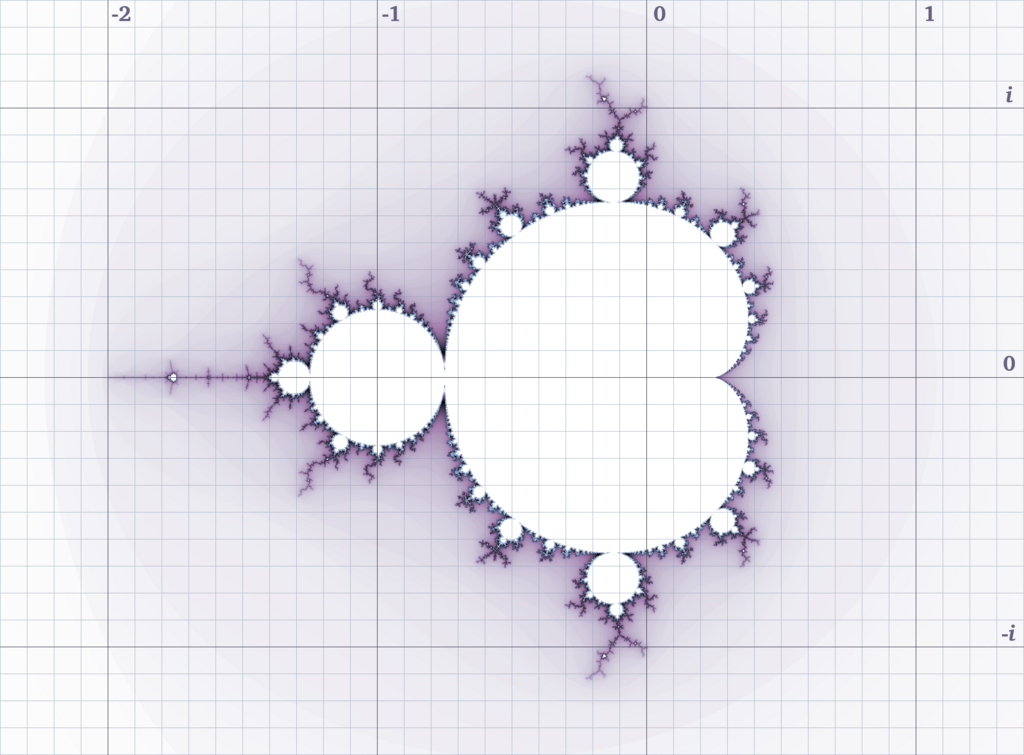
To determine if a point on the complex plane is part of the Mandelbrot set, you plug it into a simple iterative equation.
The rule is simple: if the resulting sequence of numbers stays near the origin (specifically, if its magnitude never exceeds 2), then the starting point is in the Mandelbrot set. These points are typically colored black.
If the sequence flies off toward infinity, the point is not in the set. These points are often colored based on how quickly they escape, which creates the beautiful, swirling patterns around the central black shape. The boundary of the Mandelbrot set is where things get truly interesting. Zooming in reveals an endless, infinitely detailed coastline of miniature Mandelbrot shapes and spiraling filaments.
Nature's Building Blocks
Fractals are not just mathematical curiosities. They are all around us, forming the very fabric of the natural world. Nature seems to favor these repeating, scaling patterns as an efficient way to build complex structures.
The branching of trees, the patterns of lightning, the networks of rivers, the structure of our lungs, and even the jagged shape of a mountain range all exhibit fractal characteristics.
These natural objects aren't perfectly self-similar like a mathematical fractal, but they show statistical self-similarity over a limited range of scales. A small branch of a tree is not an exact copy of the whole tree, but its branching pattern is statistically similar. This underlying principle allows for incredible complexity and efficiency, whether it's a river basin draining a landscape or our lungs maximizing surface area for oxygen exchange.
Now, let's test your understanding of these core concepts.
What is the defining characteristic of a fractal that distinguishes it from shapes in classical (Euclidean) geometry?
The principle that a small part of an object, when magnified, looks like the whole object is called...
Understanding these foundational ideas of fractals, from self-similarity to their presence in nature, provides a new lens through which to view the world, revealing the hidden mathematical order within apparent chaos.