Foundations of Web Development
Internet Basics
How the Internet Works
Think of the internet as a massive, global postal service for digital information. But instead of letters and packages, it sends tiny pieces of data between billions of connected computers. This network isn't a single entity; it's a network of networks, all linked together by physical cables under the ocean, telephone lines, and wireless signals.
For these computers to talk to each other without chaos, they need a shared set of rules. In the digital world, these rules are called protocols.
Protocol
noun
A set of rules governing the exchange or transmission of data between devices.
The most important protocol for the internet is TCP/IP. You don't need to know the technical details, just that it works by breaking down information into small, manageable pieces called packets.
Imagine you want to send a large book to a friend. Instead of shipping it in one huge box, you tear out each page, put each one in a separate envelope with the destination address, and mail them. The internet does something similar. When you load a webpage, the data for that page is broken into packets. Each packet is sent independently and may even take a different route to get to you. Once they all arrive, your computer reassembles them in the correct order to show you the complete page.
Clients and Servers
On this giant network, computers generally play one of two roles: they are either a client or a server. Think of it like a conversation. One person speaks (sends information) and the other listens (receives it).
Your laptop, phone, or tablet is typically a client. It's the device you use to request information. A server is a powerful computer that stores websites, data, or applications and serves that information to clients when they ask for it.
A client requests, and a server serves. This simple relationship is the foundation of how the internet functions.
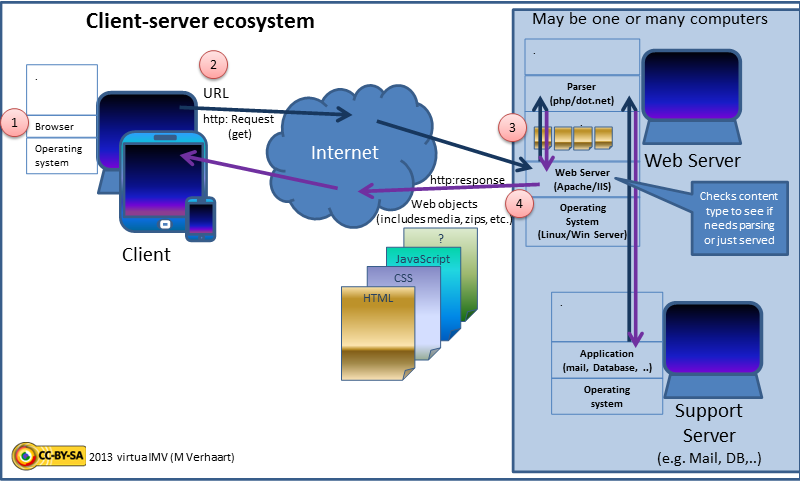
Let's use a restaurant analogy. You are the client. You go to the restaurant and place an order for a pizza. The waiter takes your request to the kitchen, which is the server. The kitchen prepares your pizza and gives it back to the waiter, who delivers it to your table. The internet works in much the same way: your browser (the client) requests a webpage from a server, and the server sends the page's data back to your browser.
Web Browsers
So how do you, the client, make a request? You use a special application called a web browser. Programs like Chrome, Firefox, and Safari are all web browsers. Their main job is to fetch information from the web and display it on your screen.
When you type a web address (like www.example.com) into your browser and hit Enter, you're telling your browser to send a request to the server that hosts that website. The browser sends the request out across the internet. When the server receives the request, it finds the correct files and sends them back to your browser as a series of packets. Your browser then assembles these packets and renders the final webpage for you to see.
In short, a web browser is your window to the internet. It translates your requests into a language servers can understand and then translates the servers' responses into the text, images, and videos you interact with every day.
What is the primary role of a protocol like TCP/IP on the internet?
When you visit a webpage, the data for that page is broken down into small pieces called what?
That's the basic flow of information online. A client uses a browser to request data, which is sent in packets across the internet to a server, and the server sends the data back.