Foundations of Vector Spaces
Linear Combinations Basics
Building New Vectors
Imagine you can only move in two directions: east and north. These are your basic movements, or vectors. But what if you want to get to a spot that’s northeast? You can't do it in one move. Instead, you combine your basic movements: walk a bit east, then walk a bit north. Linear algebra starts with this simple idea. We can create new vectors by scaling and adding existing ones.
Stretching and Shrinking
First, let's change the length of a vector. This is called scalar multiplication. A is just a regular number, like 2, -3, or 0.5. When you multiply a vector by a scalar, you're stretching it, shrinking it, or flipping it around.
Let’s say our “east” vector, which we'll call , means moving one unit to the right. Multiplying it by 2 gives us a new vector, , that points in the same direction but is twice as long. Multiplying by -1 flips it, pointing one unit west.
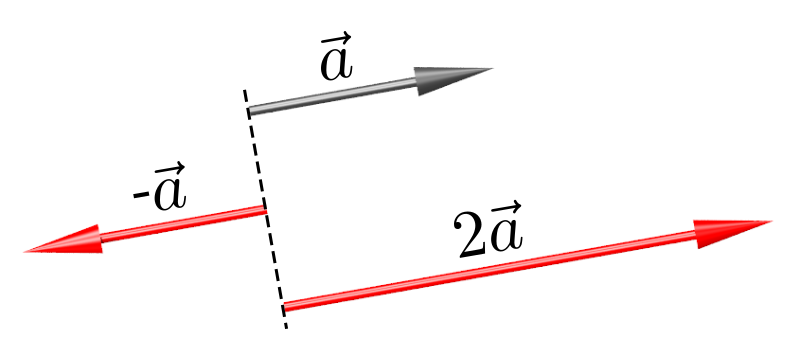
Algebraically, you just multiply each of the vector by the scalar. If our vector is represented by the coordinates , then multiplying it by the scalar 2 looks like this:
Adding It All Up
Once we can scale vectors, we need to be able to add them. The most intuitive way to visualize this is the tip-to-tail method. If you have two vectors, and , you place the tail of at the tip of . The new vector, called the resultant, is drawn from the start of to the end of .
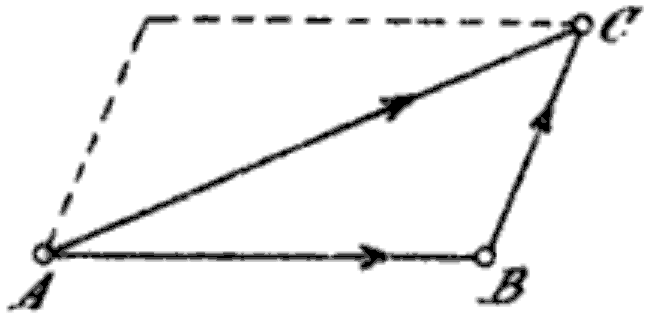
Think of it as a path. Vector takes you from point A to B. Vector takes you from point B to C. Adding them together, , gives you the direct path from A to C.
The calculation is just as simple. You add the corresponding components of each vector. If and , their sum is:
The Linear Combination
Now we combine these two operations. A linear combination is simply the process of scaling some vectors and adding them all together. It's the fundamental recipe for building everything in linear algebra.
Any time you're scaling two vectors and adding them like this, it's called a "linear combination" of those two vectors.
Let's say we have two basic vectors: and . We can create a new vector, , by taking 3 parts of and 2 parts of .
To find the coordinates of , we perform the operations step-by-step:
This means you can reach the point by combining your two original vectors, and , with the right scalars. By changing the scalars, you can reach countless other points. This is how we use a small set of basic vectors to describe an entire space.
Time to check what you've learned.
What is the primary effect of multiplying a vector by a scalar?
Given the vector , what is the result of ?
Understanding how to scale and add vectors is the first major step in linear algebra. Almost everything else you'll learn builds on this simple but powerful idea.